The Magician
Number I · Correspondence Mercury
Upright: action, creation, communication, pulling resources together, willpower
Reversed: manipulation, big ideas with little follow-through, self-doubt, blocked expression
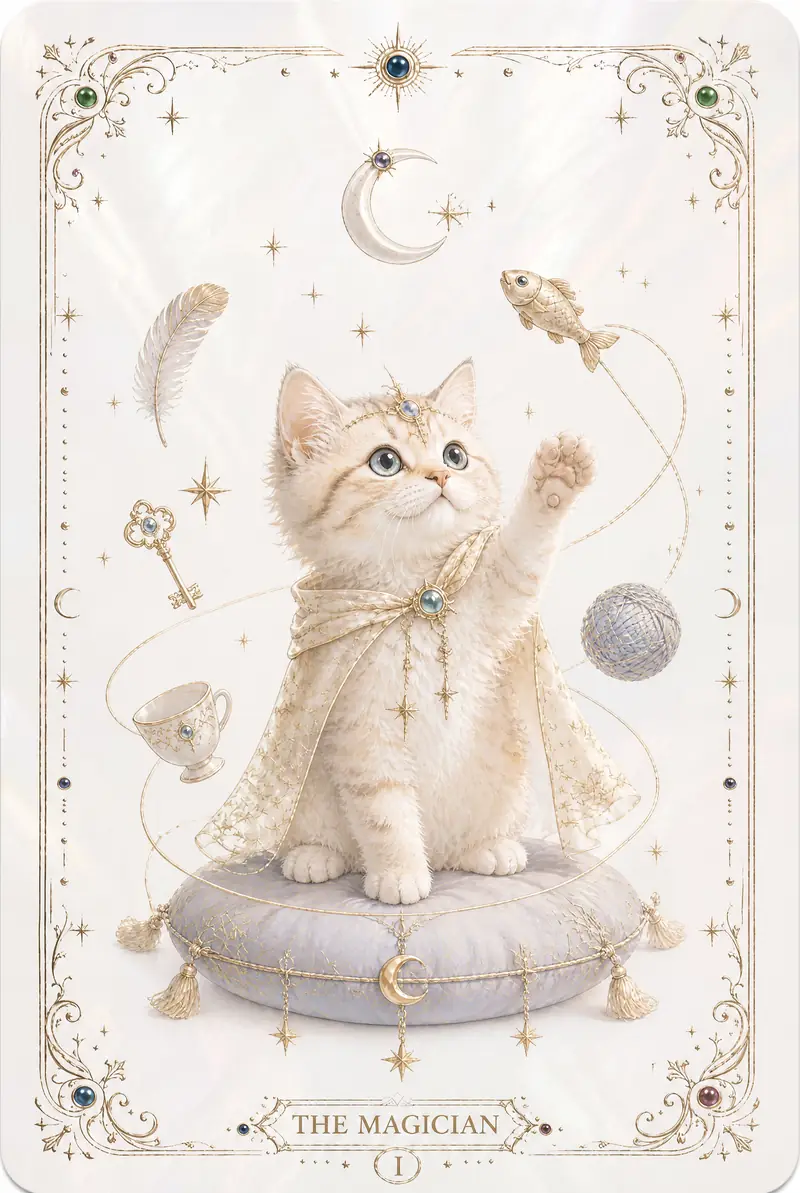
Turning an idea into a reality you can see.
The image
On the table lie the four magical tools, a wand, a cup, a sword and a pentacle, corresponding to the four elements and the four suits. One hand raises a wand toward the sky while the other points down to the ground, the "as above, so below" gesture. Above his head floats a sideways figure 8 (the ∞ symbol of infinity), and around his waist is a belt in the form of a snake swallowing its own tail, a symbol of power that circles endlessly. In the garden before him red roses and white lilies bloom side by side, passion next to purity.
His hair is black, symbolizing mystery and wisdom kept out of sight. A band is tied across his forehead, much like the restraining headband of the Monkey King in the Chinese classic Journey to the West. It suggests self-restraint over his own great power: reason has to be able to govern feeling and instinct, and the greater the power, the more restraint it needs, or it can turn back on its owner. The wand in his hand has a knob at each end (a double-ended wand), symbolizing power drawn down from above and passed on to the candle flame and the earth. The edge of the table is carved with waves, beasts and birds, echoing Water, Earth and Air, and the table itself is made of wood, echoing Fire; this reinforces the four elements of the four tools on top. The plants beneath the table follow the general tarot convention for a good harvest, symbolizing success and reward.
Core meaning
- A channel for transformation: the Magician works like a lightning rod. He is not casting a spell or summoning anything. One hand opens upward to receive spiritual energy, and the other points down to conduct that energy into the earth. The real "magic" happens in the hand pointing down, in the act of grounding energy in reality.
- The resources are already at hand: the four tools on the table show that the needed materials are already there. The conditions have never been what was missing. What is missing is the action itself.
- Willpower: the ability to gather all your energy and direct it toward one clear goal. Most people are pushed passively from one experience to the next. Those who actually get what they want are the ones who know clearly what they want and actively steer their own strength.
- Releasing instead of hoarding: the feeling of being "filled", with inspiration, excitement or creativity, is not gentle in itself. If it is not directed into a specific piece of work or action, the energy has nowhere to go. What sets artists and craftspeople apart is that they release this energy into something real outside themselves instead of letting it dissipate or build up into anxiety.
- The Promethean creator archetype: besides the trickster spirit and the wizard, the Magician's image also draws on the hero archetype of the "fire thief", who brings powerful creative force to the world.
- The moment a specific plan or conversation formally gets under way, actively using everything you already have to create, instead of waiting passively for conditions to ripen.
- The magical logic behind "as above, so below": first form a clear intention at the level of ideas, then link it to the planet that governs it, and finally act through that planet's concrete counterparts in the material world. If what you want is "to become more attractive", for example, the planet is Venus, and Venus's sacred objects such as roses and apples become the practical means of reaching that goal. The Magician, with one hand pointing to the sky and one to the earth, symbolizes this whole chain of guiding an intention from idea to ground. The terms come from the "threefold world" of Renaissance magical theory.
- How the Magician grows out of the Fool: both have the same strong inner energy. The difference is that the Fool does not yet know what he wants and simply explores at random, while the Magician has learned self-control, knows exactly where the goal is, and can gather his power into concrete action. You can think of the Magician as the Fool "grown up".
- What it means in practice: in love it often points to a partner who has a lot going for them, expresses themselves well and knows how to plan thoughtfully for the other person. In career and study it points to being smart, capable and well prepared, so things go smoothly. Mercury's link with communication also makes this card a good fit for directions that "pass wisdom on to others", such as media and teaching.
- The two functions of Beth are "life and death": where the will goes there is life, and where it does not, things fall silent. This fits the Magician's core quality of gathering all energy and directing it at a clear goal.
- Money, health and spirit: with money, the upright Magician is a strong card that brings together opportunity, motivation, enthusiasm and practical application. It means moving toward a goal with focus and order, so a plan that once seemed far off can actually happen. With health it means energy flowing well through mind, spirit, emotions and body, often because the querent already knows how to eat in moderation, keep exercising and make their surroundings comfortable.
- On the spiritual level, the Magician means you have already recognized your talents and skills and are just waiting for the chance to seize an opportunity and act. An idea without action has no value; success comes from actually carrying ideas out.
- The English word magician covers both the stage magician (who creates effects through sleight of hand and patter, with an element of performance and deception) and the true sorcerer (who turns thought into reality through sheer willpower and has no need to be a smooth talker). The card itself does not clearly point to either. Both archetypes are clever and in control, and they differ only in how much performance shows on the surface. When reading, you can choose whichever fits the querent's style inferred.
- The snake belt (the ouroboros, a snake eating its own tail) symbolizes the endless cycle of energy, and it also carries a double tension. As an animal, it is tied to instinct and the lower self. Yet in esoteric traditions the snake often stands for wisdom itself: in the Garden of Eden story it is the snake that tempts Eve to eat from the tree of knowledge, implying that the snake has wisdom second only to God's. The snake's shape is also often associated with the male sexual organ, which extends its meaning to energy, drive and the life force. This echoes Freud's idea of the sexual instinct, which covers more than sexual urges and includes the instinctual forces of reproduction, survival and pleasure that keep a person growing and striving.
Reversed
- Picture association: upright, the Magician holds firm control over the four elemental tools on the table. Reversed, it is as if he has lost command of them. The initiative moves outside him, and whether things succeed depends more on whether outside conditions are in place than on his ability to drive the whole situation himself.
- Picture association: upright, he passes on a higher intention. Reversed, he tends to present personal desires and fixations as the will of heaven. He comes across as opinionated and argumentative, communication gets stuck, and people may even feel he is splitting hairs to win.
- Overdoneusing a gift for communication and persuasion to manipulate or mislead others, or hiding one's real intentions and getting by on cleverness.
- Blockedthe conditions at hand are not actually complete, willpower cannot carry the whole situation, and the initiative and fresh start that should come keep getting put off.
- Blockednow is not the time to start rashly. Rather than forcing ahead, it matters more to repair the communication that has fallen short and to finish preparing.
- In practicein love it often describes a partner with smooth words who gets the other person to pay and do the work, makes promises that never come true, and always wins the argument. At work it is someone who reports a lot of "effort" but cannot show real results, who in partnerships says more than they deliver, and who stalls and deflects when pressed. If you draw this card reversed for yourself, it is also worth asking whether you have overestimated your abilities and worth; other people may not see you the way you imagine.
- One book also offers a more behavioral, prescriptive angle: the reversed Magician often suggests the querent is not grounded enough and cannot keep putting goals into action. Rather than going on daydreaming, they can bring their attention back to the real world through physical activity such as walking or exercise, and so regain the ability to land their plans. With money, it advises against sprinting at full strength from the start. Set a steady pace and keep to it, the way you would pace a marathon, and check whether the goal itself is realistic.
Correspondences
Mercury (communication, intellect, dexterity); Hebrew letter Beth ב. For the full set of correspondences, see Astrological Correspondences and The Kabbalah and the Tree of Life.
Beth literally means "house", a symbol of the container and foundation in which existence can settle. The opening word of Genesis in Hebrew, "In the beginning" (Bereishit), is said to start with Beth. On the Tree of Life, Beth is the 12th path. It also starts from Kether (the Crown), but it connects to Binah (Understanding). It shares the Fool's source of creative force, yet knows how to turn it into concrete results that other people can understand and accept. This echoes the Magician's core meaning of turning an idea into a reality you can see.
Views from different traditions
The Marseille tradition calls this card "the juggler" (Le Bateleur). The image shows a street performer handling small objects at a stall, closer to a figure from the marketplace than to a ceremonial magician. Waite reshaped him into a magician holding the four elemental tools and making a clear ritual gesture, and the four tools on the table correspond directly to the Golden Dawn's four-element system. This layer of ceremonial magic was added by the Waite system inferred.
Rachel Pollack contrasts the image of the shaman with the Western image of the sorcerer to explain the gap between the upright and reversed card. In Western culture the sorcerer is often imagined as someone who manipulates spiritual power for personal gain, even making deals with dark forces. In shamanic traditions, a spirit medium trains to become a channel that serves both self and tribe well without being destroyed by the powerful forces passing through. The loss of control and restlessness of the reversed Magician correspond to energy flooding in with no outlet and no proper direction.
Advanced Golden Dawn reading: the number 8 is Hod, the eighth sephirah on the Tree of Life and the one that corresponds to Mercury. Waite drew it as the sideways infinity sign above the Magician's head, a visual pun that points to both "Mercury" and "eternal cycle" at once.
- A chain of gematria values strengthens the link. The Greek name of Thoth can be spelled two ways, with values of 88 and 818, and 818 happens to equal the value of the Hebrew phrase "your dwelling", echoing Beth's literal meaning of "house" or "holy temple". Adding the Greek letter omicron before Thoth's name gives 888, which is also the value of the Greek name "Jesus". Through this string of numbers Waite wove Mercury, Thoth, the house (Beth) and the image of redemption into a single card.
- There is no need to repeat this argument step by step. The key point to remember is that the number 8 ties Mercury, Thoth and Beth together, so beyond "wisdom" and "creation" the Magician also carries a sense of redemption coming down from above.