Wheel of Fortune
Number X · Correspondence Jupiter
Upright: turning point, impermanence, cycles, timing, change beyond personal control
Reversed: stagnation, fatalistic giving up, change brewing within, anxiety about losing control
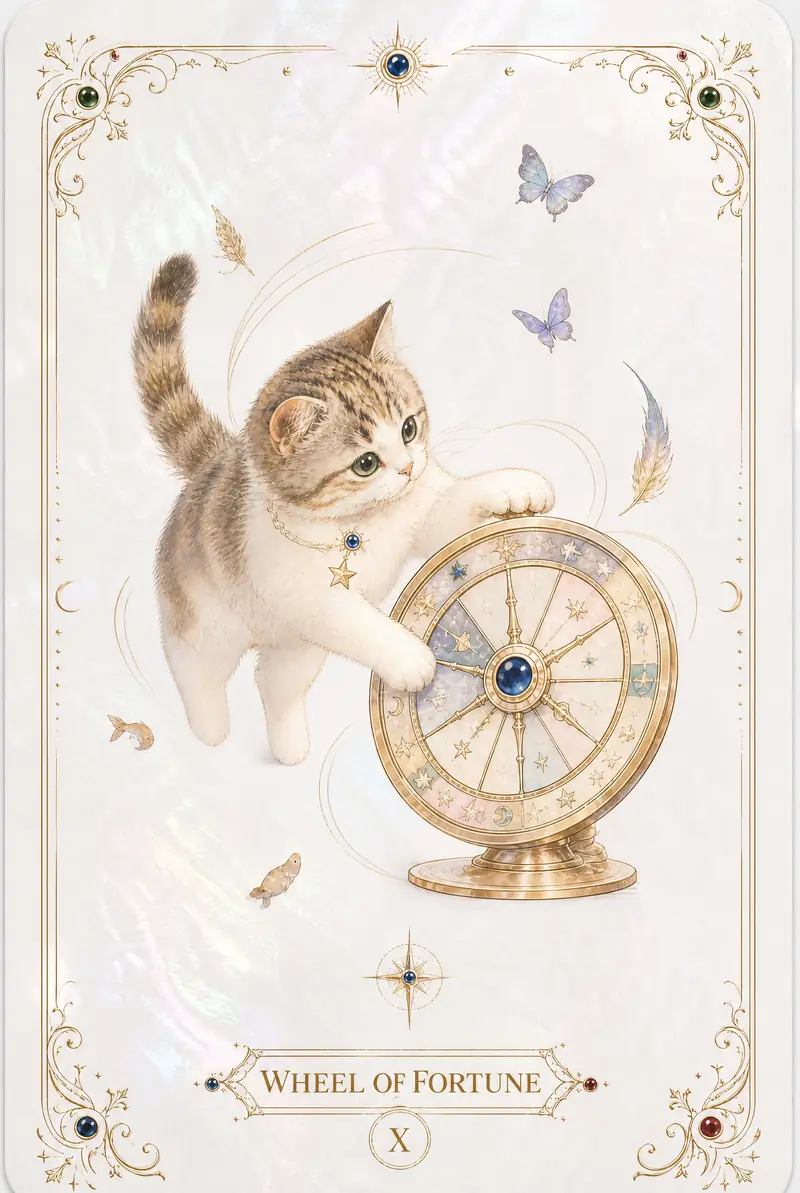
The wheel keeps turning and you do not get to choose the rises and falls, but your place on the wheel is only ever temporary.
The image
A huge wheel hangs in the clouds, turning. In the four corners there are usually four creatures (a human, an eagle, a lion and a bull), each holding a book and reading intently, as if keeping a steady watch from outside the wheel's upheaval. The wheel itself is inscribed with letters and alchemical symbols. On its spokes a snake slides downward while a jackal-headed god (Anubis) climbs upward, so one picture shows both directions at once: decline after a peak, and recovery after the lowest point.
The Hebrew letters on the spokes are in fact the four letters of the divine name, יהוה (Yod He Vau He), which states outright that the cycle is driven by the Creator. The outer rim also hides a piece of wordplay: TARO, ROTA (wheel) and TORA (law) can be read off the same letters, which together suggest that "the wheel of tarot is the law of nature" uncertain. The alchemical symbols on the wheel, at the top, right, left and bottom, are mercury, sulfur, salt and "dissolution" (Solve). Dissolution is one of the key steps in alchemy: an old form has to be dissolved and broken down before a more perfect form can be cast. This echoes a theme the card keeps returning to, that rebirth comes only after destruction. The three concentric circles at the center of the wheel correspond to three of the four Kabbalistic worlds, Briah, Yetzirah and Assiah, spreading out layer by layer from the central point that stands for Atziluth, the archetypal world. Picture a tower of stacked champagne glasses: wine poured into the top glass overflows into each layer below, so each lower world always carries something of the quality of the world above it, all the way out to the outermost material world.
The sphinx in the wheel's imagery is itself a composite of the four elements. The lion's body corresponds to Leo and Fire, the human face to Aquarius and Air, the bull's tail to Taurus and Earth, and the eagle's claws to Scorpio and Water, which is why the sphinx is often called the "fifth element" or the element of Spirit. Its image as a guardian of treasure who poses riddles comes from Greek myth. The riddle asks what creature walks on four legs in the morning, two at noon and three in the evening; the answer is a human life: the baby crawls, the adult walks upright, and the old person leans on a cane. Whoever solved the riddle won the treasure, and this is the classic source for treating the sphinx as an embodiment of wisdom. The snake sliding down the spokes is thought to be Apophis, the Egyptian figure of chaos who battles the sun god Ra day and night. The jackal-headed god climbing up is Hermanubis, a fusion of Horus and Anubis (more than Anubis alone), and stands for death and rebirth. Taken together, the snake, the sphinx and the jackal-headed god form a complete cycle of chaos and destruction, perfect wisdom, and death and rebirth, which matches the alchemical logic that perfection can be recast only after destruction. The clouds symbolize divine consciousness, since the divine lives in the heavens: to see the clouds is to see the divine. The clouds also hint at storm clouds, which ties them to Zeus, the thunder god linked with Jupiter.
Core meaning
- Impermanence itself: the card is about change actually happening, without pointing to a good or bad direction. The point is that the situation is about to shift.
- The cycle of fate and a deeper order we cannot fully see: rises and falls are two sides turned up by the same wheel. Accidents that seem to come from nowhere and the so-called laws of fate point to the same force, one we cannot see in full. Life sometimes looks meaningless only because we have not lived long enough to see the whole picture.
- Forces beyond personal control: the wheel turns whether or not the people on it want it to. The card suggests that a good part of the current situation comes from the wider environment, timing and luck, and is not entirely within reach of personal effort.
- A turning point that links what came before with what comes next: coming right after the inward settling of The Hermit, the Wheel of Fortune opens the view back out to a larger span of time, and sets up Justice, where cause and effect are faced and consequences are owned.
- The midpoint of the series, mirroring its end in The World: both cards have the same four creatures in the corners. On the Wheel they are still symbolic, mythical figures; on the World they have become real and alive. It is as if the midpoint gives a first glimpse of what life means, and only the end turns that insight into lived experience.
- The four creatures in the corners read their books, untouched by the turning wheel. This suggests that even amid impermanence, some things can stay constant (principles, beliefs, an understanding of yourself) and need not shake with every rise and fall of fortune.
- An auspicious surface does not guarantee a smooth road: this card keeps showing images of breaking down, recasting and completing (the monster defeated, the old order collapsing before the new is born). The good fortune it points to usually does not arrive out of nowhere or through plain sailing. It tends to come after a blow and a period of adjustment, and only then does a fuller situation open up. A result that looks polished often has a hidden trial behind it.
- Active versus passive, compared with the Magician: set this card beside The Magician. Both carry the creative power of Fire, Water, Air and Earth. The difference is that the Magician takes the initiative, going after things and making his will manifest, while the Wheel of Fortune goes with the current and trusts that the moment will come once the conditions are in place. In a real reading, if the querent's conditions are already in place on every front, this card leans toward "it will come in its own time, there is no need to force it" more than toward urging immediate action.
- The double function of Kaph is "wealth and poverty". The two are two sides of the same coin and can turn into each other at any moment, which fits closely with the card's core meaning of impermanence and rises and falls that no one chooses.
- How it lands in money, health and spirit: for money, the upright Wheel means the financial picture is set to improve, and a few good opportunities may appear in the coming months. The key is to prepare first and stay focused on a clear financial goal, so other opportunities do not scatter your attention. For health, it means the four elements in the body, Fire (Wands), Water (Cups), Air (Swords) and Earth (Pentacles), are coming into balance. The low-energy stretch is over and a more active time lies ahead.
- On the level of spirit, the card asks you to notice which "season" of life you are in. Times of plenty do not necessarily last forever, and times of scarcity do not last forever either. Seeing these rises and falls as the turning of the seasons lets you prepare ahead when conditions are good, and, when one part of life is contracting, turn your attention to the other areas that are growing.
Reversed
- [Image association] The sphinx on the wheel is turned upside down: the direction of events has moved beyond what the querent can control. This is a time to go with the current and not insist on steering the situation. It also hints that an earlier judgment may have been off, so unexpected turns are likely.
- [Image association] The sword on the spokes points downward and Ezekiel's wheel is inverted: the situation carries some risk of losing control or going wrong, and needs more care than usual. The scrolls tumbling in all directions suggest a refusal to learn or take in the lesson, which makes it easy to keep making the same mistake in the same place.
- [Overdone / negative meaning] Blind optimism leads the querent to ignore problems that have already appeared, relying on luck being on their side and refusing to put in real effort. When fortune weakens, they have no way to cope.
- [Blocked] The good luck that should be there is absent for now, and there may even be several setbacks in a row. This is not permanent. It is a stage that tests the querent's own ability, and with the right choices they can still turn the danger around.
- [Turned inward] On the surface the situation has not moved much, but the real issue is that the querent has not yet steadied themselves. They panic easily and repeat the same mistakes. What they actually lack at this point is a wider view and a steadier frame of mind, more than luck itself.
- [Opposite meaning] Resisting change and clinging to fatalism are equally useless. Instead of blaming heaven and everyone else, treat this period as a time of preparation and get your footing before the next turn arrives.
- In practicein love, the reversal often shows up as falling over the same problem again and again without ever moving forward. Even if this relationship ends, the next one may bring the same type of person and the same pitfall. This is a sign that the querent has not yet recognized where the problem lies, and the lesson is passed only once they see it clearly and adjust how they think.
- How the reversal lands in money and health: for money, the reversed Wheel warns that opportunities are shrinking. This is a better time to prepare for winter and to hold off on expansion or risky new commitments than to double down against the trend. For health, it means energy is gradually weakening. It points to a personal, temporary low, and suggests starting to use physical and emotional energy sparingly. It does not mean a long-term decline.
Correspondences
Number 10 and Jupiter. It is one of the three Major Arcana cards tied to a classical planet that do not fall within the twelve signs, and it has no fixed element; see Astrological Correspondences for details. On the Tree of Life, its path corresponds to the Hebrew letter Kaph (כ); see The Kabbalah and the Tree of Life.
Kaph literally means "palm" or "fist". A clenched hand is often seen as a symbol of command over the course of fate, and of personal agency. On the Tree of Life, Kaph connects Mercy (Chesed) with Victory (Netzach): divine loving-kindness descends into concrete life instincts and desires. This echoes the card's meaning that the cycle of rise and fall is driven by a larger force, yet when it lands in a specific situation it still connects to one's own instinctive choices.
Views from different traditions
Crowley's Thoth system simplifies the card's name to "Fortune", dropping the concrete image of a wheel and putting more weight on fate itself as an impersonal cosmic law at work, rather than the turning of some particular mechanism inferred. The Waite deck keeps the image of the wheel and grounds the card in a visible, concrete cycle of rises and falls. The two agree that the card corresponds to Jupiter and stands for change and opportunity. The difference is mainly whether fate is described in more abstract, impersonal terms or kept close to the everyday feeling of ups and downs.
- In the Waite deck, the very center of the wheel's hub is left deliberately blank, with no symbol at all. The number 10 hints at a return to 0, like The Fool: both "nothing" and "everything". That still center, with no ego and no fear, is the true core of the wheel.
- Golden Dawn, advanced reading: Kaph is one of the "double letters" of the Hebrew alphabet, and under Kabbalistic rules the double letters correspond only to planets, never to signs. This is the direct basis within the letter system for the Wheel of Fortune corresponding to Jupiter and not to a zodiac sign.
- The four creatures in the corners, human, eagle, lion and bull, correspond to the four fixed signs (Aquarius, Scorpio, Leo and Taurus), the four elements and the four letters of the divine name (YHVH). The house numbers of these four fixed signs in the natural chart add up to 5+8+11+2=26, which is exactly the gematria value of YHVH. This is one of the few places in the system where the numbers genuinely match.
- The four letters ROTA marked on the wheel come from an earlier fourfold system of Éliphas Lévi's, in which the human, bull, eagle and lion each correspond to an alchemical symbol and an element. It does not line up with the divine-name correspondence the Golden Dawn later adopted, and it is an example of Lévi's system still working by trial and error before the Golden Dawn corrected it.
- Compositional elements such as the blue background and the rolling clouds are thought to echo Jupiter's traditional image as god of the sky and of storms. Other claims go further: that the crossed legs and arched back of the jackal-headed god form the astrological glyph of Jupiter, or that the "four" of the four holy creatures matches Jupiter's place at the fourth sephirah. Even the course this material draws on considers these arguments rather forced, more passing association than real evidence, and not especially convincing.