The World
Number XXI · Correspondence Saturn
Upright: completion, integration, fulfillment, ease, travel
Reversed: unfinished business, demanding too much perfection, a private sense of achievement, forced interruption
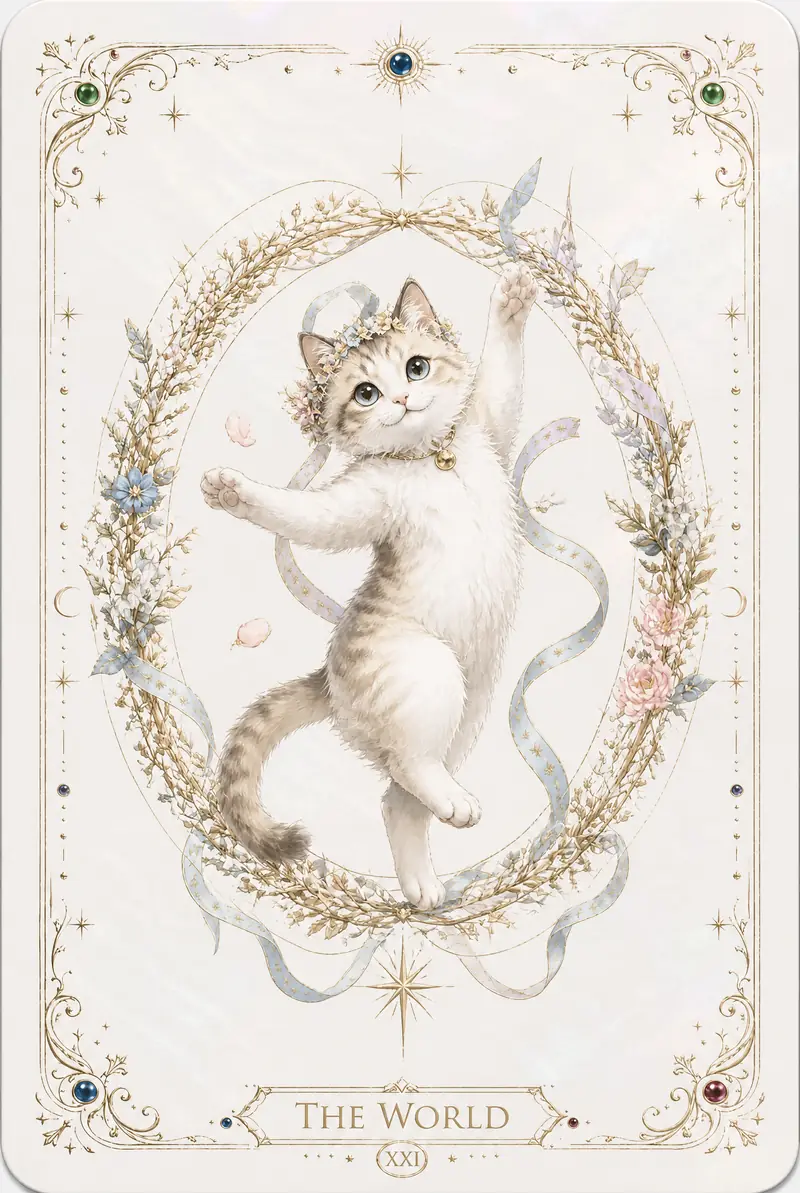
The end of the Fool's Journey and the starting point of the next one; wholeness here means every experience has been integrated into one person, which is different from lacking nothing.
The image
A woman like a dancer floats in the center, surrounded by a wreath and holding two short wands. Her pose echoes the Hanged Man's suspension but is entirely different in kind: his was a passive suspension, and hers is an active posture of easy command. The four corners around the wreath usually show four creatures (a human, an eagle, a bull and a lion). They correspond to the symbols of the four Gospels and are also often read as a miniature of the four elements or the four quarters of the zodiac, suggesting that this card gathers the elements of every earlier stage into one whole.
Core meaning
- Completion and fulfillment: a full cycle reaches its end. The lessons that needed learning have been learned, and the experiences that needed integrating have been brought in.
- Integration: no single area stands out above the others; all the parts (material, emotional, mental, spiritual) are drawn into one coherent whole. This is also how the whole story of the Fool's Journey comes to a close.
- The wreath is shaped like the number "0", suggesting the cosmic egg and the archetype of coming into being: everything exists as potential, and every potential has already been realized. The ribbons at the top and bottom of the wreath are tied in the sign of infinity, symbolizing that the self is not boxed in by the circle and keeps opening out toward the universe.
- Dance as union: the universe has no absolutely still center, and yet the center is everywhere. The dancer moves around a core that keeps shifting yet stays calm. True union exists within ongoing movement, with no still end point to arrive at. The Fool and the World are the only two "moving" cards in the whole Major Arcana, echoing a journey whose end joins its beginning and starts the cycle again.
- The androgynous dancer: this echoes myths from around the world in which the first human was one being of both sexes, and the Kabbalistic legend of Adam Kadmon (a primordial being of pure light, imprisoned in matter only through division). It also echoes the cosmic dance of the Hindu god Shiva: one foot rooted in the earth, one foot raised to free the soul, face calm, beyond sorrow and joy. The present moment of complete union with life is freedom itself.
- Journeys and travel: traditionally the card also often points directly to travel or moving house in a geographical sense, or more broadly to going out into a bigger world.
- A three-card comparison with the Empress and the Hanged Man: the World is card 21, and 2+1=3, so it shares a root with card 3, The Empress, and forms a group with card 12, The Hanged Man (1+2=3). The Empress is the mother and the Hanged Man is the child. The World holds both roles: she has breasts, the image of a mother, yet she is wrapped in the center of the wreath like a child still in the womb. The Empress leans toward enjoying the material world, the Hanged Man toward exploring the spiritual world, and the World card is the meeting point where the material has reached its peak and the spiritual journey is about to begin, so it has both a material and a spiritual side.
- Corresponding to Saturn, a "malefic" planet, looks contradictory but makes sense: material manifestation has reached its final step and everything seems to be in place, yet this completeness can itself become a new constraint. Sinking into the abundance one already has can make a person forget that the next step is a spiritual pursuit.
- In practical readings, this card points more to achievements that last than to a single win or loss. It is less like winning one small quiz and more like the kind of success that is remembered for a long time and stands the test of time. In love, it can be read as a stage between two people having settled into a lasting bond.
- Money: upright in a financial spread, it is a sign of sustainable success with money, because the four suits of the Minor Arcana (the passion of Wands, the motivation of Cups, the clear thinking of Swords and the practical methods of Pentacles) have come into balance, enough to support financial prosperity. As the answer to an investment question, it usually suggests the investment will bear fruit, but the surrounding cards should still be considered before drawing a conclusion.
- Health: the World in a health spread broadly means health is good. For questions about the outcome of surgery or a medical procedure, with positive cards around it, it means things will go well.
- Spirit: only by standing at the summit and looking back at the peaks and valleys below can a person truly understand what they have achieved: this is one peak among many. For now they can fully enjoy the joy and satisfaction this success brings. Others may see only luck; only they know how much effort and persistence lay behind it.
Reversed
- Stability pushed into conservatism and rigidity (image association): the guardian creatures at the four corners of the wreath appear in the opposite positions, symbolizing that the order that held up the "whole" is starting to loosen or tip out of balance. The dancing figure turns her head to one side instead of facing forward from the center, and the reading shifts from easy command of the whole situation toward a preference for comfort and a lack of drive to look ahead.
- One last step left undone (blocked): most of the work is finished, but a little wrapping up is still missing. The sense of completion never quite lands, and it is easy to assume things are already over.
- Clinging to the status quo (overdone): placing too much weight on existing order and frameworks makes the querent conservative and rigid, and less able to adapt to changes that really ought to happen. The ability to bring things together may also weaken, leaving the parts each going their own way.
- Keeping the sense of achievement inside without confirming it outwardly (turned inward): a goal for this stage has been reached, but the querent has not truly let themselves or others acknowledge and celebrate the completion, so the fulfillment stays mostly at the level of private feeling.
- An ending that falls short of expectations, calling for a fresh look at goals (opposite meaning): this round may not wrap up smoothly as planned, and the final gains may be smaller than expected. Rather than forcing together a "perfect ending", first look after the parts in front of you that truly matter.
- [Life-area method] Reversed in a money question, it often means the current success is partial and temporary, and greater achievement may still lie ahead. If money has already gone into a business partnership's account, it may be better to focus on building savings bit by bit than to rush after long-term goals. Reversed in a health question, it is usually still a fairly positive sign, only a reminder that energy and stamina are not as full as before and that there may be some small tests ahead, with no need to worry too much.
Correspondences
Saturn, the Hebrew letter Tav (ת). This card corresponds to a planet, not a zodiac sign, and in the Golden Dawn system it is not placed in any of the four element categories; see Astrological Correspondences and The Kabbalah and the Tree of Life for details.
Tav literally means "mark", and also refers to a cross, a seal or a signature. It is the last of the twenty-two letters and marks the "sealing" moment when the material world takes its final form. The cross itself also carries the sense of duality and the four elements returning to unity, which echoes the World card's core of gathering every stage into one whole. On the Tree of Life, this path connects the ninth sephirah, Yesod (Foundation), with the tenth, Malkuth (Kingdom). It is the last of all twenty-two paths and the closest to everyday reality. Together with the paths of The High Priestess and Temperance, it is one of the three central paths on the "middle pillar", carrying the way of balance and moderation all the way down into the material world itself. Read downward, as the "path of creation", it puts ideas and plans into real practice so they take shape. Read upward, as the "path of return", it starts from finished, concrete things and looks back to feel the meaning and abstract ideas behind them. The guardian creatures at the four corners of the World card's wreath and the double-ended wands pointing up and down also echo this position: at the very bottom of the Tree of Life, yet a "center" that commands all four directions, above and below.
Saturn's astrological glyph is likewise a combination of a cross and a crescent (the same coding technique as the palm in The Devil), and Waite hid it in the dancer's pose. Her crossed legs form a cross, and the curling scarf resembles a hooked crescent; laid together they make a variant of the Saturn glyph. The blue-violet of the scarf is also the color the Golden Dawn assigned to the path of Tav, which corresponds to Saturn. In addition, of all the pairings between the 22 Hebrew letters and the cards, only the pairing of Tav with the World is undisputed. The disagreement over whether Aleph belongs to the Fool or the Magician affects the twenty letters before Shin through a chain reaction, but it does not reach Tav, which comes last and is outside that chain. So both the French and the English esoteric systems agree in giving Tav to the World.
Views from different traditions
In the Thoth system, Crowley renames the card "The Universe". The image is still a dancer surrounded by a wreath, but it puts more weight on the material universe itself as a symbol of the complete manifestation of the divine, beyond the end point of a personal journey. The Waite system's "World" stays closer to a reading of personal achievement and integration disputed. Both schools accept that this is the card of "wholeness" in the Major Arcana; they differ on whether that wholeness is personal or cosmic. Daniel adds a point from the composition: reversed, the guardian creatures at the wreath's four corners appear in the opposite positions, and the dancer turns from facing forward in the center to looking off to one side, so the reading shifts from wholeness in easy command of the situation toward a stability that is rather conservative and short-sighted. Rachel Pollack adds a point about color: the red ribbons of the wreath correspond to the root chakra (Muladhara) in the kundalini system, showing that the dancer has not left the reality of body and matter behind, and that energy keeps flowing and being transformed and renewed. The green of the wreath itself symbolizes the natural world being raised up and taken into this union, with nothing cast aside.