The Hanged Man
Number XII · Correspondence Water (element)
Upright: deliberate suspension, a reversed perspective, meaningful sacrifice, patient waiting, seeing from a new angle
Reversed: pointless stagnation, passive procrastination, inner change not yet shown outside, martyr-like self-sacrifice, resisting a necessary pause
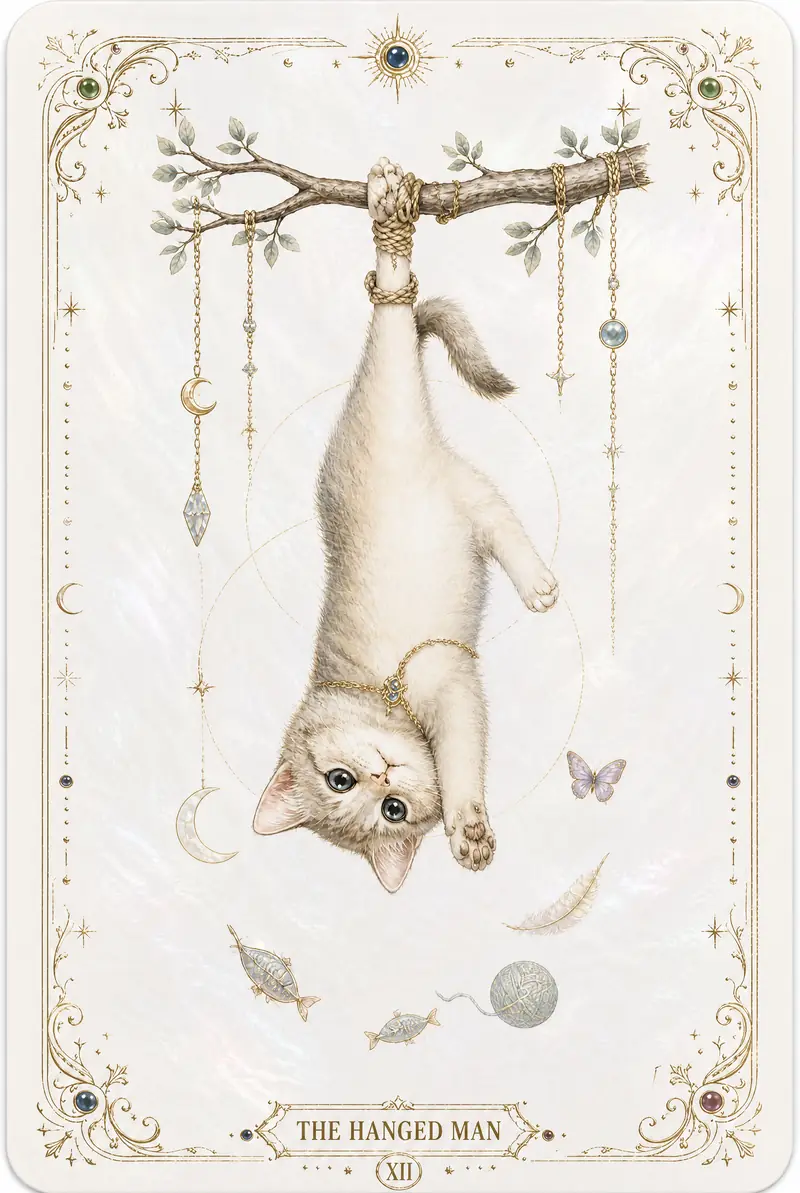
Stop, turn yourself upside down and look at the world again; the answer often appears once you change your angle.
The image
A man hangs upside down by one foot from a T-shaped wooden frame. His other leg is bent to form a figure four, and his hands are tied or hidden behind his back. Yet his face is calm, and his head often has a faint halo around it. He does not look like someone in pain or struggling. The pose has a real historical source in medieval Italy, where it was the way of depicting traitors in "shame paintings" (pittura infamante), a form of public humiliation inferred (the historical source is often cited, but accounts differ in the details). Tarot took over this pictorial scheme, while shifting its meaning from disgrace to a deliberate, meaningful suspension.
Core meaning
- Active surrender: this stillness is something other than passive waiting for things to happen. It is closer to the "surrender" of ancient initiation rites, an action taken willingly: bowing to the rhythm of life so that the inner core, usually hidden by the everyday self, can come to the surface.
- A number code in the body: the crossed legs form a "4" (the earth and the four directions of consciousness), while the arms and head together form an inverted "triangle of Water", standing for "3" (Water and the unconscious). Four times three is twelve: the road to the superconscious has to pass through the unconscious first.
- The halo around the head: it suggests that the energy drawn down by the wand of The Magician now flows into the hanging man and settles into calm. Feeling the spiritual power stored in life, in complete stillness, is the experience this card offers: peaceful on the surface, intensely exhilarating underneath.
- Sacrifice brings gain: in the short term this looks like loss, giving up, delay. But the pause itself is laying the ground for later understanding or transformation. Just as the Fisher King's wound can be healed only by "the awful daring of a moment's surrender / which an age of prudence can never retract", healing often has to pass through sacrifice first (an allusion to the Fisher King imagery in T. S. Eliot's The Waste Land).
- The true midpoint of the Major Arcana is three cards, the Wheel of Fortune, Justice and the Hanged Man, which stand for a process more than a single moment. Turn the Hanged Man upside down and his pose is almost identical to that of the dancer in The World. The Hanged Man's arms are crossed behind his back: for now, this awareness can be sustained only by withdrawing from society. By the World card, the same awareness can be held in the midst of all of life's outward activity.
- A position that links what came before with what comes next: following Justice, which is about cause, effect and responsibility, the card shifts the view from making a judgment to understanding the whole picture anew, and prepares for the complete transformation of Death. It is also a stop along the way to the World: this "tree of life" is rooted in the unconscious, passes through consciousness in the material world, and reaches up into the heavens of the superconscious.
- Four frames for being "suspended": one reading sums up the image as four archetypal situations: being punished for a wrong; sacrificing oneself for the good of the group (as in the Greek legend of Andromeda offered up as a sacrifice); stepping into a new identity, as in a baptism; and deliberately turning one's view upside down in search of enlightenment. In an actual reading, you can judge from the querent's situation which of these the present suspension is closest to, rather than applying a single meaning.
- A mother-and-child link with the Empress: one reading connects the Hanged Man (12, 1+2=3) numerically with The Empress (3). It reads the rope as an umbilical cord and the inverted pose as the position of a fetus in the womb. The Empress represents worldly abundance and enjoyment shown outward; the Hanged Man represents a spiritual life turned entirely inward, still at the "unborn" stage and for now unable to enjoy worldly fame and fortune.
- Personality, and how it differs from neighboring cards: drawn to describe someone's character, the Hanged Man is often read as modest and willing to compromise and give way, or as a little timid and afraid of trouble; overall steady and passive. Compared with the High Priestess and the Hermit, which it is often grouped with: the High Priestess is content in a self-contained inner world and asks nothing of the outside; the Hermit takes the outside world lightly and would rather be alone and at peace; the Hanged Man is more like someone afraid of making mistakes and of bringing more constraints on himself, and so tucks himself into a small corner. He can look somewhat closed off, yet inside he still holds ideals and a hunger for knowledge that he does not readily show.
- Patience with money: in a money question, the key word is patience. Resources or returns may be limited for now, but they will improve as the querent adjusts. Rather than clinging to small gains in front of them, it is better to stop, take stock of what has already been gained, and then judge whether this financial plan is really worth more time and effort.
- An enforced rest for health: in a health question, the card often points to energy that has been overdrawn. The body is using this to force the querent to slow down and make time for reading and quiet reflection. Pushing on regardless can lead to injury or collapse; a measured period of settling actually builds back balance in one's strength.
Reversed
- [Image association] The figure has broken free of the gallows but his foot is still tied to the tree: the outer limits have mostly been overcome, but the moment for real action has not yet come. Acting too soon risks wasting the patience already spent.
- [Image association] The inverted pose turns back upright: the special insight that came from a changed angle disappears, and the querent's views become no different from most people's. It is easy to drift with the crowd and accept whatever comes, without a judgment of one's own.
- [Image association] The hanging foot becomes a foot standing on the branch: this can also be read the other way, as learning to be independent and to stop depending on waiting for everything. But this self-reliance is still raw, and it needs more focus and intuition to become truly steady.
- [Negative meaning / overdone] Sacrifice and waiting are pushed too far: endless self-denial that brings no turn for the better, leaving only self-pity. It can also be impulsive action after patience runs out, moving rashly at the wrong moment and making things worse.
- [Blocked / turned inward] Going in circles without seeing a direction: acting only on one's own ideas while ignoring the actual situation, with a high chance that expectations will not be met. It is also easy to slip into feeling isolated and without help, left to bear the trial alone.
- [Opposite meaning] Sometimes it means the old constraints have finally been undone, though this freedom usually comes at some price. It can also mean a turn toward selfishness once the willingness to sacrifice is gone: caring only about one's own gains and losses, even at the cost of sacrificing others for one's own ends.
- [Life-area method] Reversed in a money question, it often points to an investment with meager returns that is hard either to stay in or to get out of. Stubbornly holding on and putting in more can leave the querent completely stuck and drained financially. What is needed now is the judgment to cut losses in time, instead of waiting on and on for a turnaround.
Correspondences
Number 12, corresponding to pure Water as an element. Unlike cards tied to a zodiac sign or a planet, it is one of the three Major Arcana cards that correspond only to an element itself; see Astrological Correspondences for details. On the Tree of Life, its path corresponds to the Hebrew letter Mem (מ); see The Kabbalah and the Tree of Life.
Mem literally means "water", and it is the only one of the three "mother letters" (Aleph, Mem, Shin) whose literal meaning matches its element exactly. The other two mother letters literally mean "ox" (corresponding to Air) and "tooth" (corresponding to Fire), and neither has this coincidence. The Kabbalistic tradition gives Water a "stable wisdom": still water with no difference in height does not flow. It is like the experience of sinking into water during deep meditation: the noise of the outside world fades away, and the inner senses are heightened. This mirrors the Hanged Man's state of hanging motionless with all his attention drawn back inside. On the Tree of Life, this path connects the fifth sephirah, Geburah (Severity), with the eighth, Hod (Glory). Read downward, as the "path of creation", it speaks of hardship and trials wearing away the obstacles to growth and waking a person up in the midst of difficulty, which matches the image of the Hanged Man with his glowing head, quietly reflecting while bound. Read upward, as the "path of return", it reminds us that the results we enjoy today were often won by people before us who went through similarly harsh trials.
The image adds a layer of color clues that confirms this path. The hanging man's legs are red, the color of Geburah; his head is yellow, the color of Hod (Glory); and the robe in between is blue, the color of Mem itself. Read as a vertical line, red, yellow and blue form a visual label for this Water path: Geburah, the path, Hod. In addition, Mem's Kabbalistic value is 40, and the rays radiating from the halo around his head also come to roughly 40. Where rays are hidden it is hard to count exactly, but the order of magnitude matches.
Views from different traditions
In The Book of Thoth, Crowley connects the card's voluntary suspension with the Norse myth of Odin hanging himself on the World Tree for nine days to win the wisdom of the runes. Compared with the Waite deck, this puts more weight on suffering taken on deliberately for the sake of knowledge, beyond a simple pause for reflection inferred. This is a matter of different associations and emphasis about where the card's symbolism comes from; there is no disagreement over its number or astrological correspondence.