Justice
Number XI · Element Air · Correspondence Libra
Upright: cause and effect, fairness, rational judgment, responsibility, a ruling
Reversed: delayed resolution, rigid dogmatism, unfairness and favoritism, unresolved feelings, matters left hanging
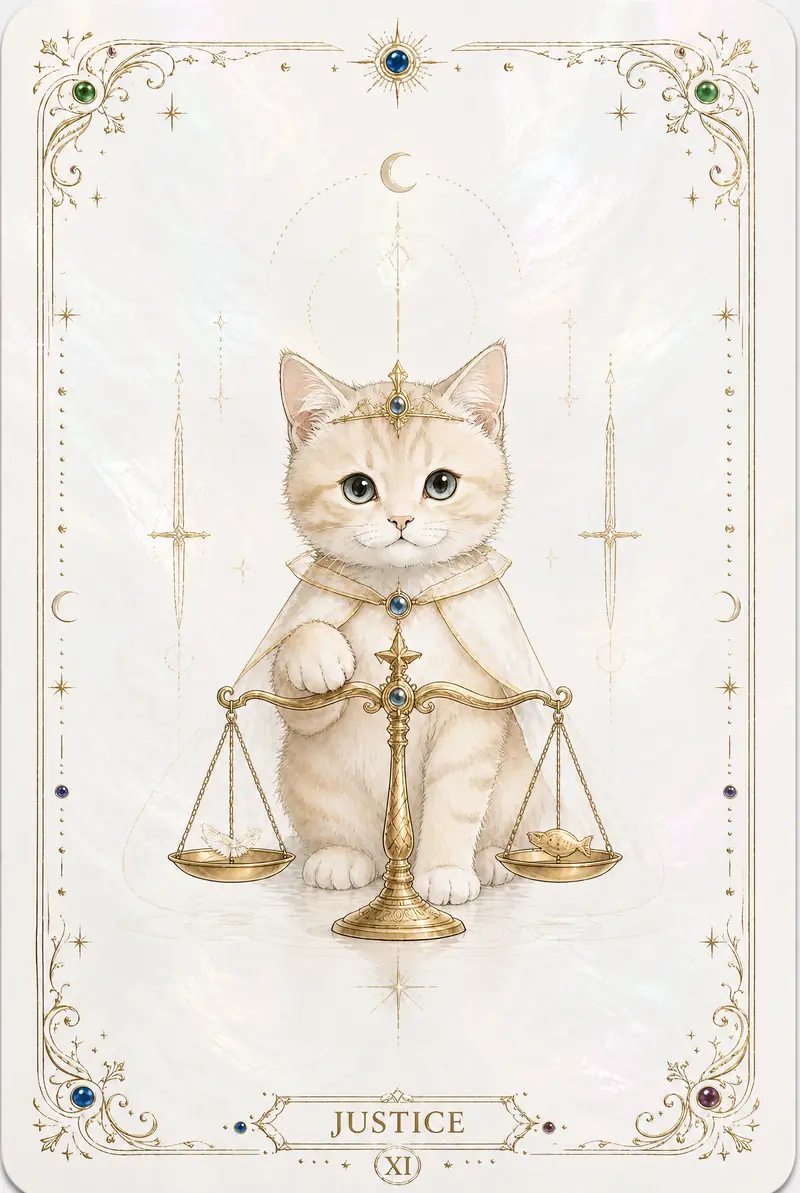
The scales weigh cause and effect without regard for likes or dislikes; what has been sown will be reaped sooner or later.
The image
A figure sits upright on a throne, holding a sword straight up in the right hand and a pair of scales in the left. The posture is level and the gaze is straight ahead, leaning to neither side. The sword stands for clear judgment and, when needed, decisive action; the scales stand for measuring and weighing. Having both together shows that the fairness this card describes needs rational analysis and also needs a result, a ruling. It does not mean weighing things forever. The figure sits between two pillars, echoing the seated pose of The High Priestess, but without her reserved, mysterious air; in its place is a public clarity that anyone can check.
The composition of a figure seated between two stone pillars recurs throughout the tarot. The High Priestess, the Hierophant and Justice all use the two pillars to suggest a kind of initiation: leaving behind worldly self-interest and prejudice and moving toward pure wisdom and unity. The same pattern can be extended to other cards that show two pillars inferred. A blue gem is set at the center of the crown, exactly where the "third eye" sits in the middle of the forehead, symbolizing insight that sees the nature of things and is not fooled by appearances. The square brooch on the chest is made of red and white, symbolizing the harmonious union of sulfur and salt. It also joins the red robe to the green cape, balancing the hardness of Mars with the softness of Venus. In the occult tradition, symbols of Venus are often accompanied by symbols of Mars, echoing the ambiguous relationship between Aphrodite (Venus) and Ares (Mars) in Greek and Roman myth. The gray cube of the throne symbolizes the stability of law itself, which does not change from morning to night. The steps below the throne connect the abstract world of ideas with the concrete material world: the text of the law is justice at the level of ideas, and its concrete manifestation in the material world is that lawbreakers are punished and the law-abiding are protected. The purple curtain behind the figure, on one hand, hides the yellow that stands for truth and the divine, suggesting that seeing the truth is not easy, the way news stories often take sudden turns and scientific laws have to be tested again and again before they are established. On the other hand, purple is a blend of red (Fire) and blue (Water), so it is itself a symbol of the balance of opposites, the yin and yang of Chinese thought.
Core meaning
- Cause and effect in equal measure: past choices and actions begin to bring their matching results. The responsibility that is due and the reward that is earned will both arrive, and neither can be sidestepped. This kind of cause and effect first demands complete honesty: you have to see that the situation in front of you is the product of your own past circumstances and decisions before you can learn the lesson from it and change how you act in the future.
- Justice with open eyes: the goddess of justice on this card does not wear a blindfold like the Themis figures common in Western courts. What she asks for is something other than impartial social justice that treats everyone the same regardless of circumstances (that belongs to the domain of The Emperor). She stands for a law of the heart and mind, one that requires you to see the truth about yourself and your life before you can move forward on it.
- Responsibility as a plain fact, with no moral verdict attached: coming right after the impermanence of the Wheel of Fortune, this card points out that however much the outside world changes, everything a person has lived through has helped shape who they are now. This has nothing to do with judging good and evil; it is simply the plain fact. The paradox is that only by actively admitting and seeing this chain of cause and effect can a person free themselves from unconsciously repeating the cycles of the past, instead of being pushed along by the past indefinitely.
- The exact center of the Major Arcana: Justice is the eleventh of the 22 major cards and sits right in the middle. Only after accepting the full picture of one's own causes and effects here can the kind of release represented by the angel of Temperance later emerge.
- Balance does not mean splitting the blame evenly: the scales must finally give a result. Justice means handing down the ruling that an accurate weighing calls for; a muddled compromise where each side just backs off a step falls short of it.
- On a literal level, the card is also often connected with occasions that require things to be argued out and settled, such as signing contracts, lawsuits and official rulings.
- The difference between relative and absolute justice: one reading draws on Plato's discussion of what justice is and points out that truly neutral justice barely exists in the human world. People always judge right and wrong, without realizing it, from positions they have lived through. The judge on the card seems fair because the figure is connected to a divine source free of worldly interests. Human justice can only ever approach that, and never become wholly impartial.
- The side that counts every penny: the equal balance that Justice seeks can, in a specific relationship, show up as keeping score too closely, demanding that the other person's contribution exactly match one's own and finding it hard to accept coming out behind. This is a less flattering personality sketch, especially useful for judging the details of love and partnership questions.
- A Greek myth is used to explain where the red, green and gold color scheme comes from. The story goes that the goddess of justice and the sea god quarreled over whether humans should stay, and each turned into an object for humans to vote on. The goddess of justice became a tree with a reddish-brown trunk, green leaves and golden olives; the sea god became waves crashing against rocks and glittering in the sun. Humans chose the olive tree, a symbol of love and peace, and the sea god decided to go on living alongside them. In its details this story is closer to the legend of Athena and Poseidon competing to be patron of Athens uncertain, but it is often borrowed to explain the symbolism of the colors of Justice's robes.
- An analogy for money: Justice is often compared to an honest civil servant or judge. Being too wealthy or living extravagantly tends to invite scrutiny and suspicion; balanced income and spending and a decent, comfortable standard of living fit this card best. In love, it often points to a relationship between well-matched equals who are honest with each other and split housework roughly evenly, so that neither feels shortchanged.
- How it lands in money, health and spirit: for money, Justice is often linked to financial documents that require things to be spelled out, such as loans, major transactions and new employment contracts. Upright, the paperwork goes smoothly; it also shows a querent willing to take responsibility for their financial decisions and recognizing that now is the right time to carry out a financial plan. For health, it is associated with the kidneys and the digestive system, often appearing as warning signals from the body such as bloating, discomfort that is temporary but meant as a warning.
- On the level of spirit, Justice represents a willingness to take responsibility for your actions and to live a life that can stand up to scrutiny. The current situation is the result of past decisions and actions, and recognizing this is itself an opportunity: it lets a person draw out of past experience the behaviors worth carrying into the future.
Reversed
- [Image association] The sword drops below the figure while the scales are raised overhead: force and coercion have no traction in this matter and may not solve the problem at all. At the same time, outside considerations have overridden one's own professional, calm judgment.
- [Image association] The sword points at the person holding it: the querent is more likely to be the one hurt by the ruling, through unfair treatment or a lost lawsuit, or, turned the other way, by being too hard on themselves. The scales swinging wildly and the weights falling off symbolize standards of judgment that no longer hold, which makes it easy to reach decisions that cannot stand up to examination.
- [Blocked / image association] The crown slips off, suggesting that the final decision in this matter was never in the querent's hands. However they weigh things, they cannot decide it and can only wait for someone else to rule.
- [Overdone / negative meaning] Clinging to rules and to rigid logic becomes harsh and unfeeling. Prejudice may also quietly take the place of objective judgment at this point, hiding the truth, and others may even exploit loopholes in the rules.
- [Opposite meaning] Even turning to the law or the rules will hardly bring a truly fair result. The querent's case may well fail on legal grounds or on eligibility, and the effort will be wasted. It can also mean the querent does not clearly understand the rules themselves or lacks final decision-making power, so whatever they decide, they cannot move things forward.
- [Turned inward / negative meaning] What each side gives in a relationship or partnership begins to fall out of balance. One person feels they are giving more but finds it hard to say so. If no balance acceptable to both can be found, the relationship is at risk of breaking.
- How the reversal lands in money and health: for money, reversed Justice often points to delays in financial paperwork, slow progress on agreements, or legal disputes. For health, it can mean blaming others for one's own health problems and refusing to take responsibility for improving and maintaining one's health. It can also correspond to a drawn-out legal process over a health matter.
Correspondences
Number 11, Air (element), Libra; see Astrological Correspondences for details. On the Tree of Life, its path corresponds to the Hebrew letter Lamed (ל); see The Kabbalah and the Tree of Life.
Lamed literally means "ox goad", the tool that keeps Aleph (the ox, a symbol of raw life force) moving forward without falling into chaos and disorder. By extension it also carries the sense of teaching and discipline. On the Tree of Life, Lamed connects Severity (Geburah) with Beauty (Tiphareth): through clearing away and passing judgment, the world regains balance and harmony. This echoes the card's core meaning that weighing and ruling go together, cause and effect are matched, and any imbalance will eventually be corrected.
The details of the image confirm this path as well. The scales are painted yellow, and yellow is the color of Tiphareth (Beauty). The right hand holding the sword corresponds to the striking, destructive power of Geburah (Severity). By sitting as it does, the figure places itself right between these two sephiroth, with sword and scales in the right and left hands matching the two ends of the path. There is a subtler design touch too: the middle finger of the figure's left hand deliberately points down. Under the Golden Dawn's own system of palmistry correspondences (which differs from traditional Western palmistry), the left middle finger is ruled by Venus, and Venus is the ruler of Libra. So this gesture quietly reinforces the chain linking Justice, Libra and Venus once more.
Views from different traditions
- The Waite system numbers this card XI, directly after Strength (VIII, Leo), so that Justice corresponds to Libra and, together with the other major cards that carry zodiac correspondences, the numbering follows the order of the twelve signs.
- In the Marseille tradition, Justice was originally numbered VIII (La Justice) and Strength XI (La Force), exactly the reverse of the Waite deck disputed.
- Crowley's Thoth system keeps the Marseille numbering (Justice still sits at number eight) but renames the card "Adjustment", stressing a cosmic, self-executing recalibration of cause and effect and playing down, more than the Waite deck does, the personified sense of a judge handing down a ruling inferred. The correspondence to Libra stays the same.
- The three traditions agree that this card corresponds to Libra. They differ only in the numbering and in the naming and emphasis that follow from it.
- Because Crowley kept the old Marseille numbering, the zodiac sequence has a break: Justice (number eight, Libra) is followed by the Hermit (Virgo), and after that comes a jump back to Strength/Lust (number eleven, Leo). The order Cancer, Libra, Virgo, Leo is broken, and this was one of the reasons the Golden Dawn argued for swapping the numbers so that Strength and Justice change places in the Waite deck.
- Rachel Pollack also reads the image details psychologically. The figure has one hand raised and one lowered, echoing The Magician; yet the figure looks neutral, with gender blurred, and the red robe recalls The High Priestess. She reads the card as the first image in which the Magician's principle of action and the High Priestess's intuitive wisdom are fully combined.
- Golden Dawn, advanced reading: the specific problem the number swap solves: without the swap, the sequence runs Chariot (Cancer), Justice (Libra), Hermit (Virgo), Strength (Leo), and the zodiac order is broken. After the swap it runs Chariot (Cancer), Strength (Leo), Hermit (Virgo), Justice (Libra), which gives the correct, unbroken zodiac order of Cancer, Leo, Virgo, Libra. This was the argument MacGregor Mathers used to persuade the Golden Dawn to adopt the new numbering. Waite never publicly explained the change, but nearly every modern tarot deck since has kept it.