Temperance
Number XIV · Element Fire · Correspondence Sagittarius
Upright: reconciling, patient blending, balancing opposites, gradual rebuilding, holding both sides
Reversed: unbalanced deadlock, too much compromise, inner balance not yet shown outside, impatience and imbalance, blurred boundaries
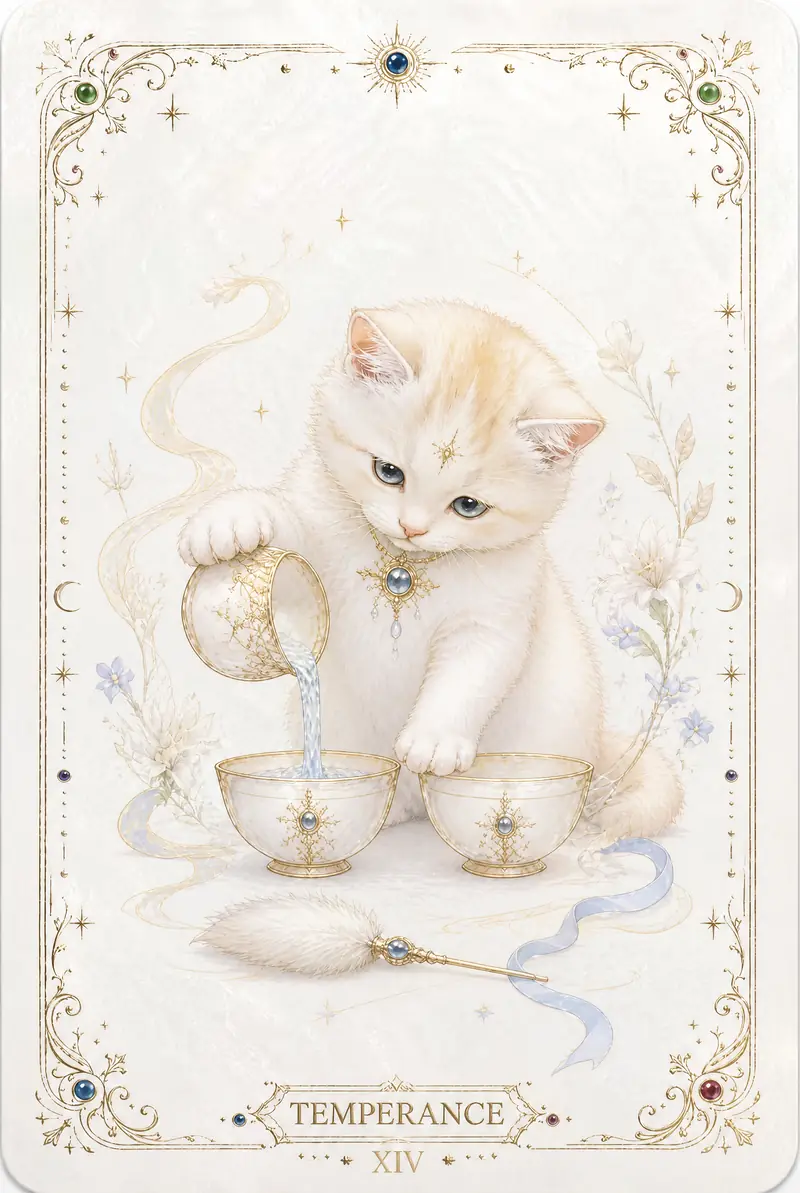
Water poured back and forth between two cups without spilling a drop: this card is about the patient craft of reconciling opposites.
The image
A winged figure stands with one foot in the water and one on the shore, holding a cup in each hand. Water flows back and forth between the two cups. The pose is steady and the water does not spill. This could never really happen, which is exactly the point: it shows a skill beyond ordinary rules, far removed from clumsy physical balancing. In the background a path often leads toward distant mountains and a rising light, suggesting that this reconciling is a process that keeps moving forward, with no end point here. The wings recall an angel and place this reconciling at a level close to beyond personal will.
Core meaning
- Real reconciling means blending, with nothing suppressed: the English name "temperance" comes from the Latin temperare, meaning "to mix" or "to combine properly", which is more than self-restraint. There is no longer any need to build separate personas for work and private life, or to cut "serious" off sharply from "play".
- A patient, gradual process: pouring between the two cups is an ongoing action, unlike a recipe completed in one go. The balance this card describes takes time and repeated fine-tuning.
- A footing between water and land: water symbolizes potential not yet manifest (the unconscious), and land symbolizes the real world where things have landed. The tempered person acts from an inner sense of being alive and connects these two worlds. This is the step that brings the wonder felt in The Hanged Man into the real world.
- Rebuilding after Death: coming right after the complete ending of Death, Temperance is the step of redistributing and recombining on the ruins to produce a new, sustainable state. Like the rainbow that rises in the sky after the flood, Temperance shows the personality that is set free once the terrifying experience brought by Death has passed.
- Balance that is close to magic, with no strain: the cups are not even directly above one another, yet the stream does not spill. This physically impossible image points out that true reconciling is an almost magical ability to handle every problem of life with joy. A rigid balance held in place by sheer willpower is something else entirely.
- In a spread, it often suggests that now is a time to slow down and look for a middle way, instead of forcing a choice between two extremes.
- The angel is Michael: the angel in Temperance corresponds to the archangel Michael. Sagittarius is a Fire sign, and the guardian angel of Fire is Michael. Michael is also counted among the "four archangels", the angel closest to God, who has led the heavenly armies against demons many times with great distinction.
- The square and triangle on the chest: the square and triangle overlapping on the angel's chest are another hint of reconciling. The four sides of the square correspond to salt and stand for a passive, stable force; the three sides of the triangle correspond to sulfur and stand for an active, assertive force. Four plus three is seven, which echoes the "law of seven" found in the seven planets, the seven metals and the seven colors of the spectrum.
- A numerical echo of the Hierophant: Temperance is card 14, and 1+4=5, which echoes card 5, The Hierophant. Both cards relate to teaching and growth, and drawing either often suggests the querent's work involves teaching or training. The difference is that the Hierophant is a lofty authority and teacher who allows no contradiction, while Temperance is more like a guide who goes through the experience with everyone, so each person grows through what they share.
- "Temperance needed because of indulgence", Sagittarius style: looking at its sign, Sagittarius is known for loving play and resisting constraint, and it is exactly this untempered nature that makes the lesson of temperance meaningful. The card can be understood as a path of growth, from acting on impulse and being unable to delay gratification toward self-discipline and restraint. The balance it describes is learned over time. It is not a state a person is born with.
- Two cups as the reconciling of higher and lower self: the liquid flowing between the angel's two cups can be read as the merging of the "higher self" (altruism, higher moral demands) and the "lower self" (one's own survival needs). Attending only to the higher self leads to giving way so much that a person cannot stand firm in real life; attending only to the lower self leads to selfishness and leaves a person with no place among others. Real temperance means first looking after your own basic needs, and on that basis considering what to give to others and the world.
- Money: upright in a financial reading, it suggests a balanced, sound position. Present restraint and trade-offs are paving the way toward long-term goals, but they need a well-filled inner life to support them first; then giving up immediate material temptations will not feel forced.
- Health: it corresponds to the hips, thighs and sciatic nerve. Upright, it suggests the querent can look after the needs of body and mind together in a balanced way, neglecting neither.
Reversed
- [Image association] Water is lifted from low to high: the weight of emotion overrides rational weighing, and judgment leans on subjective intuition more than on slow, steady blending. Cups tipping over and water spilling out correspond directly to cracks in a partnership or even its collapse: an understanding that should flow smoothly turns into each side talking past the other.
- [Image association] The path to the mountaintop is reversed to run from top to bottom: the direction of reconciling turns from exploring outward to looking back within. The symbol on the angel's chest also leans toward Water, meaning this stage is softer but also less stable, and easily led by emotion.
- [Overdone / negative meaning] Temperance taken too far becomes stinginess: unwilling to pay the price that is due, yet still wanting an equal result. It can also mean a lack of management and discipline, letting things grow loose and decay until they are hard to put right.
- [Blocked / turned inward] The gap between reason and emotion is widening, pulling the querent into inner contradiction. Higher wisdom or reminders from others are needed to bring things back together. The force that drives transformation and blending is insufficient for now, so the best option is to hold the situation steady conservatively.
- [Opposite meaning] This is not a good time to rush into a partnership; joining hastily may cost more. When communication is not working, it is better for each side to settle on their own first and continue once they have thought things through. If gentle mediation keeps failing, sometimes a more forceful, decisive approach is what finally gets the matter taken seriously.
- [Opposite meaning] Without input from others it is easy to insist on one's own way, and the result tends toward one of two extremes, great success or great failure. Most likely only small-scale adjustments can be pushed forward now, and there is not yet enough capacity to bring together a situation that is genuinely split and opposed.
- [Life-area method] Reversed in a health question, it often points to escaping emptiness through immediate sensory gratification, such as overindulging in food, relying on pills, or drinking heavily. Without becoming aware of one's real spiritual goal, it is easy to mistake satisfying the senses for satisfying life. Reversed in a money question, it is often linked to a speculative mindset: not keeping one's feet on the ground, fantasizing about getting rich overnight, or running a business like a gamble, which puts finances at risk of spinning out of control.
Correspondences
Number 14, Fire, Sagittarius; see Astrological Correspondences for details. On the Tree of Life, its path corresponds to the Hebrew letter Samekh (ס); see The Kabbalah and the Tree of Life.
Samekh literally means "tent peg". One end holds the tent up toward the sky and the other is driven deep into the ground. Its shape is close to phallic, yet its job is to hold up a tent dome shaped much like a womb. This image of masculine and feminine united matches the card's picture of two cups pouring back and forth, high and low, dissolving duality and moving toward a unified middle. On the Tree of Life, this path connects the sixth sephirah, Tiphareth (Beauty), with the ninth, Yesod (Foundation). Both lie on the "middle pillar" together with Kether at the top, so the path itself sits exactly between the opposing sides. Read downward, as the "path of creation", it turns a lofty intention into concrete ideas and plans. Read upward, as the "path of return", it uses contact with ideas and writing to sense the noble soul behind them. Whether going up or down, it is a process of drawing ever closer to the middle way.
The angel itself is the most direct code for this path. Tiphareth is often matched with selfless, transcendent beings such as the Buddha, Christ and the archangels, and the main figure on Temperance is an angel. The angel steps into a pool, and the pool corresponds to Yesod. Yesod holds every blueprint of the material world but has no substance, like the moon reflected on water: there is no real moon in the water, only a reflection of reality with no form of its own. The sun disk on the angel's head once again points out that the planet of Tiphareth is the Sun. Behind the angel a path winds slowly toward a crown at the top of distant mountains, suggesting that above Tiphareth there is the first sephirah, Kether (the Crown), which is the final goal the path of Temperance points toward. In addition, irises (Iris, goddess of the rainbow) appear beside the angel. In Hebrew, the word for "rainbow" shares the same consonants as the word for Sagittarius (Qesheth, "bow"). Seeing a rainbow calls up Sagittarius, and seeing an iris calls up the rainbow: an indirect but documented textual clue.
Views from different traditions
- Crowley's Thoth system renames the card "Art" and replaces the angel pouring water with an alchemical, androgynous figure blending the elements in a cauldron. This puts more weight on reconciling as an active, almost creative process of "refining", beyond keeping to the middle inferred. The number (XIV) and the correspondence to Sagittarius are the same as in the Waite deck; there is no disagreement.
- This difference is mainly one of naming and visual emphasis. It does not involve a clash over the number or the astrological correspondence, and it is a different matter from the disputed-level disagreement over Strength and Justice.
- Rachel Pollack also draws on details of the BOTA deck: the angel pours water on a lion while flames drip onto the head of an eagle. The lion corresponds to Fire and echoes The Magician; the eagle is the "higher form" of Scorpio, corresponds to Water and echoes The High Priestess. This is the raw energy called up in the Strength card, which by this point has completed its union with reason.