The Hierophant
Number V · Element Earth · Correspondence Taurus
Upright: tradition, institutions, faith, teaching, belonging
Reversed: rigid dogma, lack of guidance, unconventional beliefs, blind obedience
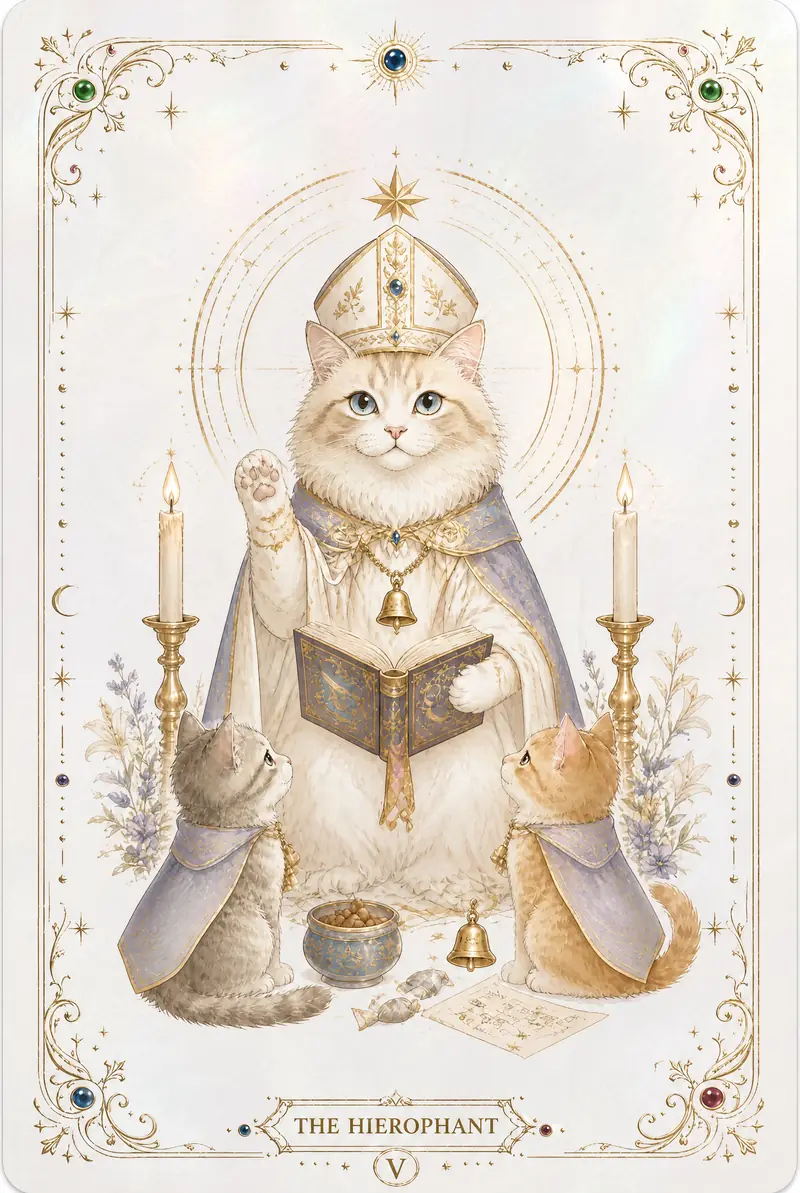
Wisdom handed down needs someone to teach it and someone to learn it.
The image
He sits between two pillars wearing a triple crown, his right hand raised in blessing: two fingers point up and two point down, a religious, ceremonial version of the High Priestess's "as above, so below". He holds a triple cross, which stands for doctrine passed down through the generations. Two initiates kneel before him and look up to listen, setting out a clear relationship between teacher and learners.
His outer robe is a strong red, matching his role of teaching people out in the world. The High Priestess only needs to sit and cultivate her inner life, but the Hierophant has to pass wisdom outward, much like the Buddhist ideal of the bodhisattva, who does not seek enlightenment alone but works to bring all beings across. Under the red robe he wears a blue garment, echoing the Emperor's contrast of "warm outside, cool inside" and his ability to both press forward and hold back. Bands hang down beside his ears, suggesting that he does not listen to outside gossip and listens only inward for divine instruction. The two initiates at his feet wear a red rose and a white lily. They stand for personalities not yet complete, one wanting to grow outward and one wanting to grow inward, and both have come to the Hierophant for guidance. At his feet lies a pair of crossed keys, one pointing left (toward the outer world) and one pointing right (toward the inner world), matching the directions of the two initiates.
Core meaning
- A division of authority: the Hierophant and The Emperor are a pair. The Emperor stands for the rules themselves and those who enforce them, while the Hierophant corresponds to the inner assent in a person's heart, the willing acceptance of some authority or tradition.
- Outside doctrine "answers" conflicts without resolving them: when you give yourself over to a ready-made set of beliefs and norms, the sharp oppositions in life seem to have answers. They have not actually been resolved, though. They have only been given a place and set aside.
- Spiritual teachers and formal education: getting guidance through mentors, rituals and established channels instead of figuring things out alone.
- Lineage and belonging to a community: the role of passing knowledge and experience down the generations, and also the sense of identity that comes from belonging to a larger tradition or group.
- Following an established path: doing things by methods that have already been proven, and handing ultimate responsibility over to tradition or the institution instead of carrying the weight of choice alone.
- Marriage and formal unions: bonds recognized by traditional ceremony, such as a wedding or a formal commitment.
- Facing the opposite way from the High Priestess: both are spiritual figures, but the High Priestess's wisdom is held within and not shown on purpose, while the Hierophant must pass on the wisdom he receives from a higher source and teach it to many. That is why he usually appears in an outward-facing, formal role. Historically, a pope's real power was also not necessarily below that of secular rulers. Under the medieval idea of the divine right of kings, papal approval at one point stood above a monarch's claim to legitimate rule; the papacy was more than "a title the emperor kindly granted".
- The black and white floor under his feet symbolizes good and evil mixed together in the material world: in pure spiritual terms, a single thought is often clearly either good or bad, but once it becomes a concrete action, motives are usually mixed and hard to judge in one clean cut. As the bridge between the spiritual and material worlds, the Hierophant deals with exactly this tangled reality.
- What it means in practice: in love it often points to a relationship without strong passion that values social approval and security. Quite often it is closer to a marriage formed because "it was time to get married", where two people support each other through daily life, than to a burning romance, but all the proper courtesies and duties will be carried out. With money it leans conservative and steady, with little lavish or risky spending.
- The function assigned to Vav is "hearing". Prophets usually receive revelation by "hearing" it rather than "seeing" it. This fits the image of the initiates bowing their heads to listen, and the Hierophant's own role as an intermediary who listens to a higher source and then passes the teaching on.
- Money, health and spirit: with money, the upright Hierophant means reaching financial stability at a conservative, steady pace. Success does not arrive suddenly; it comes step by step. Sometimes it also describes pursuing a more widely accepted career or way of managing money under pressure from others. With health, upright or reversed, it is linked to the neck, throat and shoulders. Upright, it leans toward the good health that comes from a moderate lifestyle, usually points to chronic issues rather than acute illness, and suggests that conventional medicine suits the current situation better than alternative treatments.
- On the spiritual level, the Hierophant means that at some point on life's path you need a spiritual teacher with real experience who can give real guidance. Following a faith or path others have already walked feels safer. Breaking a new path on your own gives a different view, but it also makes you more likely to stumble at obstacles.
- In the Golden Dawn's cosmology, Taurus is one of the four fixed signs that "hold up the four corners of the heavens" (the other three being Leo, Scorpio and Aquarius). This image of holding up and bearing weight also echoes the Hierophant's steadiness as a pillar of faith.
- There is another way to read the gesture of blessing. The thumb holds down the ring finger and little finger, leaving only the index and middle fingers showing: two shown and three hidden. This suggests that although the Hierophant knows the sacred secrets, he reveals only part of them to the world and leaves the rest for a higher wisdom to decide when to reveal. The index and middle fingers point upward, also symbolizing that the body will perish while the spirit stays with the source of creation and lives forever. This reading of the gesture stands alongside the "two fingers up, two fingers down" reading uncertain.
- Direction on tarot cards is also a convention you can extend to other cards: left usually corresponds to moving toward the outer world, and right to moving toward the inner world inferred.
Reversed
- Picture association: upright, the Hierophant sits high up and blesses the kneeling initiates. In the reversed image their positions trade places and the ones being taught are on top. This suggests that the querent needs to give more actively right now, or is actually still at the stage of learning and searching, and not yet ready to guide anyone.
- Picture association: upright, the triple crown and the keys symbolize clear authority. Reversed, if the crown slips off, it suggests there is no absolute authority in spiritual and institutional matters, and that it is better to think and judge for yourself than to follow an authority figure blindly.
- Overdonetreating the institution and its rules as the goal, holding on to form and forgetting the purpose it was meant to serve, and becoming rigid and dogmatic. It can also mean helping people without any principle because of a soft heart, and wearing yourself out as a result.
- Turned inwardholding ideas or beliefs that differ from the mainstream but choosing not to express them openly, and not wanting to challenge established authority.
- Blockedfor now there is no suitable tradition or teacher to lean on. At a time of inner emptiness and lost direction, it is better to talk things through with peers first than to look upward for help.
- The reversed card has its good side too: breaking with convention and leaving the path most people approve of can also lead to success. One famous Chinese author left high school to become a writer, and Bill Gates left college to found Microsoft. Still, this kind of "rebel success" is a low-probability event. The step-by-step path the upright Hierophant chooses is essentially a way of giving most people better odds of success. Each choice has its trade-offs, and neither can simply be judged better inferred.
- Money and health when reversed: with money, the reversed Hierophant is a reminder to go back to the self-discipline lesson of the upright Emperor. Running your own business in particular usually takes more discipline than drawing a salary. If you are unwilling to adopt a ready-made, systematic approach (buying software, hiring a consultant, taking a course), you have to draw up a plan that is truly your own. With health it may mean stepping outside mainstream medicine and trying approaches such as hypnosis, herbs, energy healing or changes in diet to restore the body's balance. It also asks you to notice physical signals such as a stiff neck and shoulders that reflect spiritual issues.
Correspondences
Taurus (an Earth sign); Hebrew letter Vav ו. For the full set of correspondences, see Astrological Correspondences and The Kabbalah and the Tree of Life.
Vav literally means "nail" or "hook", something used to fasten two things together. In Hebrew it also serves as the conjunction "and", symbolizing separate things joined into one. On the Tree of Life, Vav connects Chokmah (Wisdom) and Chesed (Mercy). Starting from original power, it moves toward spreading kindness and steady faith, which echoes the Hierophant's core function of taking wisdom received from a higher source and teaching it to many.
Views from different traditions
In the Marseille tradition this card is simply called "the Pope" (Le Pape), and the image clearly points to the Catholic pope himself. Waite changed the name to the broader "Hierophant" (meaning "one who reveals sacred things"), playing down the specific religious identity and widening the meaning to every widely recognized traditional authority and institution, no longer tied to one particular religion inferred. This is the same treatment he gave the High Priestess when he renamed her to soften the "Popess" reference.
- Pollack points out that the public church and the hidden esoteric order look like opposites but are basically alike. Both require initiates to first accept an existing set of beliefs and training in full; the only difference is whether the path is open or hidden. She also notes that the truly deep mystical traditions (such as the Kabbalah and Sufism) usually take root deep inside a single system. The modern habit of picking inspiration freely from every religion looks open-minded, but it can easily become shallow.
- Advanced Golden Dawn reading: on the chair behind the pillars there is a hidden Taurus symbol (beside the Hierophant's ear) and a small sun symbol. The Taurus symbol is the main visual clue for this card's link with Taurus. The meaning of the sun symbol is less clear; for now it can be read as a link with "the divine source".
- In old Hebrew script Vav looks a lot like the letter Y, and the yellow Y-shaped patterns behind the two initiates in the foreground and the shape of the Hierophant's white stole both repeat this form. In the Golden Dawn system Vav is pronounced close to U, so it can also be transcribed into English as U, V or W. These three letters are thought to correspond to the U-shaped decoration on the capitals of the two pillars, the Roman numeral V (placed above the Hierophant's head), and the W formed by the three nails at the top of the crown (Vav itself also means "nail"). This is the most solidly argued layer of symbolic correspondence on the card.
- The red-orange of the vestments and the altar is the color the Golden Dawn system assigns to Vav and Taurus. In theory Venus, the ruling planet of Taurus, and the Moon, which is exalted in Taurus, should each have a color correspondence as well, but this argument is not very tight when it comes to the color of the acolytes' robes: the robe is actually closer to blue than green.
Aleister Crowley himself disliked institutional religion. He held that the real function of religious institutions was to enslave people's minds, not to make them good. This critical view reads the Hierophant as having a side that can bring spiritual control and bind the individual with conventional morality. One example of this collective moral pressure is the double standard society often applies to an older man with a much younger wife versus an older woman with a much younger husband uncertain.