The Devil
Number XV · Element Earth · Correspondence Capricorn
Upright: bondage, addiction, materialism, the shadow self, unhealthy attachment
Reversed: breaking free, hidden dependence, indulgence out of control, facing desire
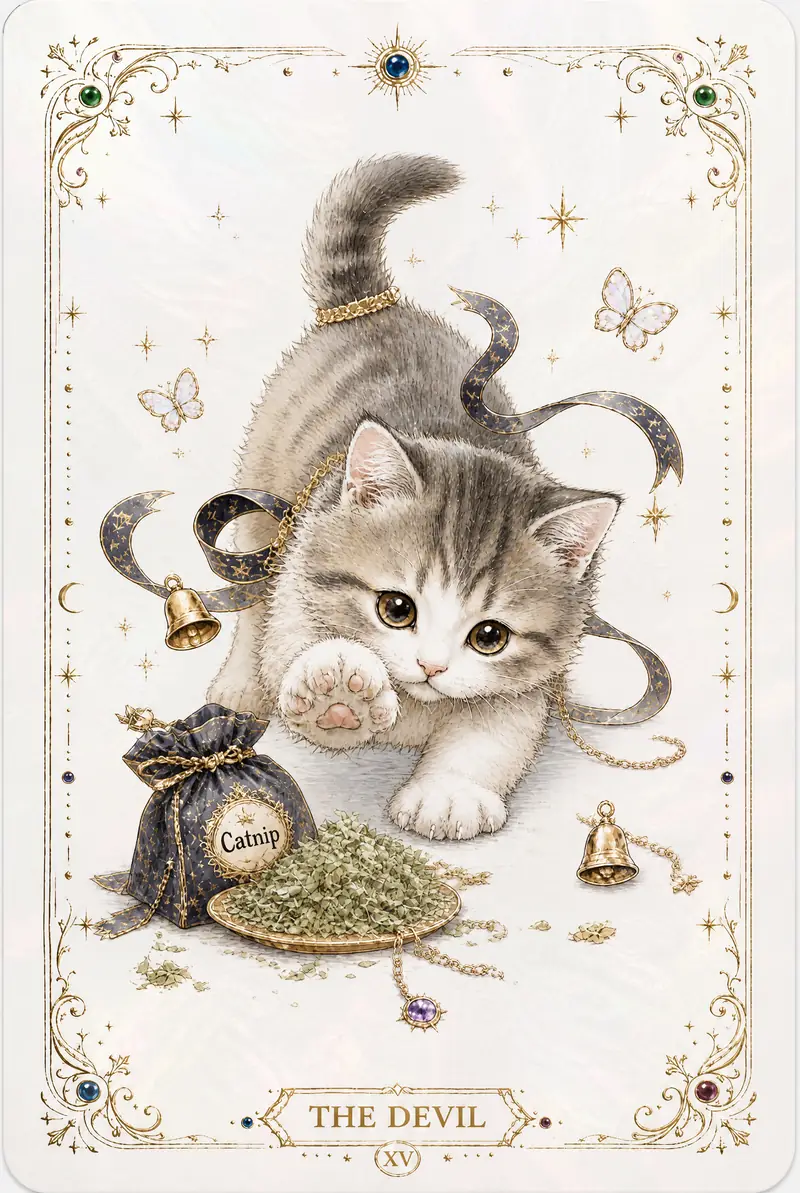
This card is about chains a person stays in willingly, more than any demon from outside: addiction, obsession, and freedom tied down by material things and desire.
The image
In the Waite deck, a figure resembling Baphomet crouches on a high pedestal. Below, a man and a woman are chained at the neck, their poses almost a copy of the two figures in The Lovers. Look closely and the chains are loose: if they wanted to, the two could lift them off over their heads at any moment. This echo in the composition is deliberate. The same pair has gone from free choice (the Lovers) to willing captivity (the Devil), showing what can happen after a choice is made if a person stops examining themselves.
Core meaning
- Self-made bondage: addiction, compulsive habits, an unhealthy dependence on a relationship or an identity. The chains were put on by the person wearing them; no outside force imposed them.
- The inverted pentagram above the head suggests desire overriding rational judgment. A human body with legs apart and arms outstretched already forms a five-pointed star; turned upside down, the genitals sit above the head. This is being led around by material things, sensory pleasure or fear, treating the layer of reality in front of you as the only real one, and forgetting that you had other choices all along.
- The shadow self rises to the surface, though it is not pure evil: these are desires and fears that have been pushed down, denied, never admitted, a life energy locked in the dark places of the self where ordinary means cannot reach. This energy takes on a "demonic" look only for someone not yet ready to receive it. In the Strength card, which sits directly above it, the same raw energy has already been tamed and raised into the image of the lion; the Devil shows its other side, not yet transformed.
- It also often points to an unhealthy relationship or power structure: controlling and being controlled, wearing each other down yet finding it hard to get out, with both sides helping to keep the situation going to some degree.
- The stone block the Devil crouches on is only half a cube. A whole cube symbolizes the entire universe (echoing the cube The Emperor sits on). The incomplete half-cube under the Devil's feet suggests that the belief "there is nothing beyond the world of the senses" is only partial knowledge.
- The loose chains are the most important detail on this card. The sense of being bound is very real, but the freedom to break out of it has been there all along. People often feel their own unhappiness fully only once they realize life has other options, and then they become willing to reach out and try.
- In practical readings, this card often points to using improper or rule-breaking means to get resources or opportunities a person could not reach on their own merits. Such temptations work because the other side has accurately spotted desires and weak points that already exist in the querent; they are seldom invented out of nothing.
- The missing fourth angel: three other angels are hidden in the tarot. The Air angel appears in The Lovers, Michael, the angel of Fire, in Temperance, and Gabriel, the angel of Water, in Judgement. Only an angel of Earth is missing. Capricorn is an Earth sign, so the Devil card is read as alluding to Uriel, the angel of Earth. Uriel is said to have passed the wisdom of the Kabbalah to humanity in the hope of helping fallen humans rise and return, and to guard the gate of Eden with a sword, driving back demons. Uriel never fell. The contrast between a figure meant to guard and protect and its placement in the Devil card is one of this card's hidden touches of ingenuity.
- The origin of fallen angels and the idea that they cannot be redeemed: different versions circulate about where fallen angels came from. In one, angels fell in love with humans, married them and taught them knowledge such as alchemy, the arts of war and the secrets of cosmetics. Humans misused this knowledge to do evil, which brought the punishment of the Flood, and the angels were cast down as demons. Another, more common version centers on Lucifer, who out of pride and envy led some angels in rebellion. God gave the angels one chance to choose freely: those who chose to stay remained angels, those who followed him fell as demons, and no angel has fallen since. Whatever the origin, demons in the biblical tradition cannot be moved to turn back to good. Evil does not transform into good, which differs from the film and TV trope of a demon won over by true love uncertain (many versions of the fallen-angel origin myth circulate; these are only two common ones).
- Goat horns and bat wings stand for the unconventional more than for absolute evil: the goat horns on the Devil's head are often traced back to pre-Christian nature worship. In early pagan religion, horns on a god's head symbolized power over forest and hunt; once monotheism rose, these pagan gods were recast as devils. The bat wings echo the same sense of the unconventional: bats live in caves, sleep by day and come out at night, and hang upside down to sleep, a reversal of nature's usual patterns. So the Devil is often used to stand for beings or choices that the mainstream does not accept but that are not necessarily "wrong", more than for evil in an absolute sense.
- Donkey ears pointing to a god of desire: the Devil's donkey ears point to Priapus, the ancient Greek god of fertility. The donkey was the animal sacrificed to him, so the donkey ears on the card are another hint of sexual energy, echoing the tail and goat legs that together make up the symbols of desire. The torch in his hand also recalls the myth of Prometheus stealing fire, bringing knowledge and power that do not belong on earth down below and kindling human desire. This echoes the old warning that when a person's virtue falls short of their position, disaster follows: knowledge that does not develop together with virtue is easily misused.
- The Devil makes the same gesture as The Magician, right hand raised and left hand lowered, and likewise channels energy from above to manifest below. The difference is that the Magician's connection is freely given, while the power the Devil hands out comes at a price.
- Seen through its path on the Tree of Life, one end of the Devil connects to Tiphareth (Beauty), which symbolizes the higher soul. The Devil was originally a fallen angel, and was not purely evil from the start. This supports the idea that the shadow self is not pure evil, only life energy not yet claimed as one's own.
- Money: upright, it is sometimes a strong card for financial success, representing a focused pursuit of real-world gain without being distracted by other goals. But it also suggests the querent may not fully believe success comes from effort itself, and so insists on controlling the business or screens financial partners with great caution. Behind this focus lies a fear of losing control.
- Health: as the card of Capricorn, the Devil in health readings often points to pain in the knees, teeth or bones, and can also reflect skin allergies, dryness and peeling. Upright, it sometimes suggests that pressure from work or money is wearing the body down. In that case there is no need to cling to a single treatment; several kinds of care may work equally well.
- Spirit: a beautiful house, an attractive partner, a valuable collection. These tangible things can bring short-lived pleasure, but the Devil warns against sinking into them, or the path you chose will in turn take you over and lure you on. What you gain from passing through this "spiritual winter" is finally seeing that money cannot buy happiness; at most it can ease hard labor.
Reversed
- The bonds begin to loosen and the power to choose returns to the querent (image association / blocked energy easing): in the image, the two chained figures rise above the Devil's head, suggesting that whether things turn toward good or toward evil is no longer decided entirely by outside forces. But the loosening only opens a fork in the road. It does not mean the querent is already free.
- Sensory and material desires grow even stronger (overdone): instead of pulling back, the querent sinks further than in the upright card into the pleasure and possession in front of them, chasing momentary satisfaction regardless of the consequences, and often pays a heavier price later.
- Judgment clouded by desire, with a tendency to get drawn into murky situations (negative meaning, the "lacking" branch): without a clear view of the material and sensory side of things, it is easy to be dragged in by benefits that only look real or by entanglements of unknown origin. This is not a good stage for major decisions.
- Dependence changes its face and stays put (turned inward): the outside constraint may be gone, but if the person is still unwilling to let go of the dependence themselves, it will only carry on in a more hidden form. They have not really walked out.
- A window for actively quitting (opposite meaning): this is also a good chance to resolve to stay away from some improper temptation and take back control. Whether the querent can really break free depends on whether they are willing to face their desires squarely, instead of waiting for an outside force to solve it for them.
- [Life-area method] Reversed in a money question, it often means the querent is willing to give up sole control of the situation and begins to accept help and advice from people around them. They start to see other workable financial goals and routes, and once unnecessary financial baggage is dropped the road ahead becomes much lighter. Reversed in a health question, it means becoming willing to try various kinds of care with a more open mind, and gradually seeing that one's mental and emotional state has been affecting physical health all along.
Correspondences
Capricorn, the Hebrew letter Ayin (ע), Earth; see Astrological Correspondences and The Kabbalah and the Tree of Life for details.
Like Aleph, Ayin is a silent letter. It literally means "eye", and its shape also resembles a pair of eyes. Traditionally it is seen as a "window": you can look out through it at the world, and the world can see through it into you. This is a reminder that what the eye sees on the surface is not necessarily how things really are. In the same way, the bondage the Devil describes is often only a chain on the surface. True and false, good and evil, need to be told apart rather than accepted wholesale. On the Tree of Life, this path connects the sixth sephirah, Tiphareth (Beauty), with the eighth, Hod (Glory). Read downward, as the "path of creation", it turns a lofty intention into reason, knowledge and technique handed on to the world; but this light also brings competition, imbalance and new desires, which is exactly the Devil's double nature of giving people power that comes with a price. Read upward, as the "path of return", it puts knowledge and means already mastered back into the service of others, away from private desire, echoing the meaning that the Devil's chains were loose all along and can be thrown off at any time.
The Golden Dawn has a general rule: every astrological glyph is a combination of three basic shapes, the cross, the circle and the crescent. Saturn, the ruler of Capricorn, has a glyph made of a cross plus a crescent, and Waite quietly hid this glyph in the Devil's palm. A clear cross among the lines of the palm, together with the crescent-like outline of the pad below the thumb, looks like Saturn's sickle, quietly stressing the link between Saturn, Capricorn and the Devil card.
The course this material draws on also mentions an association based on gematria, the Hebrew system of number values. Eleven grapes are drawn on Eve's tail, and grapes symbolize the temptation of wine. The Hebrew word for wine (yayin) has the same numerical value as the letter Ayin, 70, and equal values are taken to mean a special connection between two words, so this bunch of grapes is also read as a hint of Ayin. However, this correspondence is fairly indirect and needs extra knowledge of gematria to see, so treat it as a side note.
Views from different traditions
The Waite system reads this card almost entirely as negative bondage and indulgence. In the Thoth system, Crowley explicitly rejects this one-sided negative reading. He sees the Devil as essentially Pan-like creative power and the life force of matter itself, standing for unrepressed desire and the abundance of the material world; "evil" is more a label imposed by the Christian moral framework than a property of the card disputed. Both readings agree that the card is about matter and desire. They differ on whether to assume this is "bad". Daniel adds another view from the composition: reversed, the chained man and woman rise above the Devil's head, which he reads as turning toward good or evil being largely back in the querent's own hands, no longer one-sidedly ruled by the Devil. Rachel Pollack reads The Hierophant and the Devil side by side through their gestures. The Hierophant's two lowered fingers suggest that the path to deeper knowledge is closed. The Devil's spread four fingers (in two pairs held together, with a gap in the middle) actually come from the gesture the ancient high priests of Jerusalem used to draw down spiritual power, which survives today in the Priestly Blessing ritual of Rosh Hashanah, the Jewish New Year. The same kind of gesture can be read as the narrow illusion of a prison of one's own making, or as seeing everything with nothing hidden.