Judgement
Number XX · Element Fire · Correspondence Fire (element)
Upright: awakening, a calling, summing up, rebirth, forgiveness
Reversed: delayed response, excessive self-blame, inner reflection not yet acted on, avoiding responsibility
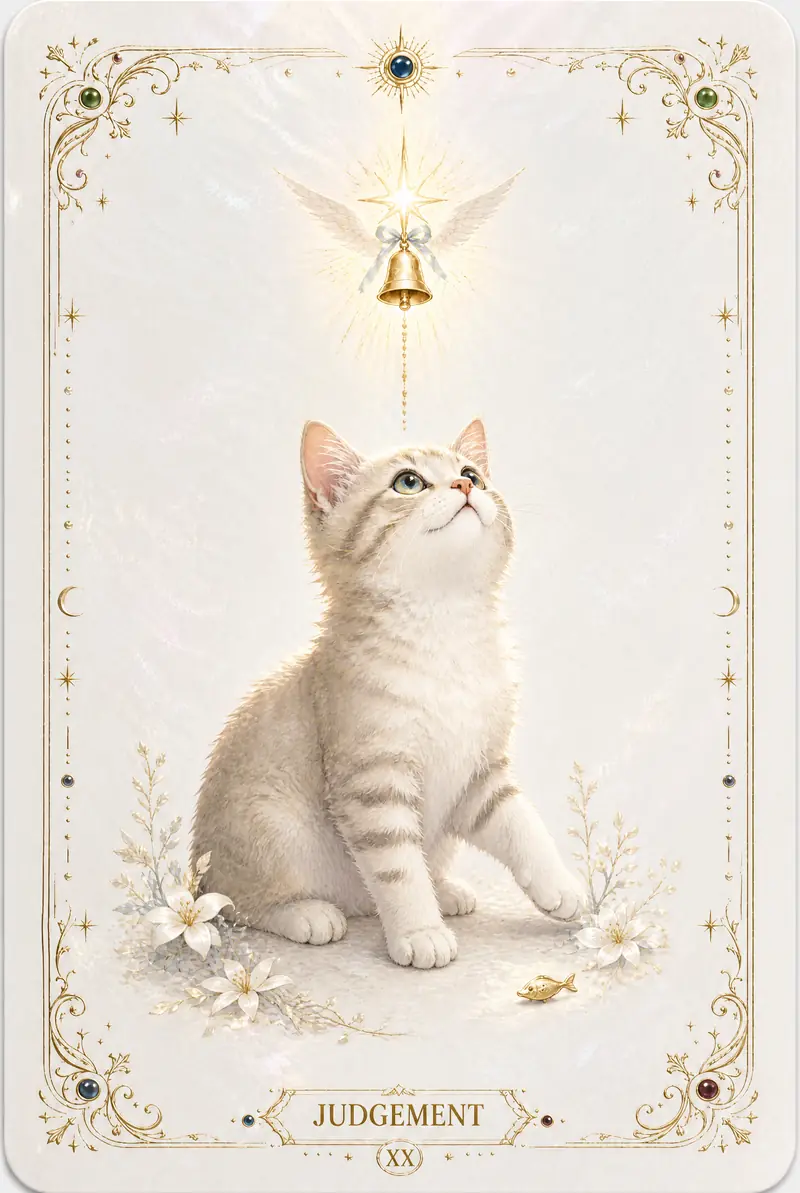
The last call before a stage ends: less a verdict from outside than the querent finally hearing a call that has long been waiting for an answer.
The image
The angel Gabriel blows a trumpet in the clouds, and on the ground people rise from coffins or graves with their arms open to greet it. The figures are mostly half naked or wrapped in cloth, which stands for setting down past identities and answering the call in a more essential state. The sound of the trumpet is an awakening, with nothing punitive about it: it turns the clarity and vitality built up in the Sun stage into a clear action or decision.
Core meaning
- Awakening and a calling: hearing a call that has always been there inside but was never seriously answered before. The call comes from within and from without at once, because the Sun stage has already broken down the artificial barrier between inner experience and the outer world, so that individual awareness and the larger drive of life merge into one.
- A contrast with Justice: both cards involve making peace with past experience, but Justice deals with personal cause and effect based on one's own actions. Judgement calls up a force beyond the individual, one that concerns the true nature of existence itself and one's place as part of everything.
- The archetype of the hero separated and found again: many myths tell of a hero separated from their "parents" and raised as an ordinary person, who discovers their true identity and inner power only on hearing and answering a call. This is the psychological archetype the Judgement card awakens.
- Summing up and passing a stage: past experiences, good and bad, are looked at again at this moment, and the querent makes an honest assessment of themselves instead of waiting for others to judge.
- Rebirth: an old identity or way of life dies (echoing the Death card), and the querent rises in a new state, carrying what has been distilled from the past.
- No liberation in isolation: every person is part of a group, and anyone who reaches the state of Judgement and the World changes the environment everyone shares. Individual awakening is never only a private matter.
- The poses of the three figures hide a piece of wordplay. The woman's arms form an "L", the man's hands crossed over his chest form something like half an "X", and the child's outstretched arms form a "V". Together they spell the Latin "LVX", that is, lux, "light", echoing the themes of the Fire path and eternal energy.
- The red cross on the banner is also thought to be one of the emblems of the Knights Templar. This medieval order's duty was to protect pilgrims traveling to the Holy Land, an aim much like that of the Red Cross. In the Judgement card it echoes heaven's protection and favor toward the devout.
- Seven lines can be faintly counted below the trumpet, corresponding to the seven notes of the scale. The difference between notes is at heart a difference in frequency of vibration, which echoes the idea that energy is vibration: the angel's trumpet passes care down from above through vibration and energy.
- In a health question, Judgement can also carry another reminder: physical discomfort is not necessarily pure enemy. It is closer to a signal that you need to be treated well. There is no need to panic because symptoms appear; treat them as a chance to have your attention called back and to look after yourself.
- Reducing card twenty to the single digit "2" lets you compare Judgement with The High Priestess and Justice as a group. The High Priestess cares only about whether the inner self is settled; Justice only hands down fair rulings on the outside; Judgement holds both, an inner check on one's spiritual growth and an assessment of the outer situation.
- In practical readings, people who draw this card are often not especially attached to worldly fame and fortune, because at its core the card points to a longing to go beyond the material and return to a higher spiritual order. In career questions it is more often read as a fair evaluation where you reap what you sow, and less as a situation where shortcuts and tricks will get you through.
- Money: upright in a money question, it usually stands for clear judgment. Asked whether an investment is wise, with positive cards around it, it gives a clear yes. It is also often used to describe whether the way money is made is honest. Money earned with a clear conscience lets you sleep well, and also brings a sense of financial stability that only long-term investment can build. A reputation in business builds slowly but is easy to destroy.
- Health: in health readings it is a positive sign, usually meaning that the present state of the body is the result of many years of accumulated lifestyle. Treat the body well over the long run and health will last; ignore its signals for a long time and a decline is to be expected. The card points to the natural result of past behavior, more than to sudden bad luck.
- Spirit: it reminds the querent to remember the true spiritual purpose of their life: reflect on past experience, and consider how to enrich the soul through learning or teaching others. It also asks for more patience with people nearby who are struggling or have lost their way, since everyone is on the road to deeper spiritual understanding.
Reversed
- The call turns from outside toward the inner self (image association): the trumpeting angel moves to the bottom, symbolizing that this awakening is something to listen for in one's own heart, with no outside verdict involved. At the same time the crowd is lifted to the top, and the emphasis shifts from individual awakening to the influence of the crowd and the collective mood on the querent.
- Putting off answering the inner call (blocked): the querent has already faintly heard the voice, but because of fear, hesitation or not feeling ready, they stay where they are without really acting.
- Indecision and delaying judgments that need to be made (negative meaning, the "lacking" branch): without enough judgment and conviction, it is easy to miss opportunities that should be seized. It can also mean failing to learn from past experience, so the same problems keep coming back.
- Stubbornly refusing to admit what needs to change (overdone): the querent knows the current situation is wrong but will not concede it or adjust. The longer this stubbornness drags on, the bigger the backlash it tends to bring.
- The time for settling accounts has not come, and the truth is not yet fully out (opposite meaning): this is not the time to rush to conclusions. It is too early to judge either oneself or the situation. Leaving a little more time may bring a turn for the better, and gives the hidden parts a chance to come to light.
- [Life-area method] Reversed in a health question, it often means the present physical condition may be tied to imbalance on the spiritual level. Meditation, reading books that raise one's spiritual level, or using one's talents to help others may all bring health benefits. Reversed in a money question, it suggests the querent's judgment is weak right now and may not see the whole picture, pointing to an unwise investment, or to money that would do better put somewhere else.
Correspondences
Pure Fire as an element (not one of the twelve signs), the Hebrew letter Shin (ש); see Astrological Correspondences and The Kabbalah and the Tree of Life for details.
Shin literally means "tooth". Teeth control what may enter the mouth and what may not: what is accepted gets chewed and let through, and what is not meets a clenched jaw. This image of screening and ruling matches the core function of the Judgement card. On the Tree of Life, this path connects the eighth sephirah, Hod (Glory), with the tenth, Malkuth (Kingdom). Read downward, as the "path of creation", it examines and judges everything in the material world on the basis of reason and logic, echoing the upright Judgement card's frequent reading of "after careful weighing, this decision is right". Read upward, as the "path of return", it looks back over established realities and decisions and asks what rational grounds lay behind the original choice. It is a path of return just as the Moon's is, but this one examines rational weighing, while the Moon's path of return (which connects to the instinctive, nonrational Netzach) examines emotion and the subconscious.
The letter Shin is shaped like three rising flames, and the three resurrected figures below, as well as the angel's head and wings, are clearly composed to echo this three-pronged shape. The position of the red cross on the banner hides a subtler code. The little flag is drawn over the magic square of Mars (5×5=25 cells, since Mars corresponds to the fifth sephirah, Geburah). The red cross takes up exactly the middle column plus two cells on each side, 9 cells in all, and the four blank corners take 4 cells each, making exactly 25. This ties the flag to the magic square of Mars.
The card also has an apparent contradiction: its letter corresponds to Fire, yet the image is full of water. Gabriel stands in the clouds, the coffins float on a broad blue sea, and there are icebergs in the background. The contradiction can be explained by how Hebrew words are built. The Hebrew name for the sun, Shamash, is made of the three letters Shin, Mem, Shin (fire, water, fire); "heaven" (Shamayim) is made of Shin plus "water" (Mayim), again a union of fire and water. Both words begin with Shin and have water built into them, suggesting that the heart of fire should contain water. This matches the design of a card that is named for Fire but drawn full of water.
Views from different traditions
The Waite system keeps the Christian imagery of the Last Judgment (angel, trumpet, resurrection). In the Thoth system, Crowley renames the card "The Aeon", replaces the Christian judgment scene with images from his own Thelemic cosmology (Nuit, Hadit and the child Horus), and shifts the theme from the Last Judgment to the start of a new aeon, a new cycle of consciousness disputed. Both schools agree that the card is about the end of one stage and the start of a new one; they differ on which mythic framework to tell it through. Daniel adds a point from the composition: reversed, the trumpeting angel moves to the bottom of the image and the crowd to the top, and the reading turns from an outside verdict toward listening to one's own inner call. Rachel Pollack links the Hebrew letter Resh (head) with the Jewish New Year, Rosh Hashanah, which marks the anniversary of creation more than the start of the calendar. She uses this to explain that what Judgement calls for is less a change of circumstances than a meeting point, on the cross of the angel's banner, between ordinary everyday time and spiritual eternity, which becomes a new kind of consciousness.
An advanced Golden Dawn note adds a disputed point: according to the original text of the classical Sefer Yetzirah (Book of Creation), Mem is the masculine or positive element and Shin is the feminine or negative one. This is exactly the reverse of the current Golden Dawn system, in which Shin belongs to Fire and stands for the masculine. The correspondence in common use today is the version the Golden Dawn produced when it rearranged the Kabbalah, and it does not reflect the original meaning of classical Kabbalah.