The Sun
Number XIX · Correspondence Sun
Upright: clarity, joy, success, truth, vitality
Reversed: joy temporarily blocked, blind optimism, hiding oneself, a passing low
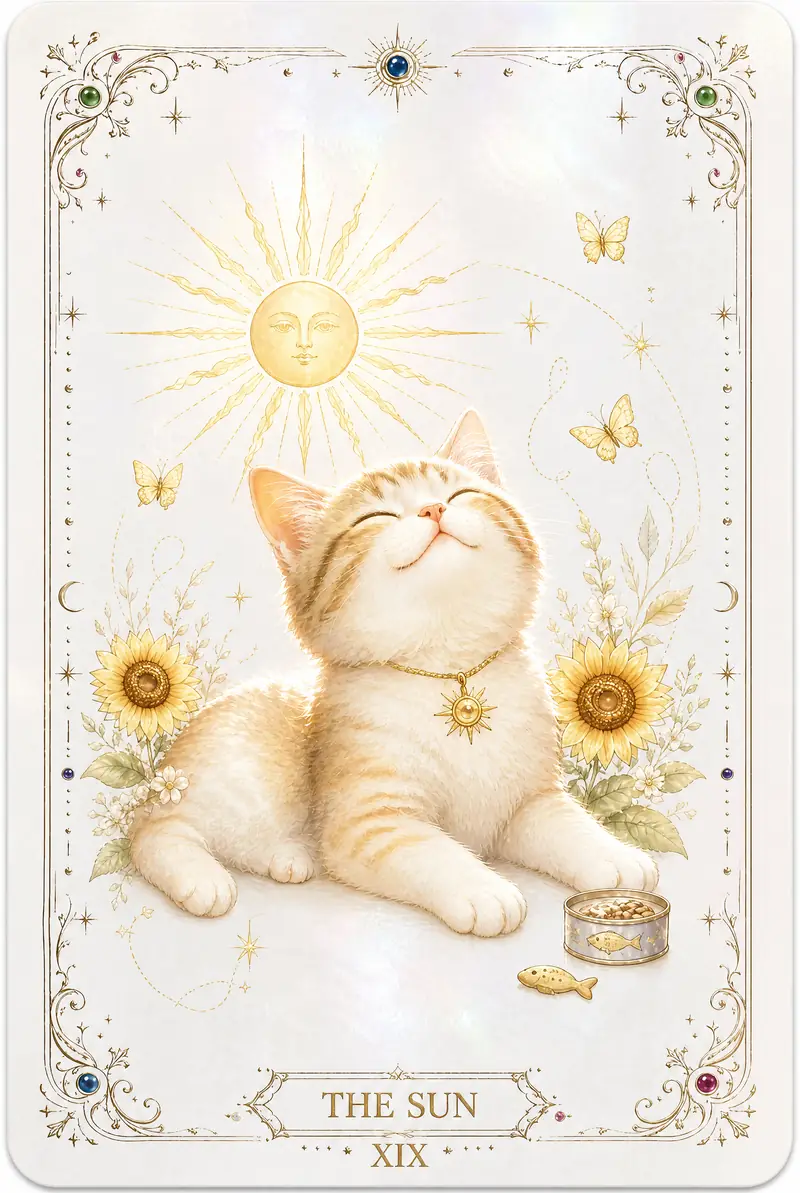
After coming out of the Moon's fog, things can finally be seen plainly; this card is about complete clarity and openness, more than simple good luck.
The image
A naked child rides a white horse, wearing a garland of flowers, with a whole wall of sunflowers behind. Overhead the sun gives off clear, distinct rays. The child's nakedness and ease correspond to the open woman of the Star, but here not a trace of defensiveness is left. Sunflowers always face the sun, symbolizing turning toward truth and light without hesitation. The horse is white, echoing the white horse in the Death card. In both cards the white points to purity and to something that cannot be stopped; here it brings joy where Death brought an ending.
Core meaning
- Complete clarity: the person lit by the sun no longer has to feel their way by guessing and intuition. They see everything directly and fully. The English word "lucid" originally meant "full of light", and this unobstructed knowing is what the Sun governs.
- The heart of a child, without childishness: the childlike joy on the card is an ease won only after passing through the earlier collapse of the Tower and the dark trials of the Star and the Moon. It is more certain than what most real children have. Innocence here is the fruit of inner work. It is different from the blankness of someone who has never been through anything.
- Light born from darkness: the Sun is the archetype of knowledge and light (like the all-knowing sun god Apollo), yet Apollo's mother Leto was a goddess of night, and his most important oracle, at Delphi, also began with a goddess of darkness. The fullness and clarity of this card grew out of the darkness and collapse of the cards before it. It is not good luck that came from nowhere.
- Imprisoned light waiting to be set free: many myths and spiritual traditions speak of the soul as light wrapped in a body (the Atman, the legend of the Buddha shining in his mother's womb). Gnostic and Kabbalistic thinkers went further, holding that after the Fall this divine light was imprisoned in every person. Releasing and integrating that light is the real work this card points to, which goes well beyond a passing good mood.
- Union in the numbers: 19 can be split into 1 and 9. The drive to act of The Magician and the wisdom in the lantern of The Hermit combine fully here, and life's energy finally merges with its meaning and purpose.
- The sun's face always has its eyes open and never closes them, in clear contrast to the Moon card's profile, with eyes half closed, looking without seeing. This constant gaze is read as care, light and warmth given without reservation, which do not change depending on whether you "behave well".
- In practical readings, the Sun card is strongly linked with pregnancy and childbirth. The naked child itself, together with the association of sunflowers producing seeds (sowing and nurturing), means that in questions about marriage and pregnancy this card is often read directly as a sign of pregnancy or of a new life on the way.
- The image of the pure, unstained child finds echoes in many cultural traditions. The Tao Te Ching compares the purest, truest state to that of a newborn infant. There is also a belief that children who die young may go straight to the highest heaven because their souls have not been stained. Both use "the child" to symbolize the state closest to the divine and least touched by the world uncertain (the exact doctrinal wording varies by tradition).
- The card a person likes best or feels most drawn to is often the self-image they identify with most deeply in the unconscious. It can be used as a mirror, to learn in turn what qualities they have.
- Success, recognition and vigorous health: things move forward smoothly, energy is plentiful, and the outside world often responds positively. Strength of body and energy is one of the card's common practical meanings.
- When the number is reduced further to a single digit (1+9=10, 1+0=1), the Sun shares the number 1 with The Magician and the Wheel of Fortune. The Magician creates actively once ready; the Wheel of Fortune actively lets go once ready and leaves things to fate. The Sun does not worry about active or passive at all. It is creation itself, being itself, and its confidence comes from "I am everything", without having picked any particular stance toward action.
- The gray wall behind the child can also be read as a deliberate choice: keeping the bright side worth attending to in view and walling off what drains energy. This is a clear-eyed choice about which side gets more attention, and it is no escape from reality. The joy on the card is the result of that choice.
- Money: in a money question, it is like being in the summer of your finances. For the querent right now, money comes quickly and goes quickly. Creative plans can provide a steady income and new opportunities are within easy reach. It is a card of being able to afford what you want to do.
- Health: it corresponds to the heart and spine. Upright, it broadly suggests a healthy body with plenty of vitality. It may also be a prompt to watch for signals such as palpitations or a heart murmur, or for the spine to need professional adjustment. Creative but noncompetitive activities, such as painting, playing an instrument, writing, yoga and gardening, are considered especially good for body and mind.
- Spirit: the spiritual path is full of creativity and wonder, and life is both radiant and abundant, so a person feels like a child of the universe. Living with a natural, unaffected, playful attitude keeps creativity flowing, and like a child one adapts easily and makes full use of every day.
Reversed
- The light is partly blocked and the achievement is discounted (image association): in the image a high wall cuts off some of the sunlight, symbolizing parts of the matter that remain imperfect or out of reach. This is no outright failure; the joy and smooth progress simply have not come through one hundred percent.
- The positions are reversed, putting the weight on who is in charge (image association): the child moves to the top, and the emphasis shifts from enjoying the ease of the moment to directing and controlling. If this urge to lead goes too far, it can turn into an eagerness to show off and a refusal to hear other views.
- Vanity and overconfidence (negative meaning, overdone): when there is a gap between ability and performance, the querent insists on keeping up appearances, which is even more embarrassing once exposed. Too much confidence also easily becomes self-centeredness and carelessness, ignoring other people's feelings and warnings.
- The light is held back for now and not fully shown (blocked): good progress is actually happening, but it has not yet been fully felt or seen by others. Nothing has gone bad at the core; what is missing is patience and a little time.
- Still feeling something is lacking in results already achieved (opposite meaning): the overall situation is not bad, but the querent feels regret or dissatisfaction. Instead of demanding that everything be perfect across the board, it is better to put effort into the specific places that really need improvement.
- [Life-area method] Reversed in a money question, it often means the querent is being driven by bigger goals. Even after reaching impressive financial success, an ongoing hunger to compete and a fear of being caught up with keep them from truly enjoying the results. One book notes that this kind of reversal is often linked to highly competitive work such as sales. Reversed in a health question, it is a reminder to give life a bit more play and a bit less competition, using creative activities with no winners or losers, such as painting, playing an instrument, writing, yoga and gardening, to ease stress and restore harmony between body and mind.
Correspondences
The Sun (the planet itself), the Hebrew letter Resh (ר). This card corresponds to a planet, not a zodiac sign, and in the Golden Dawn system it is not placed in any of the four element categories; see Astrological Correspondences and The Kabbalah and the Tree of Life for details.
Resh literally means "head", and by extension the forehead, in direct contrast to the "back of the head" that corresponds to the Moon. The forehead corresponds to the prefrontal cortex, which governs reason and self-control; people with damage there often become impulsive and irritable and find it hard to control themselves. Success and leadership are often directly tied to this rational self-control, echoing the Sun card's core of clarity and openness. On the Tree of Life, this path connects the eighth sephirah, Hod (Glory), with the ninth, Yesod (Foundation), bringing the light of reason into the dark, still-unformed waters. Read downward, as the "path of creation", it means expressing one's intellect and talent, turning them into writing and speech that light up others, which is the Sun card's unhidden light shining outward. Read upward, as the "path of return", it means suddenly grasping the wisdom and brilliance hidden behind someone else's words or writing. That moment of sudden insight is also where the experience of an idol's "halo" comes from.
The composition forms a pair of opposites with the Moon card. The Moon is drawn in profile, showing the back of the head (Qoph); the Sun is a face turned straight toward the viewer, showing the whole forehead (Resh). Back and front match the body part named by each card's letter. The orange banner in the child's hand is also read as the pictograph of Resh in ancient Hebrew (its early form looked like a small flag and is said to come from an Egyptian hieroglyph meaning "the one god"), and orange is also the color the Golden Dawn assigned to the path of Resh. In addition, the number of sunflowers in the child's hair is seven in the standard Universal Waite, symbolizing the seven planets, but six in the original Rider-Waite, corresponding to the sixth sephirah, Tiphareth (in the court card system, six corresponds to the Son). The two editions differ in this detail, which is worth noticing when buying a deck.
Views from different traditions
The Waite deck shows a single child on a white horse. The Marseille tradition and earlier designs usually show two children standing under the sun, and Crowley's Thoth deck also keeps a symmetrical two-figure composition. An advanced Golden Dawn reading holds that the change was deliberate. Waite had already reduced the original three figures of The Lovers to two to mark Gemini, and if the Sun card kept its traditional two children it could easily be misread as another Gemini card. So Waite cut the number of figures on the Sun to one, to set it apart from the "two people" of the Lovers. The change may also have drawn on the old Germanic runes: in the rune sequence, the nineteenth rune, Ehwaz, symbolizes the link between the horse and the sun (a horse drawing the sun's chariot across the sky), and the Sun is also card nineteen in the tarot. Waite very likely borrowed this coincidence and drew the image of horse and sun back into the card. The change does bring a different leaning in interpretation: a two-figure composition more readily suggests harmony in a relationship, two people sharing the sunlight together, while a single figure stresses the ease and independence of the individual inferred. Daniel adds a point from the reversed composition: reversed, the child moves above the horse and the sun, and the reading shifts from enjoying the ease of the moment toward directing and dominating. This is the compositional basis for negative readings such as overconfidence and refusing to listen. Rachel Pollack adds that the two children in the Thoth deck are named "the eternal self" and "the mortal body", and stand hand in hand under the sun. Look closely and you will see that the female figure in particular actually has an adult body: this childlike innocence was won by passing through the earlier The Tower, and it differs from the naive ignorance of someone who has never lived through anything.