The Hermit
Number IX · Element Earth · Correspondence Virgo
Upright: introspection, solitude, wisdom that has settled in, guidance, slowing down
Reversed: isolation without support, shutting yourself off, avoiding connection, relying on others for guidance, loneliness
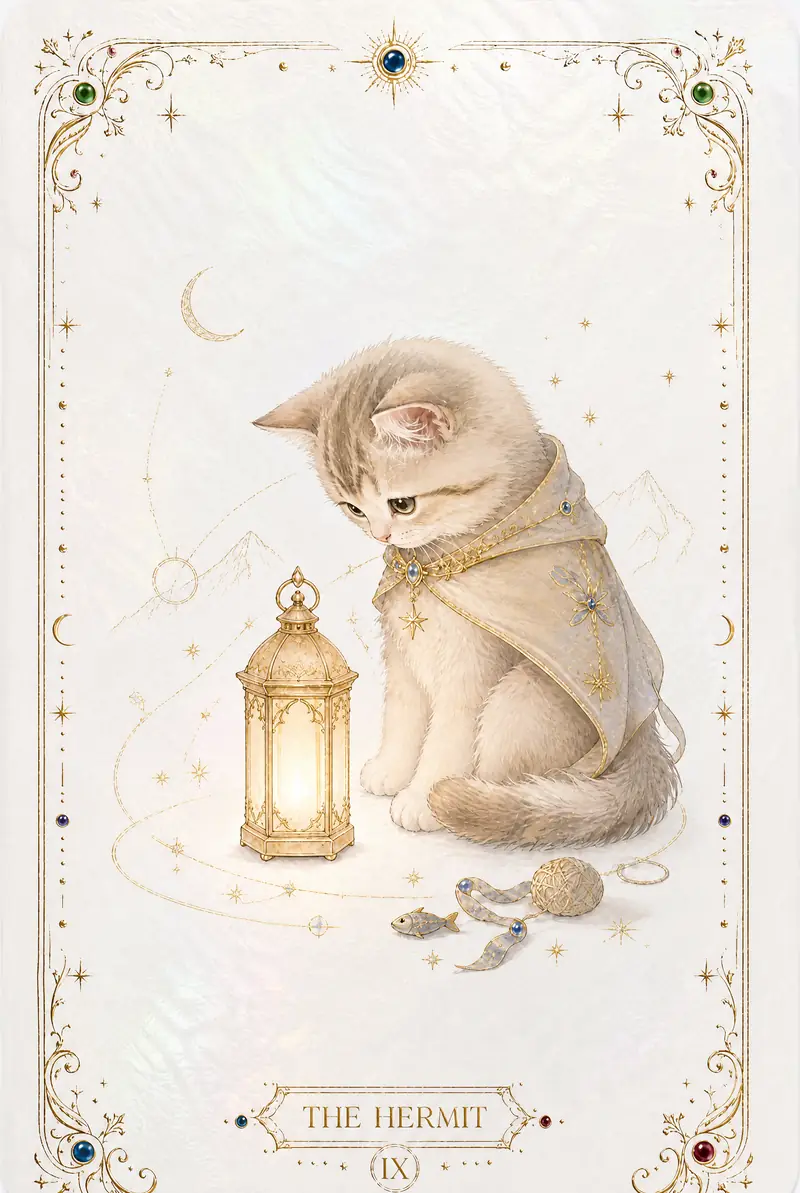
Withdrawing from the crowd in order to see more clearly, without turning away from the world.
The image
An old man stands alone on a snowy peak or wild summit, wrapped in a gray cloak, one hand holding up a lantern and the other leaning on a staff. The lantern usually holds a six-pointed star, widely read as a star of wisdom. He does not look out at the view; his gaze is usually lowered or half-closed, a posture of looking inward rather than outward. The colors are cool and dark overall, in contrast with the outgoing warmth of Strength before it, and they mark the turn from "facing others and instinct" to "facing oneself".
The gray cloak shows only his hands and one foot. Covering his whole body symbolizes that he does not reveal his wisdom easily. Showing only one foot, and standing still rather than walking, also suggests that this wisdom has settled in through inner seeking and was not won by running around in the world. The six-pointed star in the lantern is made of two overlapping triangles, symbolizing the union and balance of yin and yang, the paired opposites. The six-pointed star also stands for light and fire turning into each other, echoing the idea that energy and drive can be converted from one into the other.
Core meaning
- Chosen solitude: the withdrawal on this card is a choice. He is not being forced into isolation; he is turning off outside voices for a while in order to think something through.
- Light pointing two ways: inward, waking the parts of the unconscious that usually stay silent; and outward, being willing to lend a little light when others need it. Exploring yourself and guiding others are two sides of the same ability.
- Withdrawal does not have to mean moving to the mountains: what really matters is shifting attention away from outward worldly activity like "getting and spending" and back toward what you truly need inside. Emotional withdrawal matters more than living alone somewhere remote.
- Leaning on purpose instead of swinging by instinct: the staff in the Hermit's hand echoes the stick The Fool swings about by instinct. Here it has become a support built through deliberate practice, one he can lean on at any time, symbolizing inner awareness opened by a specific method rather than by passing impulse.
- Settling after a stage is complete: coming right after Strength, instinct has been settled, and this step gathers in the experience of the outer world and turns it into inner understanding.
- In a spread, it often suggests this is a good time to slow down, socialize less, and bring your energy back to yourself to sort things out and reflect, instead of rushing to act in the world.
- Virgo-style fussiness and solitude: in light of the perfectionism and attention to detail of its sign, Virgo, the Hermit's solitude is more than a chosen retreat. It also carries a temperament that "spots the logical flaw in everything and cannot be bothered to settle". The sharper the analysis and the higher the standards, the harder it is to find people to talk with as equals, and in the end he chooses to step away.
- How he differs from the High Priestess: both are Major cards of "inward exploration". The High Priestess, though, never had worldly attachments to begin with; she is always self-contained and detached, equally cool and calm in a crowd or alone. The Hermit understands the world but steps away because he cannot agree with it or cannot stand it. This is one view and not the only one.
- A Bible story supports the link between "the old man" and God: Moses is said to have asked to see God's face, but no mortal could look upon it directly, so God let Moses see only his back, which looked like an old man. Among God's many titles is also "the Ancient of Days", so people find it hard to imagine the supreme Creator as young and more readily picture a white-haired, wise old man. This is one reason the Hermit is often thought to hint at God himself.
- Money tends to be tight, upright or reversed: Hermit-like people often make "living simply and poor" part of their identity, feeling that those who pursue scholarship or the spirit should not soil their hands with money. This attitude of "poverty as a virtue" is not rare in esoteric circles either inferred.
- Career: unless the work is technical or creative with a high bar and little need to deal with people (such as writing code, or literature and art), this person often struggles to move up in roles that require building connections. The exception is finding a partner willing to handle the social side for them, the way Marx had Engels inferred. In study they are often the classic top student who studies hard in silence and quietly gets the highest grades. The irony is that after school they may end up working for classmates whose grades were average but who were better at socializing or came from wealthier families.
- The function assigned to Yod is "touch". Truth needs no words to describe it; it can be felt directly through contact. This echoes the Hermit's emphasis that there are no shortcuts in spiritual practice and that understanding can only come from within.
- Money, health and spirit: with money, the upright Hermit means looking back over past financial decisions and spending habits, and through reflection finding the negative patterns that keep repeating. Only then can money really be steered in a more worthwhile direction. With health it stresses that reflection, calm and meditation are good for the body in themselves. People who spend all day working, earning and spending are often the very ones who most need to stop and ask themselves "am I happy?" and "is this the road I really want?"
- On the spiritual level, the Hermit means looking back at the courage and commitment that brought you to where you are today, and drawing out lessons to carry into the next stretch of the road. Meditation, journaling and seeing a counselor are all concrete ways of deep reflection, with the aim of understanding your own actions and motives and not repeating old mistakes.
Reversed
- Picture association: the lantern moves from held high to hanging low. The focus shifts from "lighting the way for others" to "the seeker finding his own way". The light is hidden and does not want to be found, which easily brings a sense of disguise or avoidance, and the person becomes more cautious and more timid.
- Picture association: the Hermit's gaze and body turn inward and downward. This suggests that the matter can only be faced and worked through alone, with no help to be expected from outside. If you read in the image of the Hermit falling from the peak, it can also suggest that the advantages built up so far are starting to decline, and more care is needed.
- Overdonestanding still at the summit turns him into a stubborn old curmudgeon. Instead of passing on the experience he has built up, he becomes isolated from other people because he is too critical and refuses anything new.
- Blockedtoo much caution makes a person timid. Even when a rare opportunity is right there, they do not dare reach for it and stay stuck in daydreams. On the other hand, acting rashly without enough preparation will also run into walls.
- Opposite meaning: sometimes it means you have not yet reached the answer you are looking for, and giving up halfway now would waste all the work done so far. It can also mean the querent cannot actually bear real solitude, feels lonely even in a crowd, and avoids difficulties instead of looking into them and solving them.
- Opposite meaning: one's own experience and judgment are not yet enough to guide others. This is not the time to rush to give advice, and also not the time to trust other people's untested claims, or you may be led off course.
- One book's take on the reversal stresses "using busyness to avoid reflection". The reversed Hermit often suggests the querent is so busy with immediate commitments and tasks that there is no time to stop and think clearly about direction. They may even prefer to ignore the warning signs the body sends rather than look into the real causes of a health problem. Ignoring these deeper needs for a long time can lead to a low mood that one day appears out of nowhere, with no clear cause.
Correspondences
Number 9, the element of Earth and the sign of Virgo; for details see Astrological Correspondences. Its path on the Tree of Life corresponds to the Hebrew letter Yod (י); see The Kabbalah and the Tree of Life.
Yod literally means "hand", especially open hands waiting to receive grace. The shapes of the other 21 Hebrew letters are said to grow out of the single point of Yod, so it is also seen as the first and simplest archetype of creation. On the Tree of Life, Yod connects Chesed (Mercy) and Tiphareth (Beauty): finding truth with a compassionate heart, then bringing that light back to share with everyone. This echoes the Hermit's core meaning of holding up a lamp that searches inward and is also willing to light the way for others.
Views from different traditions
Daniel works backward from the change in the reversed image, where "the lantern moves from high to low and the role of seeker is enlarged". In Waite's upright image, the lantern held above the head is first of all a light shown outward, playing the role of guide; only secondarily does it light the path at his own feet.
- Pollack points out that the link "the sage is a wise old man" is itself a cultural filter, a mark left by five thousand years of patriarchal tradition. In earlier times the guide often appeared as a woman, a messenger of the "supreme goddess". This shows that the core of the Hermit archetype is a "teacher" tendency in the psyche, and its specific appearance changes with culture and experience; there is no single fixed form.
- Advanced Golden Dawn reading: the Hermit's lantern with its six-pointed star is read as a double numerical hint at Virgo (the sixth sign of the zodiac) and at Tiphareth (Beauty), the sixth sephirah of the Tree of Life, whose color is yellow; the star lantern is painted yellow too. The outline of the Hermit's hood and cloak is also read as the shape of the letter Yod, though this visual argument is drawn rather subtly in the Waite deck and is not especially obvious.
- Yod is also the first letter of the term "Ancient of Days" (often pictured as a bearded old man). Waite himself clearly described the Hermit's archetype as "a union of the Ancient of Days and the Light of the World". This fits the intuitive link between the Hermit and the image of a wise old man and Creator.
- The Hermit's solitary standing posture, the upright staff in his hand, the folds of his robe and the outline of the peaks behind him all carry associations with the male sexual organ. This echoes Yod's link with Fire and its standing as the "absolutely masculine" letter (this layer of symbolism is more obvious in Crowley's Thoth tarot).
- The Hermit corresponds to the path on the Tree of Life connecting the fourth and sixth sephiroth. The six-pointed star in his hand (corresponding to the sixth sephirah) and the "Pillar of Mercy" he stands on (the masculine pillar, corresponding to the fourth sephirah) together point to the two ends of this path, echoing the composition's logic of "a compassionate sage walking toward the wisdom of starlight".