The Fool
Number 0 · Correspondence Air (element)
Upright: new beginnings, adventure, innocence, freedom, trusting intuition
Reversed: recklessness, indecision, losing touch with reality, avoiding responsibility
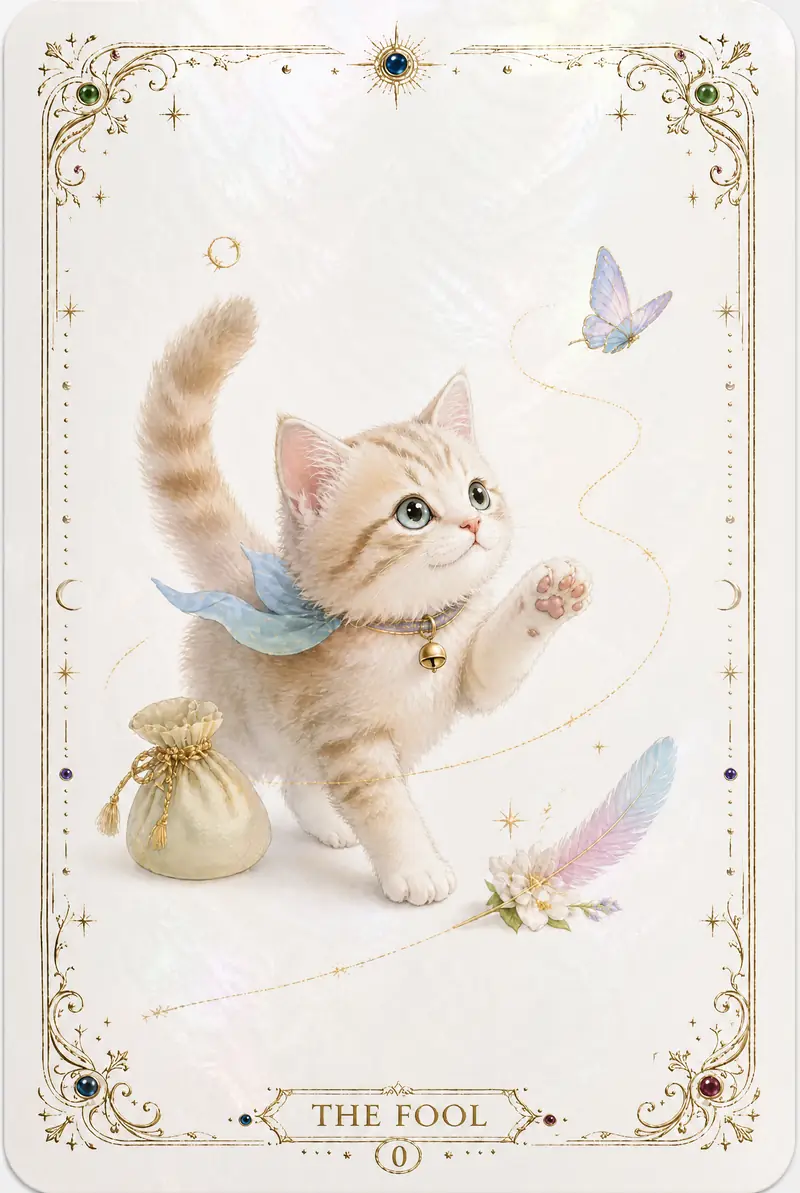
A leap taken without asking how it will turn out. This is where the Fool's Journey begins.
The image
A young traveler stands at the edge of a cliff with one foot already stepping out, his gaze on the sky rather than the drop below. A small bundle hangs from the end of his staff, a symbol of possibilities that have not yet unfolded and are not yet crammed with past experience. At his feet a small white dog leaps or barks, like a warning from instinct, but it does not stop him. A white rose is pinned to his chest, standing for pure love unmixed with desire.
His tunic is pieced together from white, red and black, which correspond to the three basic substances of alchemy: mercury, sulfur and salt. All metals were thought to be made of these three in different proportions, and a base metal, once purified and recombined, could become gold. The process was also used as a metaphor for the soul moving from imperfection to perfection. Inside ten circles on the tunic is an eight-spoked symbol, which the Golden Dawn system treats as a sign of "spirit". There are also patterns of green plants and fruit (material abundance), a wreath on his head (a closed ring, meaning a supply that never runs out), and a belt made of seven links (in numerology, 7 corresponds to the seven classical planets, the seven metals and cosmic wisdom). A red feather on his head trails back toward the sun. Red stands for passion and the feather belongs to Air, the element of thought; together they suggest that the Fool has creative thinking he is ready to act on.
Core meaning
- A fresh start: setting out from where you are now, not knowing what lies ahead, and still willing to take the step. The bundle on his shoulder actually holds the experience he has gathered along the way. His past has not been wiped clean. It simply no longer dictates his choices.
- Innocence is not ignorance: true innocence is a fearless state of complete openness to life, and it includes expressing feelings and desires naturally and without shame. It does not mean being uninformed, repressed or "sexless". This point is often misunderstood.
- Accepting the instinctual self: the dog (or cat) that travels with him represents animal instinct that has been acknowledged and treated kindly. Followed, it stays gentle and friendly; denied and suppressed, it turns fierce. This is the deeper psychological root of the card's "trust your intuition" meaning.
- Spontaneity and freedom: not bound by plans, duties or consequences, acting on the impulse of the moment.
- Potential rather than results: the number 0 symbolizes the original, undivided state that contains every possibility. It describes the moment before possibility unfolds and does not point to any specific achievement.
- The ever-present traveler between stages: the Fool is more than the start of the Major sequence. Like a wild card, it runs through the whole deck and shows up at every hard turning point, helping a person leap across the gap between one stage and the next.
- Uranus in modern astrology: Uranus symbolizes innovation, rebellion, breaking convention and unpredictability. Compared with simply assigning the card to Air, this modern astrological approach puts more emphasis on the side of the Fool that ignores established rules and is full of change.
- Three levels of freedom: reckless indulgence with no thought for consequences is the lowest level of freedom. Following your heart without harming others is a further, inner freedom. Going beyond all gain and loss and all attachment, to the point where even family ties no longer bind you, is the near-godlike freedom the Fool truly points to. In a reading, respond to the level the querent is actually at instead of treating them all the same.
- What it means in practice: in a money question the Fool often points to a high-risk, high-reward opportunity with an uncertain outcome, and other cards are needed to judge which way it goes. In a love question it is closer to a youthful attitude that does not dwell on the past, makes no promises about the future and only wants to enjoy the present; often neither person has yet learned to really consider the other.
- In the Kabbalah, Aleph is one of the three "mother letters" and has no specific function of its own. This fits the Fool, which pursues no particular goal and exists purely as a driving force.
- Money and health: with money, the upright Fool usually means jumping into a new field right away on the strength of faith and inspiration. That could be starting a new business or investing rashly without experience; how it lands depends on whether the querent is willing to go all in on a gamble they are not sure of. With health it is usually a positive sign of abundant energy and balance between body and mind. Even if life feels busy right now, there is no need to worry too much.
- On the spiritual level, the Fool stands for believing that you can see where the opportunities are, and that some unseen force will support you. That trust is the most important preparation before setting out on a new path, more important even than a concrete plan.
- The white rose is a major emblem of the Rosicrucians, standing for the secrets of the universe and spiritual awakening. So the white rose the Fool carries means more than pure love. It also points to spiritual purity that the everyday world has not yet touched.
- The Fool's deeper archetype is close to a newborn baby: no sense of gender or separateness, one with the divine, neither knowing nor needing the rules and morals of the world. This is where the old idea that great wisdom can look like foolishness comes from: he seems foolish only because ordinary people cannot understand where he stands. A common comparison is Shiva, called the "Lord of Innocence" in Hinduism, who ignores worldly manners and behaves strangely but, being beyond the world, does not have to follow its rules uncertain.
- The small red bundle: red corresponds to Fire and stands for plenty of drive. The bundle is small because he does not pack for the past or hoard for the future, so he can settle anywhere and adapt to whatever comes. In personality terms he is close to the P (Perceiving) preference in MBTI.
- Mountains on tarot cards generally symbolize noble character and wisdom. Everything else is pulled down by gravity, but a mountain rises against it, much like a person who keeps growing upward despite pressure from outside. The higher the snowy peaks behind the Fool, the deeper the wisdom and the higher the character hidden beneath his apparent foolishness. This correspondence also applies to other cards that show tall mountains inferred. Besides the danger of "one more step and you fall", the cliff itself can be read as exploration. There was no path here until the Fool's steps made one, just as a baby has to fall and bump into the corner of a table before learning that it is dangerous; knowledge can only grow bit by bit through exploring. The layered rock faces of the cliff also suggest that danger and understanding both reveal themselves gradually rather than all at once.
- Animals in tarot generally represent instinct rather than wisdom: like people, animals have feelings, but they lack human reason. This rule also applies to other cards with animals (lions, wolves and so on) inferred.
- A practical tip: you can use the sun's position on the card to estimate time roughly. The sun sits on the left (east) and has not yet reached its highest point, which corresponds to about nine in the morning. When a reading needs a judgment about timing, details of direction and height like this can provide supporting clues.
- Study: the upright Fool tends to be lopsided as a student, putting effort only into subjects that interest them and doing well in those, without the patience to grind through material they dislike, though bright overall. Reversed, the mind is scattered, misses the key points and is easily distracted by irrelevant details or outside interruptions.
Reversed
- Blockedwanting to begin but being held back by fear or circumstances. The step stays suspended in midair and the drive to act is held down.
- Overdoneimpulse goes too far and becomes recklessness with no thought for consequences, turning "trust the process" into ignoring risk altogether.
- Turned inwardthe innocence and sense of freedom turn into daydreams. They are no longer put into action and remain adventures of the imagination.
- Overdoneleaving the consequences of your choices entirely to luck or to other people, and skipping the preparation that reality actually requires.
- Blockedunable to take that step for a long time, trapped by "what if" thoughts, with hesitation outweighing action.
- In practicewith money it is no longer "risk and opportunity together" but closer to pure risk, even gambling or operating in gray areas, with losses far more likely than gains. At work it can become the talented employee who refuses to be managed, acts arrogantly and does not show up on time, and is eventually let go (compare the upright card, where the boss is willing to put up with an eccentric genius's temper). In love it shows as a carefree looseness that ignores the other person's feelings: arriving late to dates and thinking only of oneself. It still brings novelty and the fun of adventure, but it is tiring and hard to rely on. Creativity can also be misdirected into an obsession with inventing gadgets that serve no real purpose.
uncertain Chapters 4–6 of Daniel's Chinese-language book on reversals systematically cover the reversed meanings of the other 21 Major cards but leave out the Fool; the book never mentions the Fool at all. The book does not say why. It may be because the Fool is traditionally numbered 0 and often seen as standing outside the formal sequence, or because some schools simply do not distinguish upright and reversed for the Fool (it represents pure, undivided potential, so whether it is reversed makes little difference to its meaning).
Another, practice-oriented book does give a specific reading of the reversed Fool: losing touch with intuition, wanting to ask everyone's opinion about everything, and ending up more confused by the flood of advice. It can also mean wanting to escape duties and obligations in search of freedom while the things already started still need to be wrapped up, so it is not yet the time to walk away. With money, impulsive, unplanned action tends to lead to losses. With health, it may mean knowing your lifestyle is a problem and carrying on anyway, until complications set in over time.
Correspondences
Astrologically the card corresponds to the element of Air in its pure form (not to any of the twelve signs), and its Hebrew letter is Aleph א. For the full set of correspondences, see Astrological Correspondences and The Kabbalah and the Tree of Life.
Aleph literally means "ox", a symbol of the raw creative force and vitality that breaks new ground. The letter itself makes no sound; it is the only silent letter among the 22 Hebrew letters, so it is also used to symbolize the undivided void and breath at the beginning of creation. On the Tree of Life, Aleph is the 11th path, connecting Kether (the Crown, the first creative impulse) and Chokmah (Wisdom, the force that expands outward without a goal). The Fool stands on exactly this path: he has the original drive but no specific direction, and simply ventures outward and leaps. This matches the card's meaning of spontaneous freedom without concern for outcomes.
Views from different traditions
In the Marseille tradition the Fool (Le Mat) carries no number, and historically there was no agreement on where it belongs in the deck. Some versions put it at the beginning, some between cards XX and XXI, and some at the very end uncertain. The Waite system fixed it as number 0 at the start of the sequence, making it the hero and starting point of the Fool's Journey described in The Major Arcana. This was Waite's clear decision about the shape of the whole narrative inferred.
From the standpoint of myth and archetype, Rachel Pollack points out that the Fool corresponds to the "holy fool" or jester figure who appears again and again across cultures: Merlin in the Arthurian legends, part teacher and part prankster; the Fool in King Lear, who is allowed to speak the truth; the "Lord of Misrule" who presided over European carnivals; and, in modern popular culture, the Joker facing off against Batman. Each of these figures stands outside convention and beyond the control of institutions, and from there shows up the blind spots of the conventional world.
Advanced Golden Dawn reading: Waite hid a further set of detailed visual arguments in the Fool's image to reinforce its link with the Hebrew letter Aleph.
- A gematria coincidence: the full Hebrew spelling of Aleph and the words for "sun, moon and stars" add up to the same numerical value, 831. On that basis Waite placed the sun behind the Fool and tucked the moon and stars near his left shoulder, using the heavenly bodies to reinforce the image's link with Aleph rather than as mere decoration.
- The outline of the dog at his feet is read as the parts of the letter Aleph put together, and the Fool's open hand gesture hints at the second letter, Beth. Together they make "Aleph-Beth", the root of the English word alphabet, echoing the Fool's place as the "beginning" of all things.
- The ten circles on his shirt correspond to the ten sephiroth of the Tree of Life, suggesting that the Fool's consciousness stands above the sephiroth and exists before them. His hat, hair and feather all blow in the wind, and together with the bright yellow background they keep stressing that Aleph corresponds to Air.
- The fourteen rays of the sun behind the Fool are read as a numerical hint at the Fool's true path (the 11th path, connecting the sephiroth Kether and Chokmah). The sun itself is painted white, echoing the traditional color of Kether.
- The Fool walks from right to left, matching the direction Hebrew is written. This is more than a choice of pose: it is also read as Waite using the first card to set a "right to left" esoteric reading direction for the whole deck.
- The yellow stripes at the lower left of the Fool's clothes take the shape of the letter Shin. They echo the claim by 19th-century French occultists that the Fool corresponds to Shin (see How Tarot Became Occult), but they are more likely a decoy for outsiders: Waite's real design still points to Aleph.