King of Wands
Number K · Element Fire · Correspondence —
Upright: leadership, vision, decisiveness, building an enterprise
Reversed: high-handedness, rashness, lack of authority
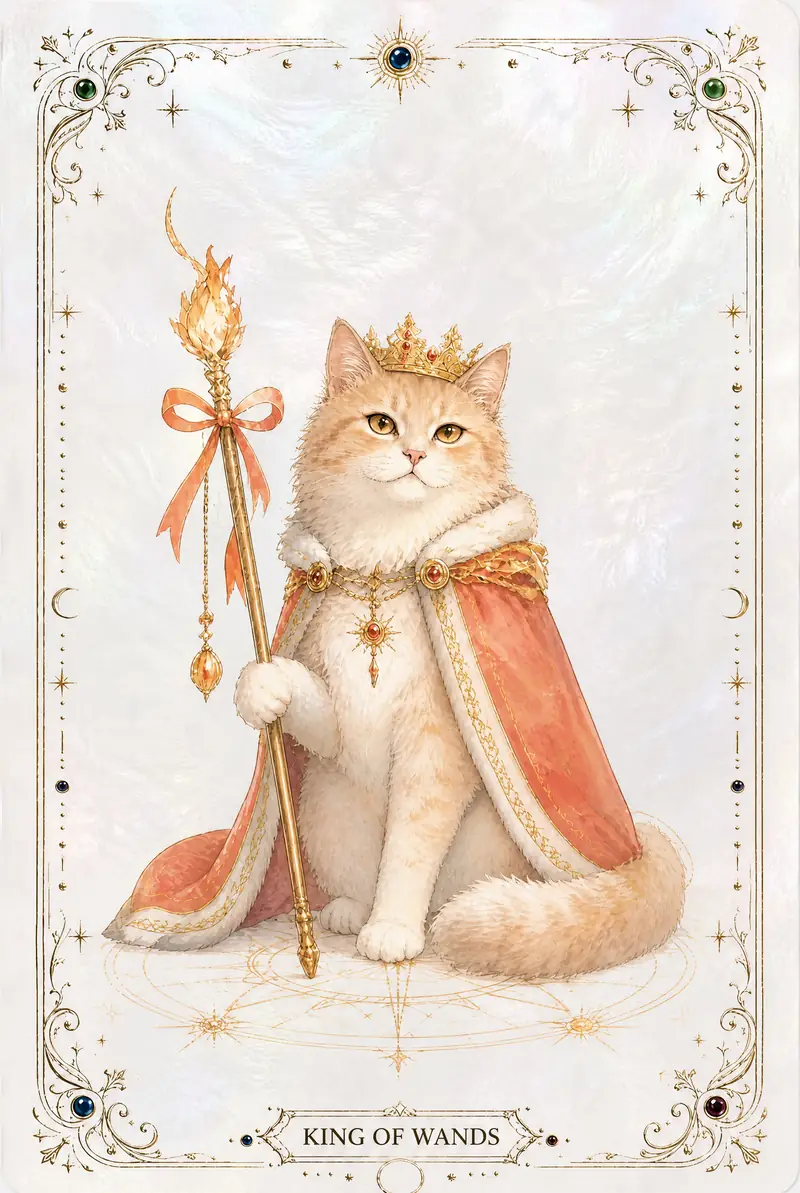
His throne is carved with lions and salamanders, and the man sitting on it has nothing left to prove.
The image
The King sits upright on a throne decorated with lions and salamanders, holding a wand and looking steadily into the distance. His cloak carries a flame-like pattern (Rider-Waite-Smith).
Core meaning
- The King's Fire stacks fully on the Fire of Wands. This is one of the few court cards where the same element appears twice (see the "same element" rule in Elemental Dignities). The energy is extremely outgoing and direct, with almost no disguise or indirection.
- His power does not come from scheming or persuasion. It comes from an unshakable belief that he is right. He is sure he has grasped the truth and that his way is the best one, and he takes it for granted that others will follow him.
- Wands have an adventurous, risk-taking nature. Confined to the King's position, which demands long-term social responsibility, he is quietly ill at ease. He often sits leaning slightly forward on the throne, as if ready to leap up at any moment and go after new experiences. This restlessness in his bones is what sets this card apart from the Kings of the other suits.
- The fire burning inside him is so intense that it makes him honest and optimistic by nature, but it also makes it hard for him to understand other people's weakness, hesitation or despair. Without noticing, he easily falls into the unforgiving logic of "I can do it, so you should be able to as well."
- The salamanders on the King's robe bite their own tails, closing into circles. This can be read as the creative fire having been truly tamed and grown into maturity and wholeness. Compare the salamanders on the robe of the Knight of Wands, whose mouths and tails do not meet: one detail that shows the Knight is not yet ripe and the King already mature.
- Where the Queen of Wands draws people together through personal charm, the King relies more on a clear vision and structured decisions. He gathers the Page's curiosity, the Knight's drive and the Queen's confidence into a leadership that can direct the whole.
- Money: upright, the card stands for success through self-discipline, the ability to channel all that enthusiasm toward practical, achievable goals. This discipline is exactly what distinguishes the King of Wands from the Knight. He has plenty of drive and knows where to spend it.
- Health and career: reversed, the card is often read as "a poor dealer." Wanting to see results right away, he easily overlooks the long-term consequences of what he does, and he often takes on too many projects at once, runs out of steam and has to give up. This pattern of repeating the same mistakes often only stops when an outside force steps in (being pushed out of a job, for example, or a relationship ending), so it is worth taking as an early prompt for self-reflection.
Reversed
- Blocked: the King's posture now dominates the emblems of authority behind him. He thinks very highly of himself and easily looks down on people less capable than he is. The crown falling symbolizes lost authority; he may already have left his old position and need to adjust to a new situation.
- Overdone: his gaze turns toward a stronger fixation on security and stability. He clings to existing ideas and will not hear any objection, and the pursuit of stability hardens into stubbornness.
- Trapped by preconceptions, he cannot see the truth of the matter and needs to set his own bias aside before he can judge correctly. It may also be that the situation is changing too much right now; steady progress is better than haste.
- Turned inward: the present situation is so settled that it becomes boring. Even when he has ideas for change or innovation, his surroundings make it hard to carry them out.
- A time to draw on the experience of those who came before and ask experienced people for help, instead of insisting on inventing everything himself. It can also show as being too focused on others, losing his own position and becoming indecisive. In that case it is better to hold steady and not act rashly.
- Another root of the reversal lies in how he learns. The Wands type is used to learning through direct experience and rarely learns by watching and borrowing from others. This means mistakes are easily repeated exactly as before, and the more they are repeated, the more he loses patience with himself and his surroundings, creating a vicious circle.
Correspondences
Rank element: Fire (King) + suit element: Fire (Wands), the same element doubled; see Elemental Dignities and The Court Cards. Court cards are not assigned to the decans.
Views from different traditions
The Thoth system calls this rank the Knight, the oldest and most authoritative of the four ranks. For how the systems correspond, see "Views Across Traditions" on the Page of Wands page disputed. Take care not to confuse it with the Rider-Waite-Smith Knight, which is the second rank. Rachel Pollack also compares the King of Wands with The Fool. Both are full of energy and alive like a blazing flame, but the King embodies responsibility, while the Fool embodies pure instinct and freedom. They are like the same flame before and after it puts on the crown of responsibility.