Page of Wands
Number P · Element Fire · Correspondence —
Upright: curious experimenting, new messages, a learner's mindset, budding enthusiasm
Reversed: short-lived enthusiasm, indecision, rash impulsiveness
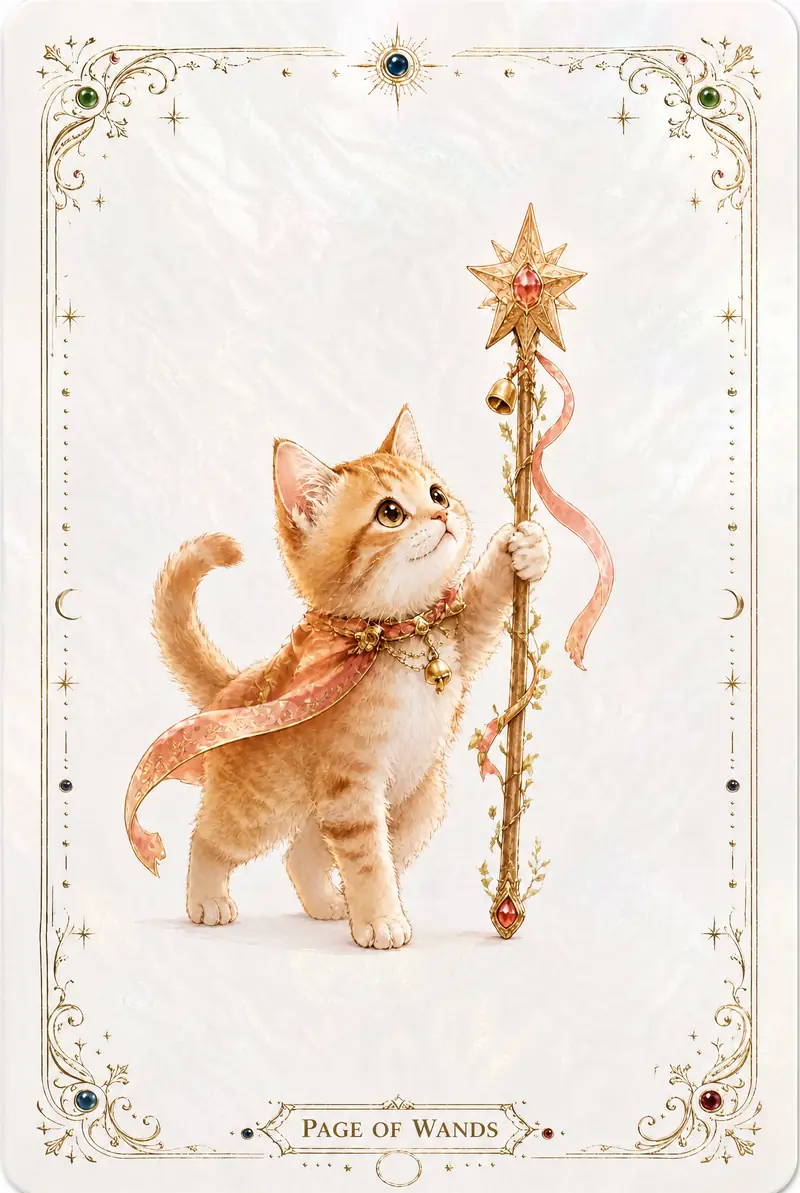
Holding a wand that has just sprouted, studying it with curiosity, not yet sure what to do next.
The image
A young person stands in open, desert-like country, holding a wand with new shoots at its tip and looking down at it closely. The tunic is decorated with lizards or salamanders, and pyramids stand in the distance (Rider-Waite-Smith).
Core meaning
- The Page's Earth sits on top of the Fire of Wands, a combination that tries out a passion in a hands-on, grounded way: willing to touch it and test it, instead of only imagining it. Of the four Wands court cards, this one is the rawest and carries the least baggage of experience.
- Pages represent each suit's qualities in their simplest state, enjoying the self in a lighter, more youthful way than the mature Queen of Wands. For an adult, this means a moment free of outside pressure, experiencing life purely for the sake of experiencing it.
- Because Wands symbolize beginnings, the Page of Wands points especially to the start of a plan. It announces to the world and to oneself, "I am ready to begin a project" (not only a practical plan; it can also be a relationship or a new stage of life). On a simpler level, it can also mean a messenger, news, or the passing on of information.
- The salamanders on the tunic are mostly drawn biting their own tails, but this differs from the meaning of "the plan is complete" in the King of Wands. In the Page, this closed circle is more like the simple wholeness of the self: a sense of completeness about who I am, not yet tied to any concrete result.
- Represents a young person with little experience but plenty of desire to explore, or the part of the querent that is willing to take a chance and try. What matters is a young outlook, whatever the actual age.
- Compared with the Knight, Queen and King that follow, the Page has not yet formed a steady sense of direction. Enthusiasm often outweighs planning. This is the immature but valuable state unique to this stage.
- Health: people of this type like outdoor activities and physical challenges, which also makes them more prone to minor injuries from sports and accidents. The typical scene is spraining something during a game and limping home in a cast.
- Career: when taking on a new project, what this person values is the freshness of the process itself. Competition does not make them back off; it sharpens their focus on the goal. But when they meet resistance, they can easily spend their energy on discussion without really moving forward, so the project stays stuck at the starting stage.
Reversed
- Blocked: the terrain, normally in the background, takes over and dominates the figure, suggesting that outside difficulties have grown beyond what can be handled right now. Nothing is settled yet, and things are left hanging in an unstable state.
- Turned inward: the gaze only looks down, and inner worries and unease are not turned into action. The hat and cloak falling off suggest acting without thinking first, or, the other way round, being trapped by too many thoughts and unable to decide.
- Overdone: what was good news may turn into bad news. Lack of experience means even simple things can go wrong easily, and forcing it out of bravado only leads to worse damage.
- Too naive, and liable to walk into a trap without knowing it. Handles things emotionally and loses their temper at the slightest setback, so the personality comes across as changeable.
- Blocked: not a good time to act rashly. However much effort goes in, the results may be limited, and the news itself may be nothing but rumor, not yet reliable enough to believe. It can also show as no action at all, in which case there is naturally no result.
- Reversed, besides restlessness and rash, awkward behavior, the card also often shows as hesitating to really start a new project. Enthusiasm is there, but the person is upset and distracted by the small matters in front of them, or simply afraid to begin, so they keep hesitating before acting.
Correspondences
Rank element: Earth (Page) + suit element: Fire (Wands). For how the combination works, see The Court Cards. Court cards are not assigned to the decans.
Views from different traditions
The Thoth system does not use the name "Page." It calls this rank the Princess, and the four ranks become Knight (corresponding to the Rider-Waite-Smith King), Queen, Prince (corresponding to the Rider-Waite-Smith Knight) and Princess (corresponding to the Rider-Waite-Smith Page). This is where the traditions differ most among the court cards [disputed: the two systems name and order the four ranks differently; the text on this site uses the Rider-Waite-Smith Page, Knight, Queen, King].