Knight of Wands
Number Kn · Element Fire · Correspondence —
Upright: drive, decisive action, a fierce start, directness
Reversed: recklessness that spoils things, fickleness, stalled action
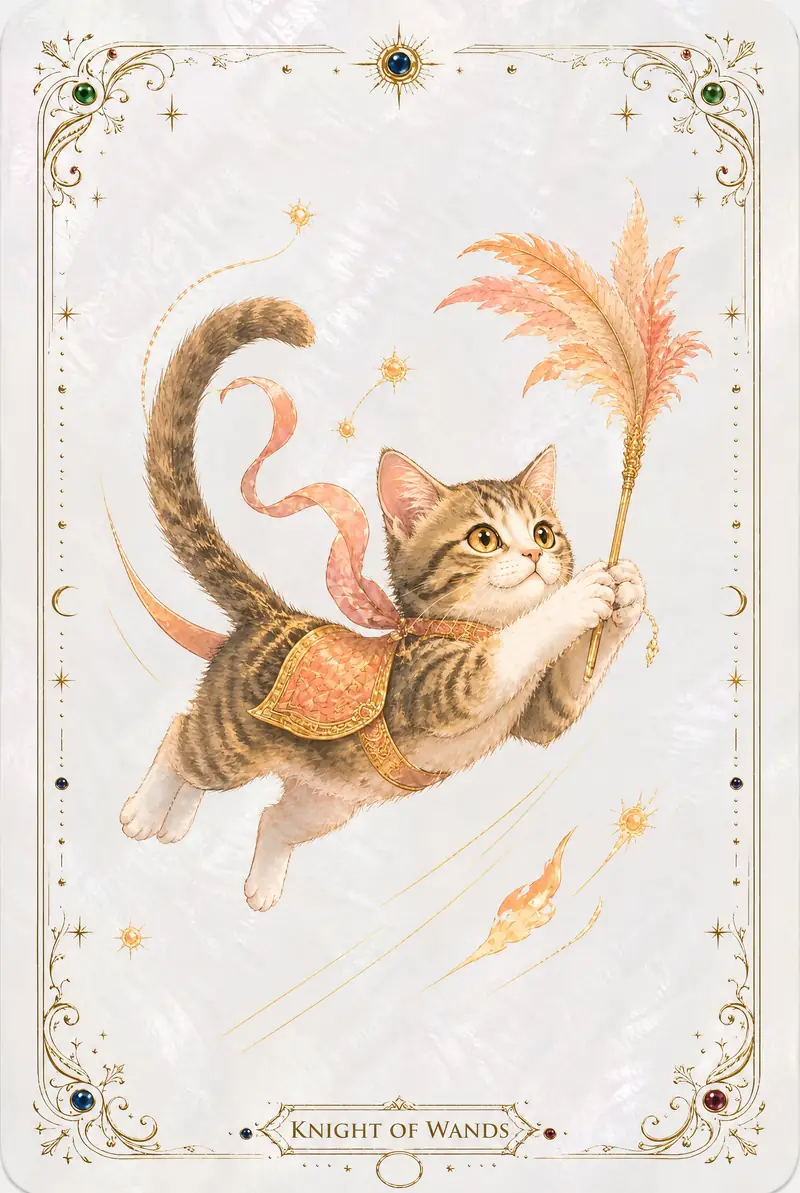
Riding a horse that rears on its hind legs, charging off in one direction without looking back.
The image
The knight, in full armor, charges forward on a horse that rears up on its hind legs, ready to spring. His cloak is decorated with salamanders and his helmet carries a plume. The background is desert and pyramids (Rider-Waite-Smith).
Core meaning
- The Knight's Air combines well with the Fire of Wands. Air makes fire burn hotter (see Elemental Dignities). With two outgoing, active energies stacked together, this is the most forceful of the four Wands court cards and the hardest to talk out of anything.
- Knights translate the suit's qualities onto the level of action. The King and Queen express the energy through achievement and through perception, while the Knight stands at an earlier, less mature stage. He puts the element to all kinds of practical use, but always lacks the certainty and steadiness of the King and Queen.
- Fire itself symbolizes action, and the Knight of Wands, Fire on Fire, pushes that quality to its limit. He stands for eagerness, vitality and adventure, action purely for the sake of action. Without a grounding influence, this excitement can easily burn out as he tries to charge in every direction at once.
- Given a clear sense of purpose, and with the planning influence of Air to rein it in, the Knight of Wands can in fact supply the energy and confidence to achieve great things. The problem is usually direction and follow-through, rarely a lack of drive.
- The salamanders on his tunic do not bite their own tails, symbolizing action not yet complete and plans not yet formed. Compare the salamanders biting their tails on the King of Wands: the Knight has only just set out on his adventure, and the work is not yet ripe.
- Compared with the curious experimenting of the Page of Wands, the Knight is already a doer at full sprint. He represents a person who is passionate, direct and extremely energetic, but impatient.
- Career and money: this energy is good at catching fleeting opportunities and acts decisively and generously, which suits situations that need quick decisions on the spot. But taking on too much at once while avoiding long-term commitments easily leaves plans abandoned halfway, and there is seldom a thorough follow-up plan made in advance.
- Health: very strong in short bursts, but quickly bored by any routine that needs long-term persistence (such as an ongoing exercise program), and likely to quit halfway. This type does better designing healthy habits as short, intense and novel, instead of an unchanging daily routine.
Reversed
- Blocked: the terrain in the picture now rises over horse and rider, symbolizing outside difficulties and distractions that have outgrown personal ability. The drive that once pushed straight ahead is stopped by reality, and may even lose all momentum and stall.
- Turned inward: the direction of the ride shifts from charging outward to looking back inward. This stage calls for looking after what you already have first, instead of rushing to expand, set off on a long trip or move house.
- Overdone: rushing impulsively into every possibility without thinking of the consequences, leaving a mess that is hard to clean up. Once you jump into a partnership or alliance without care, hidden problems sooner or later turn into a break.
- Friction between people can no longer be kept out of sight. Rather than keep up a surface peace, lay it all out and talk it through; avoiding it will only make things worse.
- Stubborn, making simple matters more and more complicated, and deaf to the advice of others. Pressing ahead regardless usually ends in failure.
- Reversed, the card often shows as constantly escaping present commitments by looking for the next, better opportunity. Work, relationships and family can all be dropped for this reason. People of this type are used to living in the future, but they often carry what they left unfinished into the new situation. Reversed, this tendency to start over while still carrying the old problems is especially strong.
Correspondences
Rank element: Air (Knight) + suit element: Fire (Wands), a combination where the elements strengthen each other; see Elemental Dignities and The Court Cards. Court cards are not assigned to the decans.
Views from different traditions
The Thoth system calls this rank the Prince. The text on this site keeps the Rider-Waite-Smith name, Knight. For how the two naming systems correspond, see "Views Across Traditions" on the Page of Wands page disputed.