The Tower
Number XVI · Correspondence Mars
Upright: sudden change, collapse, shattered illusions, forced awakening, liberation
Reversed: delayed collapse, inner shakiness, resisting change, rebuilding after the ruins
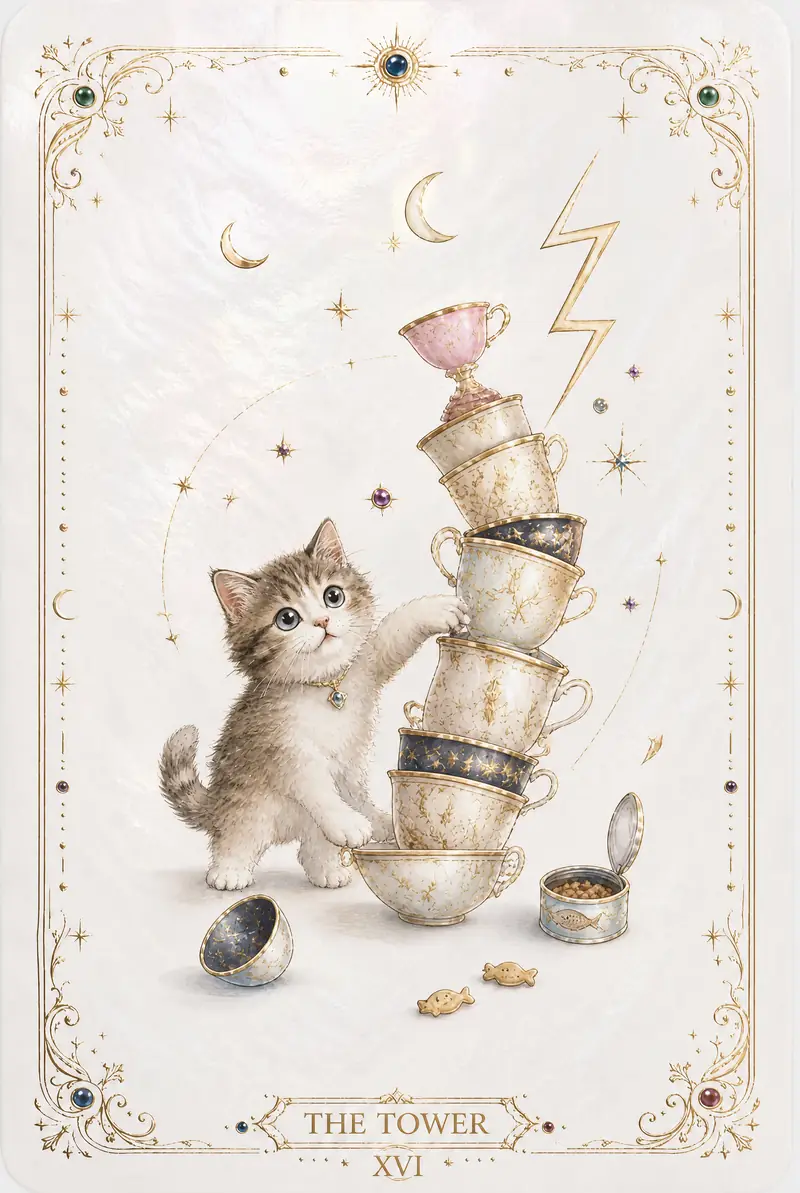
Whatever is built on a faulty foundation will fall sooner or later; the Tower describes the moment an illusion is forcibly broken, more than plain bad luck.
The image
Lightning strikes the top of a tall tower and knocks off its crown-shaped top. Two people fall from the tower, and the building is on fire. The tower usually stands on bare rock with no foundation shown at all, suggesting it was never stable from the start. The lightning comes from outside and without warning, leaving no time to prepare. This is the biggest difference between this card and the other major cards of transformation, such as Death: Death's transformation is a process, while the Tower's is instantaneous.
Core meaning
- Sudden collapse: a structure that seemed solid (a belief, a relationship, a plan, a sense of identity) is shattered by an outside force or a sudden event, quickly and violently.
- Jung's dam metaphor: consciousness is like a dam holding back the river of the unconscious. Temperance is the sluice gate that lets the water through at a controlled rate; the Tower is the dam blown apart completely, with repressed energy turning into a flood in an instant.
- An illusion forcibly broken: the drops of flame on either side of the tower are shaped like the Hebrew letter yod, and there are exactly as many of them as there are Major Arcana cards, twenty-two. These drops symbolize grace more than anger: the psyche will not, in the end, allow itself to be locked forever in a tower of illusion and oppression.
- The tower was built in the wrong place to begin with: the blow seems to come from outside, but the root is usually a problem with the foundation itself. The tower would have fallen sooner or later; the lightning only moved the moment forward.
- Echoes hidden in its position: the Tower sits directly below The High Priestess, and what the image tears open is the idea of her veil. The lightning also recalls The Magician: the energy and truth that once flowed through the Magician's whole body now strike back with full force.
- Short-term pain, long-term release, though freedom is not guaranteed: a string of disasters or violent emotions can also break a personality that was once strong. The key point is that if there is no other outlet, the unconscious will sooner or later find its own channel to erupt, and we can use the experience to find a better balance.
- Height and being targeted: standing at a height others can see tends to attract envy and attack. If you are so high that others cannot hope to reach you, they admire and look up to you instead. Most people are somewhere in the middle, and that is where the urge to "pull you down" is most likely to fix on you. This is one more explanation for why the Tower is built on a peak in full view of everyone, and draws so much attention.
- A numerical echo of the Chariot: the Tower is card 16, and 1+6=7, which echoes card 7, The Chariot. Both cards carry a sense of conflict and of being struck. The difference is that the Chariot is a war that people start, often with the aim of protecting someone or upholding justice, while the Tower is a blow like a natural disaster, with no good or evil motive behind it. It is more like a prompt for the querent to reflect on whether something in their own life needs adjusting, much like the old belief that omens from heaven called on a ruler to examine his own conduct. When struck from outside, rather than blaming others, first look at what you yourself can improve.
- It also often points to a collapse of trust or a breakdown of communication between people: a relationship that was getting along fine suddenly falls apart because of one misunderstanding, one twisted remark, or because the two no longer see things the same way. The breaking of a relationship and the collapse of a belief structure are two sides of this one card.
- Stagnation often comes from being too comfortable: achievements and security already in hand make change costly, so a person knows they should adjust but keeps putting it off. A Tower-style blow breaks a long-stalled situation open for the querent at the moment when self-awareness and willpower are not enough.
- Money: in questions about investing and managing money, the Tower often suggests a pursuit that was not careful enough, where sharp changes in the outside environment may deal a heavy blow to what was put in. The card also often turns up when the wider environment itself is in violent upheaval (around a recession, for example), reminding the querent that now is a time to weigh risks with special care. It should not be read in isolation as a curse on personal finances.
- Health: in a health question, the Tower often points to something that comes on suddenly and is hard to foresee, with few signals from the body beforehand. The other cards in the spread can help pin down which part of the body or which situation to watch. Do not read it as misfortune that is fated to happen.
- Spirit: caught between the comfort of the Devil and the fulfillment of the Star, the Tower forces a naked choice: keep refusing the inner call, or face a change that is uncomfortable but necessary. As one book on the card points out, no amount of wealth can make up for unhappiness deep in the soul. What really cools desire is inner peace, more than outward accumulation.
Reversed
- The place of collapse is reversed, putting the weight on struggling to survive in the ruins more than on being struck (image association): the figures who were falling from on high move to the top of the picture, and the reading shifts from "disaster arrives" to "still fighting to save oneself in the chaos". It also suggests that only by letting go of the old structure can a new way out be found.
- The limits come from within, more than from outside (image association / turned inward): the tower and the lightning are both turned around, symbolizing that what really traps the querent is their own panic and uncertainty, more than outside rules or sudden events. On the surface it looks like a blow from outside; the root is actually internal.
- The collapse is postponed, but not cancelled (blocked): the problem already exists, and the querent is getting by with delay or half-measures. The pressure keeps building, and sooner or later it will have to be faced.
- Excessive fear of collapse, or resistance to it (overdone): so afraid of losing control and of change that the querent clings to the old structure in even more violent or rigid ways. The resistance itself wears them down more than the collapse would, and easily provokes a stronger backlash.
- An analogy with acute and chronic illness: the difference between upright and reversed can be compared to acute and chronic illness. Upright is like an acute illness that strikes suddenly and can be cured with one operation: the pain is severe, but it is settled cleanly, and afterward it reminds you to take more care. Reversed is more like a chronic illness: it will not kill you at once, but it drags on and torments you again and again, because the querent keeps refusing to face and accept it, and so the problem is never really solved.
- Things are less serious than feared, and there is still room to put them right (opposite meaning): this is no total, irreversible destruction. If the querent calms down and finds the true source of the problem (usually something that built up inside over a long time, more than a single sudden accident), there is still a chance to cut losses in time and avoid actually reaching the point of collapse.
- [Life-area method] Reversed in money and health questions, it often means the querent avoided an upheaval that might otherwise have happened, thanks to earlier decisive choices or timely adjustments. The threat was real, and action defused it before it could land. This also points back to the lesson of the upright Devil: first hold yourself steady with solid material security or a regular routine, until the spiritual side is cared for as well, so that the risk is truly lower when the next upheaval comes.
Correspondences
Mars, the Hebrew letter Peh (פ). This card corresponds to a planet, not a zodiac sign, and in the Golden Dawn system it is not placed in any of the four element categories inferred; see Astrological Correspondences and The Kabbalah and the Tree of Life for details.
Peh literally means "mouth". The mouth can take in food that nourishes life, and it can also put out words. According to legend, the Tower of Babel fell because language was suddenly confused and people could no longer communicate and work together, so the building collapsed. The idea that careless words bring trouble, and that speech can bring down trust, connects directly to the image of the Tower. On the Tree of Life, this path connects the seventh sephirah, Netzach (Victory), with the eighth, Hod (Glory), forming a horizontal "gate" across the tree. Read downward, as the "path of creation", it is like the first dawning of awareness: instinct suddenly meets the light of reason and technique, astonished and shaken, like an insight that strikes as lightning. Read upward, as the "path of return", it is the urge, after seeing civilization and technology, to deliberately set aside complexity and return to simple instinct. This echoes the sense of release in the Tower: after the collapse, a burden that never belonged to you has been put down.
The astrological glyph of Mars is a circle with an arrow, and the pointed lightning bolt on the card echoes the shape of that arrow, drawing the Mars glyph straight into the scene of catastrophe. On a larger scale, the zigzag lightning also suggests the Kabbalistic "path of the flaming sword", the lightning-shaped path that links the ten sephiroth of the Tree of Life from one to ten. It symbolizes energy from a higher level suddenly piercing through, judging and reshaping the whole material world, and it also stands for the course that creation itself must run. The two falling figures are one blue and one red. Blue (feminine) corresponds to Netzach on the right; red (masculine, here relative to Netzach and not as an absolute quality) corresponds to Hod on the left. The Tower itself is the path that connects them.
Views from different traditions
In the Marseille tradition the card was originally called "the House of God" (La Maison-Dieu), and the image carries a more religious sense of God judging or punishing an arrogant building. Waite changed the name to the neutral "Tower", softening the sense of judgment, and the reading leans more toward a forced awakening brought on by structural collapse than toward punishment uncertain (there is no clear documentary record of Waite's specific motive for the change). Daniel adds a view from the composition: reversed, the falling figures move from below the tower to above it, and the weight of the reading shifts from "a disaster that befalls someone" to "a person still struggling to survive in the ruins and looking for a way out". This difference in names also points to the card's double nature. Some decks call it "the House of the Devil" and others "the House of God": in the end, what destroys the prison of the psyche is a spiritual force, more than the disaster itself.