The High Priestess
Number II · Correspondence Moon
Upright: intuition, the subconscious, mystery, quiet wisdom, inner knowing
Reversed: suppressed intuition, deliberate mystification, unclear information, being swamped by emotion
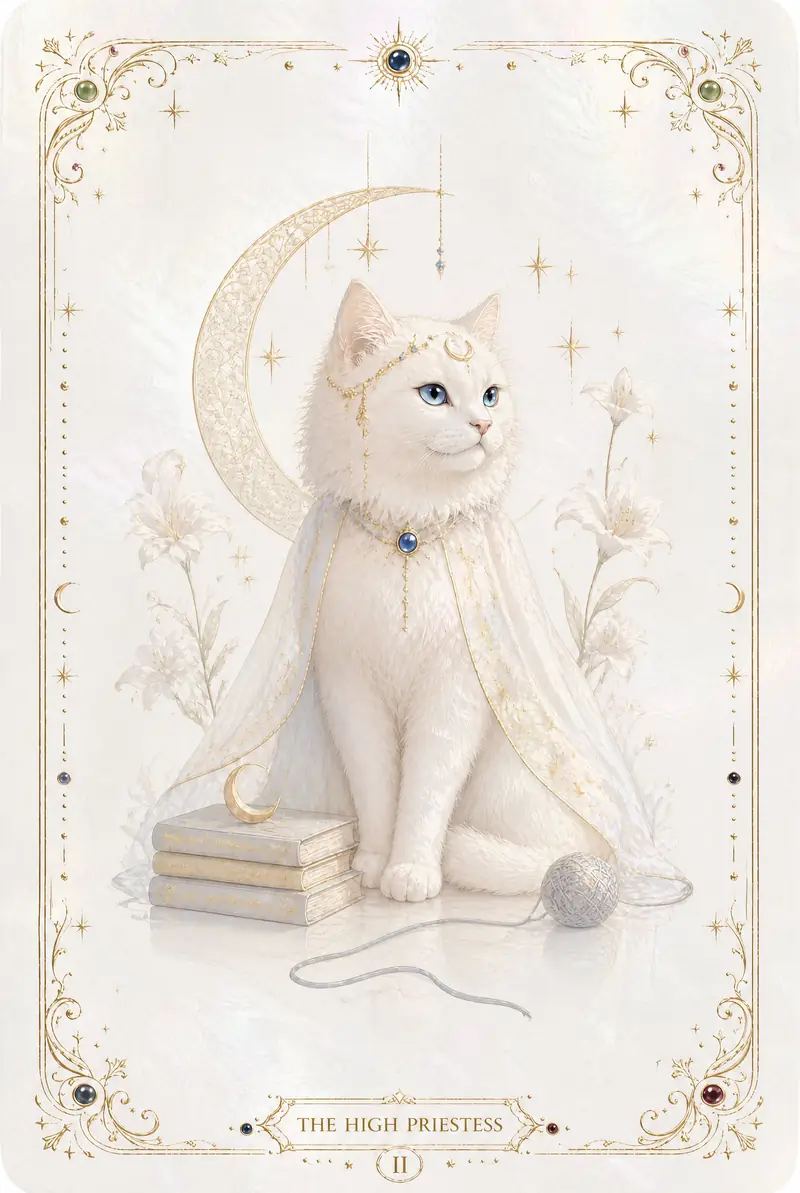
A time to feel your way inward and stop pressing with questions; the answer is not ready to be revealed yet.
The image
She sits between two pillars, a black one marked B (Boaz) and a white one marked J (Jachin), which places her at the point of balance between two opposite poles. The veil behind her is embroidered with pomegranates and lifted only at one corner, so what lies beyond it stays hidden. The scroll of the law open on her lap shows only the letters "TORA"; the rest is covered by her robe. Her feet or the folds of her robe suggest flowing water, pointing to intuition and the unconscious.
The colors are mostly white and blue, in contrast with the white and red of the Magician next to her. Red is outgoing passion and blue is inward calm, which suggests that the two cards stand for energy moving outward and energy moving inward. She wears a triple crown set with a waxing moon, a full moon and a waning moon, the mark of the Triple Goddess. It corresponds to the three stages of a woman's life (maiden, mother and crone) and also symbolizes the waxing and waning of the moon and the endlessly cycling energy of the feminine. A thin white veil falls from under the crown and covers her hair. Unlike the Magician, who shows everything he has, she keeps much of her power inside, with no need for everyone to know. On her chest is an equal-armed cross whose four directions correspond to the four elements, symbolizing faith joined with nature and divine power. Besides pomegranates, the veil also carries a pattern of palm trees. The palm symbolizes the male sexual organ and the pomegranate the female, so, like the black and white pillars, they are another pairing of opposites held in balance on this card.
Core meaning
- Intuition and inner knowing: truth sensed without logical reasoning, an ability that listens inward instead of looking outward for proof.
- Hidden knowledge that is still within reach: the space behind the veil is not completely closed to us. We just do not yet know how to cross into it. Learning to understand the non-rational wisdom of the unconscious with awareness is the very lesson the whole journey through the Major Arcana sets out to teach. The veil is not a door sealed shut forever.
- Passivity has its own power: only when you step back from outward action do the unconscious and the inner voice get a chance to surface. People who keep their heads down and just act never get the chance to reflect on what their actions have taught them. This is the often underrated value of being passive.
- Potential not yet realized: the strong possibilities she represents are still at the stage of potential. They have to be picked up by action that follows, or they will stay "possible" and never actually land.
- The ability to keep a secret: knowing clearly what should and should not be said, and keeping proper boundaries.
- Receptive, feminine power: power that comes from deep perception rather than from controlling the situation.
- Another, more concrete reading of the image: the space behind the veil can also be read as the Holy of Holies in Solomon's Temple, where the Ark of the Covenant and the Ten Commandments were kept, rather than a general "sea of the subconscious". Only those who have passed the trials and are strong enough inside may lift the veil and reach this sacred wisdom. This is a more specific symbolic reading than the conscious/subconscious framework.
- The law of polarity hidden in the pillars: the black pillar bears a white letter and the white pillar a black one. This detail echoes the Hermetic principle of polarity, much like the yin-yang idea that each pole holds a seed of the other and that anything pushed to its extreme turns into its opposite. As the balancing force in the middle, the High Priestess reconciles these two poles as they rise and fall. She is more than the feminine pole alone.
- What it means in practice: in love it often points to a relationship of spiritual affinity and mutual admiration that is fairly short on passion. In career, if she works in a field she truly believes in (writing, art, religion and philosophy, personal growth and similar areas), she can throw herself into it and shine, but she is often not good at promotion and business, and needs a partner to fill that gap. With money she is generally conservative, because she does not care much about worldly wealth.
- From a Kabbalistic point of view, Gimel is the only path that crosses the Abyss of the Tree of Life directly. This echoes the image of the knowledge behind her veil, which can only truly be reached by crossing a very wide gulf.
- Money, health and spirit: with money, the High Priestess advises first thinking through whether pursuing wealth conflicts with your inner spiritual goals. More often the card suggests that the seeds of a financial goal have been planted and need time to bear fruit. It can also mean profiting through intuition, for example in analytical work, or investing on inspiration that came from meditation or dreams. With health it stresses that meditation and contemplation are themselves good for the body because they calm the mind, and it may also mean reaching the subconscious through dreams or intuition.
- On the spiritual level, the card is a chance to nourish emotions and spirit from within, hearing the inner call in quiet sleep or meditation. If you feel spiritually depleted, regular meditation can calm the mind and reconnect awareness with your deeper self.
- The last letter, H, of the TORA scroll is deliberately hidden, suggesting that the High Priestess's wisdom is never fully seen and always holds something back. Some also rearrange the four letters of TORA to read TAROT, as a hint that the mysteries of tarot and the wisdom of Jewish law share a common root uncertain.
- There are two different approaches behind the "subconscious" reading. Freud held that the unconscious mainly stores repressed dark and negative material, which breaks out as mental illness when it can no longer be held down. Jung held that the unconscious also holds creativity and archetypal drives, and that exploring and understanding it is the key to taking charge of one's own fate. The High Priestess can be read through either theory; the two do not exclude each other inferred.
Reversed
- Picture association: upright, the crescent moon lies beneath her seat and each pillar stands in its place, symbolizing intuition kept within and a balance of two sides. Reversed, the crescent rises to the top and the black and white pillars trade places. Intuition takes over, the old balance is broken, and it is no longer right to keep watching coolly from the sidelines.
- Picture association: upright, the scroll is held close, wisdom hidden and not yet shown. Reversed, the scroll opens outward and things that should have stayed unspoken are said too early, though what gets said is often only half-understood and shallow.
- Overdonetrusting your own judgment so much that it becomes arrogance, or the opposite, having no faith at all in your intuition and forcing a real hunch down with logic.
- Blockedthe answer that should appear is not ready yet, and pressing for it backfires. Once the balance is broken, the surface stays calm while strong currents move underneath.
- Turned inwardthe store of knowledge or intuition itself is not enough, so ambitions run ahead of ability. Being too cautious and refusing to take a position can also mean missing a change that should have happened.
- In practicein social life it tends to swing between two extremes. One is strongly avoiding people and wanting to escape as soon as there is a group. The other is forcing an outgoing act that comes across as stiff and artificial, saying the wrong thing, and being mistaken for hostile. In love it often shows as silent brooding: the partner comes home five minutes late and her face changes, but when asked why she will not say, and what she does say is usually beside the point, so the relationship has a hard time finding real balance.
- One book's approach to the reversal stresses "going back out into the world" more than intuition being out of balance. The reversed High Priestess often suggests it is time to put plans into action, end a period of solitude, and return to social life or build a new social circle. With health it may mean returning to normal life after a period of rest and recovery, or even after an illness.
Correspondences
The Moon; Hebrew letter Gimel ג. For the full set of correspondences, see Astrological Correspondences and The Kabbalah and the Tree of Life.
Gimel literally means "camel", the creature that can cross a desert on the water stored in its body. On the Tree of Life it corresponds to the 13th path, the only path that directly connects Kether (the Crown) and Tiphareth (Beauty) and crosses the Abyss. It symbolizes that only inner feeling and intuition (the water stored in the camel's hump) can carry you across. This path echoes the image of the High Priestess seated between the two pillars, balanced in the middle, linking lofty wisdom with human understanding.
Views from different traditions
In the Marseille tradition this card was historically called "the Popess" (La Papesse). The name was once thought to allude to the medieval legend of Pope Joan, which gave it a clearly controversial religious tone uncertain. Waite renamed her the High Priestess, playing down the specific religious reference and stressing instead her general role as guardian of intuition and hidden knowledge inferred.
Rachel Pollack uses the Greek myth of the hunter Actaeon to describe the dark and risky side of this card. Actaeon followed a stream to its source and stumbled upon the moon goddess Diana bathing. For having seen her naked he was turned into a stag and torn apart by his own hounds. The story is about the price of forcing your way, unprepared, into the unconscious and the mysteries.
Advanced Golden Dawn reading: the pomegranates and palms on the veil are arranged in the shape of the Tree of Life, and the High Priestess's crown and throat fall exactly where the sephiroth Kether and Tiphareth sit. The line between those two points is the 13th path, which crosses the Abyss and joins these two sephiroth. Through this composition Waite suggests that the High Priestess herself "sits" on that path.
- Card 18 (The Moon) is assigned to Pisces rather than to the Moon, an arrangement that often confuses people. By placing a crescent moon at the High Priestess's feet, Waite makes it clear that card 2 is the place of the Moon itself, and pins down a correspondence that is easy to misread.
- The shape of her headdress is also very close to the astrological symbol for Pisces. This detail once led some people to argue that the High Priestess should be assigned to Pisces and the Moon given to card 18. Waite held to the opposite assignment, and used the crescent at her feet and the water-like folds of her robe (echoing the Moon's soft, changeable nature) to override this ambiguity.