The Empress
Number III · Correspondence Venus
Upright: abundance, nurture, creativity, sensual pleasure, motherhood
Reversed: over-giving, blocked creativity, filling a void through dependence, controlling care
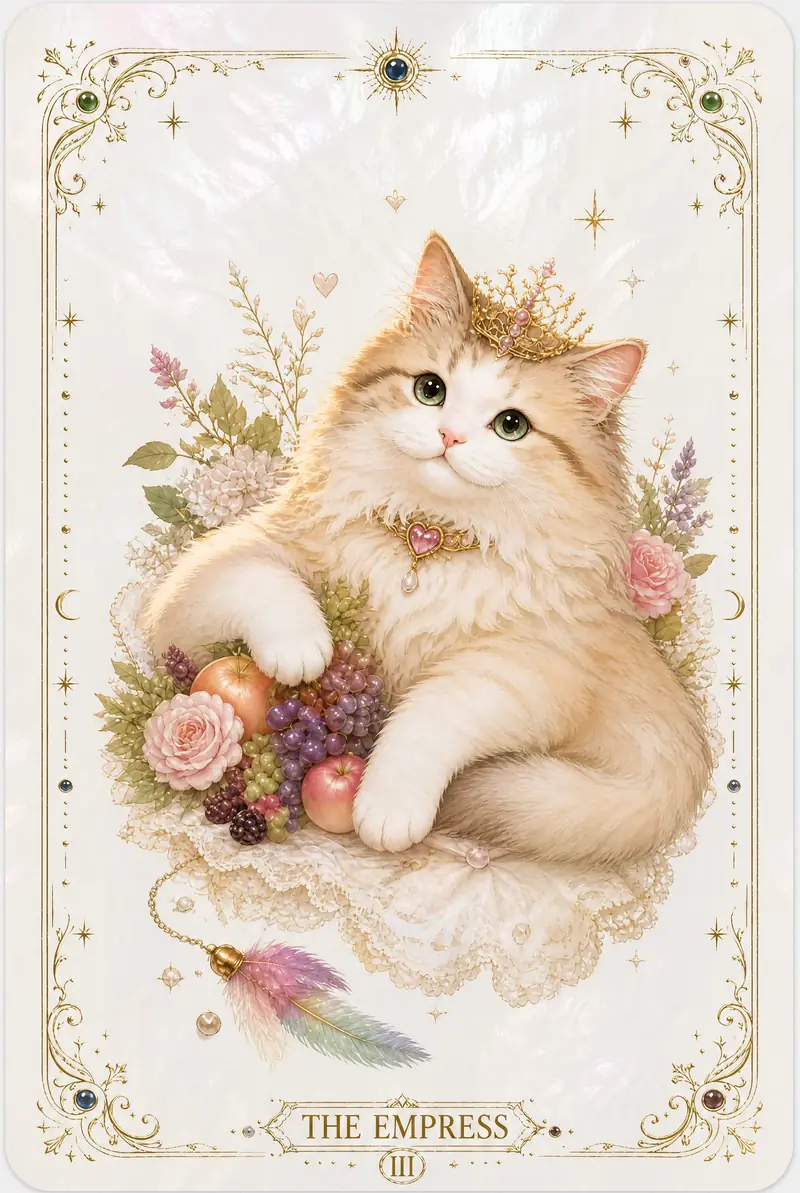
The force that lets everything grow naturally and come into full abundance.
The image
She sits outdoors on comfortable cushions, surrounded by a thick field of wheat and a forest, a scene of natural plenty. Her loose robe and posture suggest pregnancy, and the orb at the top of her scepter symbolizes creativity and rule held together. The symbol of Venus is carved on her cushion or shield. A stream flows beside her, suggesting that feeling and life force keep moving, so the abundance here is never static.
Her crown is set with twelve stars, matching the twelve signs of the zodiac. Sorting personalities into types this way is similar to modern systems like MBTI and the Enneagram, which use a limited set of types to help people understand themselves and others inferred. Her necklace has seven beads, matching the seven classical planets, and together with the crown it reinforces her role as one who "holds the secrets of the universe". The gray around the cushion or shield has its own meaning as well: gray lies between white (pure spiritual power) and black (the power of manifestation in the material world), and symbolizes spirit in the process of taking material form. The Empress stands for the crucial step where creation moves from nothing into something concrete.
Core meaning
- Abundance and creativity: not limited to having children. It covers every process of "bringing something new into being", including creative projects and careers.
- Nurture and care: the patience and gentleness needed to look after the growth of others or of oneself.
- Sensory experience is a starting point toward the spiritual. It is not a stain to be denied: only after fully living in the world of the senses and of matter can you really go beyond it. Pure indulgence and pure asceticism are both unbalanced extremes. A natural appreciation of beauty, the body and the pleasures of nature comes from accepting the sensory world completely.
- The power of mothering: protection, provision and support given without counting the cost. It is not necessarily tied to having children.
- Abundance made real: wishes or plans begin to bear actual fruit and enter a stage you can see and touch.
- Direct experience, not yet cut up: as the "child" born from the union of the Magician (active consciousness) and the High Priestess (potential and intuition), the Empress also stands for the original state of feeling the world directly, before the ego and social conditioning divide it into pieces. This is one of the abilities tarot hopes to help people recover.
- Her place in the creative sequence: if the High Priestess stands for pure feminine energy not yet tied to any particular gender, the Empress is the stage where that energy "lands" in a concrete female form and really begins to conceive and create. One reading compares the sequence from the Fool to the Empress to the line in the Tao Te Ching, "one gives rise to two, two gives rise to three, and three gives rise to all things". The Fool is the One, the Magician and the High Priestess form the two poles of yin and yang, and the Empress is the point where yin and yang merge and begin to give birth to all things.
- Not only for women: when a man draws the Empress, it can equally point to qualities such as being gentle and family-minded, good at caring for others, having a fine sense of beauty, or coming from a comfortable background. There is no need to feel the card does not fit just because it shows a woman. The temperament is softer, but that does not mean a lack of masculinity.
- What it means in practice: upright in love, it usually points to feeling cherished and secure, with the relationship moving steadily toward marriage. In career and money it is generally favorable. Reversed, it often shows as indulgence in pleasure, vanity and a lack of diligence. Relationships tend to stay stuck in an undefined in-between stage and have trouble coming to a good end. If the question is about pregnancy or a project's progress, it may also hit setbacks halfway and struggle to reach a full conclusion.
- Money, health and spirit: with money, the upright Empress often describes working from home, or finances closely tied to the household (such as a mortgage, or a second mortgage taken out for a family goal), and broadly points to financial progress. With health it corresponds to Libra and the kidneys, and it is also often related to eating habits: feeling bloated after meals is the body's reminder that eating habits need adjusting.
- On the spiritual level, the Empress asks you to be grateful for the abundance life brings, especially physical abundance. From a warm hug to a generous feast, life nourishes people in many ways, and this is also a good time to share that abundance with those around you, especially family.
- Jung's concepts of the anima and animus support the view that feminine energy and biological sex are two different things: even a man naturally carries feminine energy within him. The High Priestess represents exactly this pure feminine energy not yet tied to any particular gender inferred.
- The clothing of figures on tarot cards is also a general clue for reading. Formal, dignified dress suggests a serious character; armor adds a strong defensiveness on top of seriousness; shabby, casual clothes usually mean an easygoing nature; and loose, comfortable clothing points to someone tolerant who values comfort in life. This pattern applies beyond the Empress and can be used to read other figure cards inferred.
Reversed
- Picture association: in the upright image the wheat field and the forest exist side by side and the waterfall flows down naturally, so developed and undeveloped potential both unfold together. Reversed, the wheat field covers the forest and the water seems to flow backward. This suggests potential being overused and the drive to act being blocked; much of the current effort is wasted rather than truly productive.
- Picture association: the scepter turns from pointing outward to pointing inward, a reminder to draw back some energy for inner reflection. Dwelling there too long, though, can also lead to indecision and a reluctance to actually act.
- Overdoneabundant resources and energy go to the wrong places. Pleasure without limits becomes extravagance and waste, and the burden on money or body grows steadily without being noticed.
- Turned inwardwhile care and effort go outward, hidden dissatisfaction and conflict are building up inside, though they have not yet really broken out.
- Blockedcreativity cannot find an outlet, and ideas and plans keep failing to take root and bloom. Now is a better time to finish what is already in hand than to start something new.
- Blockedthe power of love and beauty is weakening. It is easy to lose yourself by caring too much about how others see you, and in love you may end up in an unequal relationship or give your heart to the wrong person.
- In practicethe reversed Empress's finances often resemble those of a socialite living off her connections, moving among different relationships and coaxing a little money out of each. She looks glamorous and well off on the surface, but there is little left in her pocket, because she has no ability to make money grow. What she earns she spends, and once it is spent she looks for the next way to get more.
- One book adds a concrete angle about "the home environment eating up resources": the reversed Empress can also mean having a home that does not feel like home. The living space may be overrun by paperwork and office supplies, or the chaos of a renovation may be swallowing available funds and affecting work and financial opportunities along with it. With health it may point specifically to kidney problems, or to the home environment itself harming one's health.
Correspondences
Venus; Hebrew letter Daleth ד. For the full set of correspondences, see Astrological Correspondences and The Kabbalah and the Tree of Life.
Daleth literally means "door". A door is both exit and entrance; it lets lifeless things gain life, and it is often extended to the image of the womb that conceives new life. On the Tree of Life, Daleth is the 14th path, running across from Chokmah (Wisdom) to Binah (Understanding). It gathers endlessly expanding vision into the one or two ideas that can actually be conceived and expressed, which echoes the Empress's core meaning of making abundance visible as fruit.
Views from different traditions
In Daniel's Chinese-language book on reversals, he proposes reading reversed meanings directly from the composition of the picture. Taking the Empress as an example, when the card is reversed, the flipped composition (the relative positions of the wheat field and forest, the direction of the scepter, the direction of the water flow and so on) serves as a direct clue to the reversed meaning, instead of the upright meaning simply being read backward.
Advanced Golden Dawn reading: Waite repeats the Venus symbol in several places, in the heart on the cushion and in similar patterns that recur on the robe and the embroidered pillow, to reinforce the Empress's link with Venus so that the correspondence does not rest on a single detail.
- The ripe ears of grain in the foreground are sacred to Venus in Greek myth, and the myrtle trees behind her are also sacred to Venus. The stream at her feet flows out of the forest and gathers where she sits, which echoes the image of Venus rising from the water in Botticelli's The Birth of Venus and further merges her with the planet and goddess Venus.
- Daleth literally means "door", and the Empress's place in the card order is also read as "the gate into the garden of Venus". This fits her core meaning as the gate through which life is conceived (the womb image), and it is one of the few layers of this card's Hebrew letter correspondence that makes sense almost without stretching.