The Emperor
Number IV · Element Fire · Correspondence Aries
Upright: authority, structure, stability, discipline, leadership
Reversed: tyranny, rigidity, need for control, lack of discipline
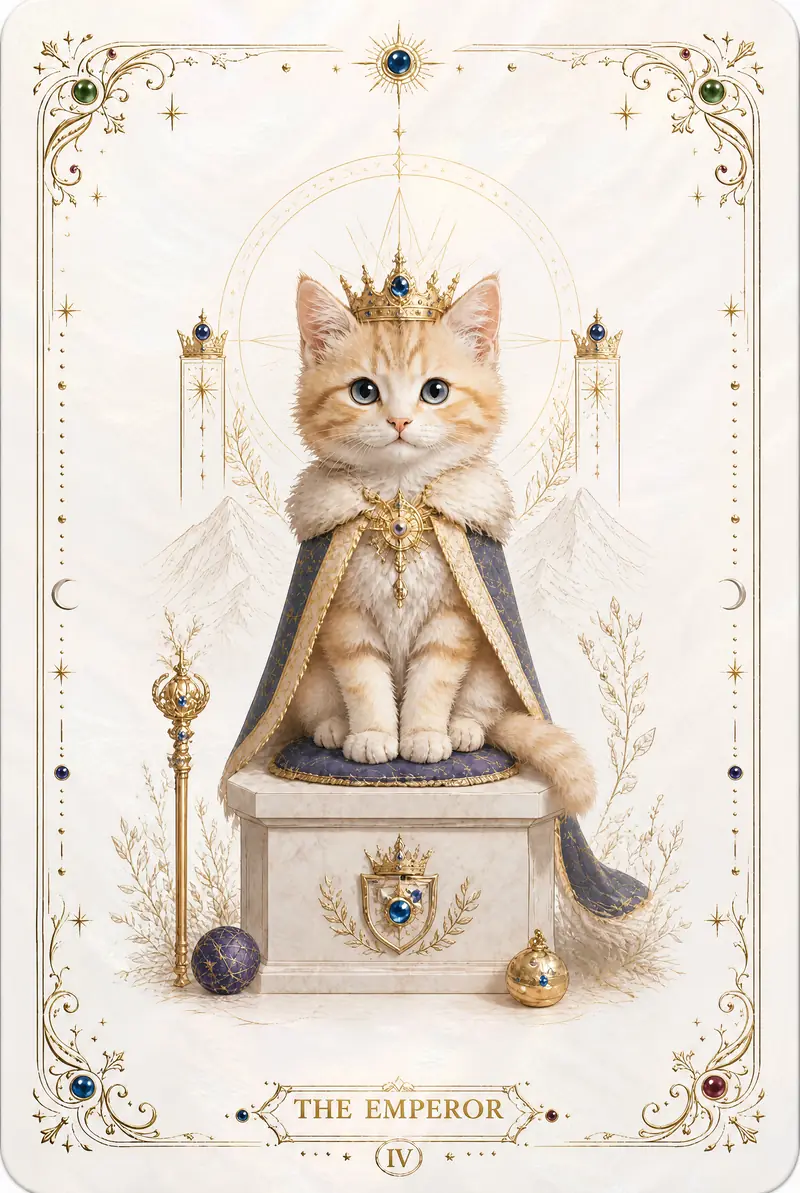
Using rules and will to set the world in a visible order.
The image
He sits upright on a stone throne whose arms and back are carved with rams' heads, echoing Aries. He wears armor and holds a scepter, symbolizing worldly power joined with protection. Behind him rise sharp, barren mountains. Compared with the natural plenty of the Empress, this is territory that will and order have tamed and that nature has not taken over. His posture is straight and his gaze is fixed ahead without hesitation.
His red robe echoes the passion, courage and drive of Fire and Aries. Over it he wears a purple cape, the traditional color of emperors, marking him as a builder and maker of rules. The purple cape is embroidered with four concentric circles, which correspond to the four worlds of the Kabbalah (Atziluth, Briah, Yetzirah and Assiah). They symbolize his aim to take formless creative power and, by his own will, make it manifest step by step and build it into an ordered, concrete reality. The orb in his other hand symbolizes the core energy of creation and rule, and also his pursuit of balance and completeness. Five gems are visible on the front of his crown; with five more hidden at the back, there are ten, echoing the ten sephiroth of the Tree of Life. The visible gems are red and blue. Red is the active, outward force of manifestation and blue is the passive, inward force of stability and reflection; the blue garment under his red robe echoes the same idea, showing that the Emperor can both press forward and hold back. His white hair and beard contrast with the Empress's golden hair. Besides showing his age, they stress his long experience and deep knowledge of the world.
Core meaning
- Structure and order: setting up rules, boundaries and systems so that things work in a predictable way. Psychologically, it echoes the way the "superego" replaces raw impulse and takes social norms as the guide for behavior.
- Authority and leadership: command of the situation, and the willingness and ability to take responsibility for decisions. In readings it also often points to a specific person in one's life who holds great power: usually the father, but possibly a husband or lover treated as a substitute father.
- A stable foundation: steady as a mountain, thinking long term instead of acting on impulse. This stability also gives creative work and spiritual practice room to take root and grow.
- The power of fathering: giving protection and direction through rules and example rather than through direct caretaking.
- Willpower and discipline: carrying a plan through by self-discipline and persistence instead of acting on passing feelings.
- Worldly achievement and status: building a visible career, position or influence in the concrete world.
- The double edge of order itself: once stability is placed above justice and treated as a supreme value beyond question, it turns from a framework that protects individual growth into shackles that suppress it. And when all connection with one's own passion is lost, life becomes cold, hard and barren. This limit is built into the Emperor archetype itself. It does not only appear when authority is abused or the card is reversed.
- How he acts differently from the Magician: the Magician makes formless power manifest, and the Emperor then builds rules and order on that basis. He wants more than for things to happen; he wants them to be predictable, sustainable and orderly. This contrast helps separate two neighboring but different kinds of creation, "manifesting" and "building order".
- The scepter and the Empress's Venus symbol: the scepter in his hand is shaped like the Egyptian ankh (a symbol of life, which also suggests the soul dying and returning to life after its trials, in an unending cycle), and its form echoes the Venus symbol on the Empress card. This hints that the two cards are a complementary pair. The Emperor holds power over life and death, but he also needs to win hearts and affection the way the Empress does, or his position will never be truly secure.
- What it means in practice: in love, even if the upright Emperor has a busy social schedule, it is usually for work or obligations and not because his affections have strayed, and he still gives his partner a clear place. It can also describe a partner who is not very family-minded, is a bit of a chauvinist and is poor at expressing feelings. Reversed, watch for someone who likes to boast about status but has trouble keeping promises and lacks a sense of responsibility; the stability and faithfulness of the relationship go down as well.
- Money, health and spirit: with money, the upright Emperor means financial stability that comes from discipline and effective control of spending. When it appears in a young person's spread, it often means they are about to take over a business someone else has run for years, or an elder is passing experience on to them. With health, watch for headaches or head injuries from accidents. These often come from choosing competitive or punishing kinds of exercise and then overindulging in food afterward, so that a state of low-grade poor health goes ignored for a long time.
- On the spiritual level, the Emperor says that before a creative idea can be realized, it needs a practical structure to hold it. Discipline and commitment are how spiritual ideas or creative visions are brought into daily life in a regular, measurable way.
- The Emperor is the first card in the Major Arcana sequence that corresponds to a sign of the zodiac (rather than simply a planet or an element) inferred.
- The Emperor's slightly sideways glance can also be read as the guardedness common among people who hold high positions: the higher you sit, the harder it often is to trust others easily. This is an extension in interpretation and not necessarily something the picture itself sets up inferred.
- There are two more visual links between the Emperor and the Empress. The water beneath his throne is said to be a continuation of the river on the Empress card, suggesting that the Emperor's masculine power grows out of the Empress's feminine energy, so he is not only hard. The mountains behind him, besides symbolizing a solid foundation, can also stand for having something solid at your back, which in career readings points directly to useful connections and backing from people with influence inferred.
Reversed
- Picture association: upright, the Emperor looks down on the low mountains behind him and holds the globe-topped scepter of control firmly. Reversed, the peaks rise above his head and the globe seems about to slip. This symbolizes growing outside challenges and resistance; his old sense of control is draining away, and he clings to power all the harder, which reveals a deep insecurity.
- Turned inwardunder the strong exterior and armor there is actually a fear of losing control. A hard stance covers inner unease; this is not leadership with real confidence behind it.
- Overdoneauthority is abused and becomes a stubborn urge to control. The rules themselves become tools for pressing people down, and insisting too hard on one's own view provokes even greater backlash.
- Blockedwillpower and follow-through cannot hold the situation together. Things that were already settled become uncertain again, and the decisiveness and discipline that should be there never really take hold.
- Blockedexperience and maturity are not yet enough, so situations easily cause panic. What is needed now is to think the direction and methods through first, instead of rushing to take charge and give orders.
- One book is more specific about the reversed Emperor's finances. Instead of starting small and waiting until enough money is saved before acting, the reversed Emperor tends to borrow a large sum to start a business, launches the plan with great enthusiasm, and then sees the commitment vanish without a trace. Kept up for long, this easily leads to bankruptcy. With health it warns about problems from a lack of self-discipline, including overindulgence in food, drugs or alcohol.
Correspondences
Aries (a Fire sign); Hebrew letter Heh ה. For the full set of correspondences, see Astrological Correspondences and The Kabbalah and the Tree of Life.
Heh literally means "window" and also carries the extended senses of "breath, existence, becoming"; it is the same Heh found in the divine name YHVH. A window lets you look out and also lets the outside world look in, so it carries a sense of foresight and judgment. On the Tree of Life, Heh connects Chokmah (Wisdom) and Tiphareth (Beauty). Starting from original power, it builds a whole order in which everyone has their place and things run in harmony. This is a picture of the Emperor's core meaning: using rules and will to set the world in a visible order.
Views from different traditions
In Daniel's Chinese-language book on reversals, he again starts from the composition to read the reversed Emperor. The mountains rising above his head and the globe he held firmly seeming about to slip are treated as direct visual clues to a loss of control and to outside challenges overpowering personal will, instead of the upright meaning simply being turned around.
Rachel Pollack places the Emperor within the mythic theme of "a mother-centered order replaced by a father-centered one". Many myths tell of a new generation of male gods killing the primal goddess of creation, such as Marduk killing Tiamat, the mother of chaos, in Babylonian myth, and replacing direct experience of nature with law and structure. This echoes Freud's psychological model of the superego replacing the id.
Advanced Golden Dawn reading: the four rams' heads on the arms and back of the throne are the most direct visual evidence for this card's link with Aries. On the Emperor's right shoulder (from the viewer's side) there is also a faint, half-hidden circular ram's-horn pattern, thought to be a repeated emphasis of the same hint.
- In the zodiac each sign rules a part of the body, and Aries rules the head. So Waite gave the Emperor a crowned helmet topped with the glyph of Aries, using the "head/helmet" body correspondence to point to Aries again. This argument is not especially strong, though: the Empress also wears a crown and the High Priestess also wears a headdress, so the claim that the crown was added "to highlight the head" is not very convincing.
- The picture uses a great deal of red. In the Golden Dawn system red is the color assigned to Aries, and it is also the color of Mars, the ruling planet of Aries. Yellow and orange correspond to the Sun's exaltation in Aries. These color choices are thought to reinforce the combined link between the Emperor and Aries, Mars and the Sun.