Death
Number XIII · Element Water · Correspondence Scorpio
Upright: complete ending, irreversible transformation, equality before change, making room for new life, letting go
Reversed: endings dragged out, excessive destruction, inner change not yet shown outside, fear of impermanence, avoiding loss
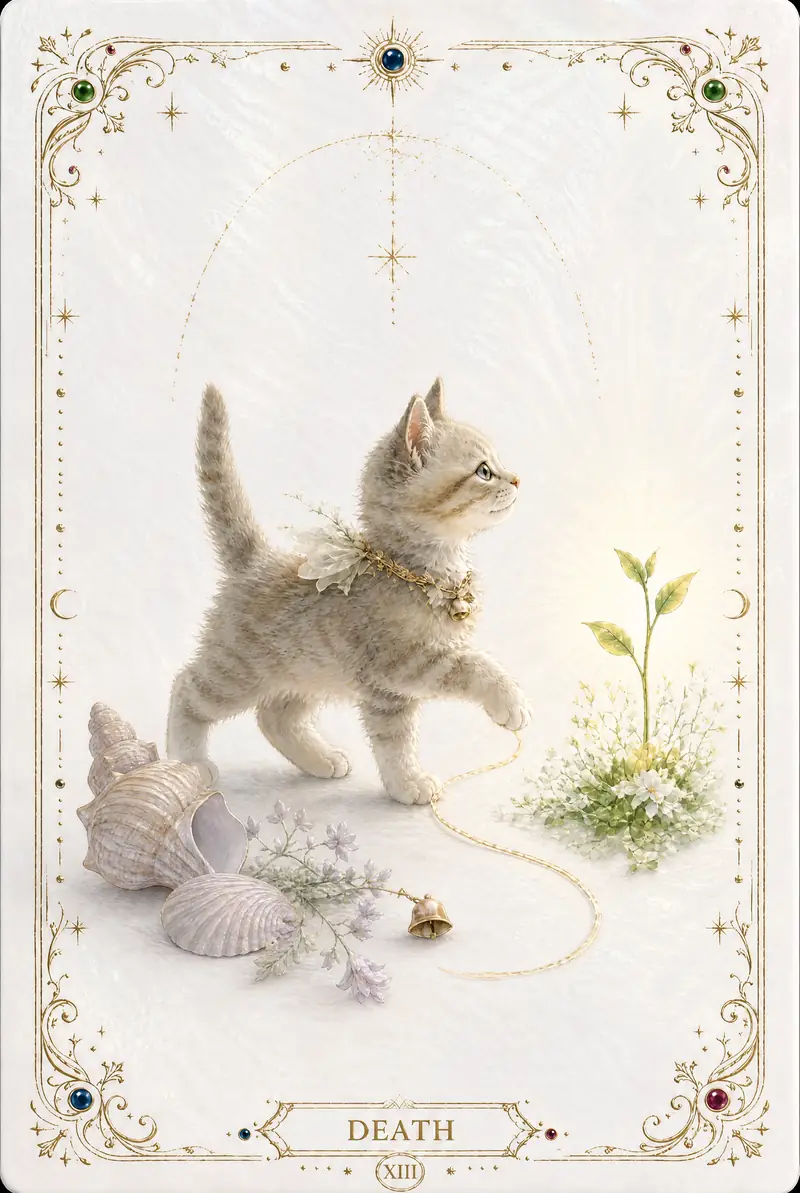
This card almost never means death in the literal sense; it speaks of a stage ending completely so that something new has room to come in.
The image
A skeleton knight in black armor carries a banner painted with a white rose and rides past a crowd of people: a king fallen to the ground, a cleric kneeling in prayer, a child and a young woman shrinking back in fear. Their poses all differ, showing that before death there is no rank or status and everyone is equal. On the distant horizon a rising sun is often drawn, planting a hint of rebirth within a scene of ending. The white rose is usually read as a symbol of purity and transformation, more than of mourning alone inferred.
Core meaning
- A complete ending: a stage, relationship, identity or habit has reached its end, and it is the kind of ending you cannot go back from or put off any longer. This is no minor adjustment.
- Ending as the precondition for new life: coming right after the inward reversal of The Hanged Man, Death turns that shift in perspective into real action. The old has to make way first so that Temperance, which follows, has room to blend a new balance.
- It does not pick and choose, but people react differently: before the skeleton everyone is equal. The fallen king is the rigid ego that has collapsed. The cleric can face Death only by propping himself up with a belief system. The young woman kneels but turns her face away, aware of herself yet still unwilling to surrender. Only the child can face Death with no defenses at all and offer it a flower. These four postures are the different ways people may respond when faced with change.
- What is truly feared is the dissolving of the personality, more than death itself: the ego treats itself as a mask separate from life, so it instinctively hoards energy and resists letting go, and as a result new energy cannot get in. It is like someone in a panic gulping in air and refusing to breathe out, and ending up unable to breathe.
- Thirteen breaks the completeness of twelve: twelve combines the archetypes of "one" and "two", symbolizes the wholeness of the zodiac and the cosmic order, and can be divided by many numbers. Thirteen can be divided only by one and itself, which breaks that neatness. Yet this "imperfection" is exactly what signals new creation: death breaks old forms and clears the way for new possibilities.
- Rarely literal death: when it appears in a spread, it overwhelmingly refers to endings on an abstract level, in relationships, work, habits or mindset, and does not foretell an actual death inferred (though this is a broad consensus in tarot teaching).
- Rebirth from the skeleton in shamanic traditions: the last step from life to death is to hand over everything one has: property, status, name, family, body, blood. Only when nothing is left but a skeleton does a person receive a new identity, a new purpose and a new name. The skeleton knight in armor shows this image of the passage between death and life directly: old bones dressed in clothes of entirely new meaning.
- The double omen of the white horse: the white horse Death rides has long been tied to the world of the dead. Traditionally, white horses were sacrificed at the funerals of the rich and powerful, as an auspicious and honorable act; in English and German folklore, dreaming of a white horse was often taken as a sign that death was near. In this card, the white horse also hints at the old idea that a loss can turn out to be a blessing: behind an apparent loss there may be a turning point worth taking seriously.
- The feather of Maat: besides the white rose on the banner, the feather itself is a symbol of Maat, the Egyptian goddess of truth. In Egyptian myth the dead are judged in the underworld by having their heart placed on a scale against Maat's feather. If the heart is lighter than the feather, the person is judged righteous and may pass on toward rebirth; if it is heavier, the heart is devoured by a beast. This layer of imagery links Death with judgment after death and with the return of one's deeds.
- A numerical echo of the Emperor: Death is card 13, and 1+3=4, which echoes card 4, The Emperor. The Emperor stands for the rules and laws of the material world and is the founder of the order of the state; Death stands for the irresistible laws of the natural world, that is, birth, aging, sickness and death. On the card the emperor has already fallen dead, which shows that the order of the material world must in the end yield to deeper natural laws.
- Reading it for personality: when the question is about someone's character, Death brings in the typical traits of Scorpio: mysterious, intense, quietly calculating behind a pleasant face, vengeful, hard to read yet carrying a dangerous kind of sex appeal.
- The core is drastic change, more than ending alone: note that this card's emphasis falls on the intensity and seriousness of the change itself, beyond just "the end". Besides obvious endings such as a breakup or losing a job, positive upheavals that turn life over just as completely, such as marriage or pregnancy, also belong to this card. Whether it is good or bad has to be judged with the cards that appear alongside it; do not assume bad news the moment you see Death.
- A hint of windfalls in money readings: linking this card with the eighth house in astrology, which corresponds to Scorpio, Death in a money question is often tied to irregular income: unexpected money coming in (insurance payouts, inheritance and the like), or income with sharp swings that is hard to predict coming or going. It does not simply mean losing money.
- A stop-loss signal for money: when the question is whether to keep going with an investment or plan, Death often answers "end it". Rather than agonizing over how to keep it going, close it out decisively, start a new chapter in managing money, and turn your energy to the next step.
- An end to old habits for health: it often suggests the body is pushing the querent to end some long-standing unhealthy habit or way of living (an unbalanced sleep schedule or diet, for example). The more useful reading is an old pattern that needs to be wrapped up, more than a warning of disaster or illness, and more than any specific condition.
- Gentle letting go on the level of spirit: the core message is that you do not need to wait until everything is in place before letting go of a relationship or situation. Real peace comes from trusting that life has arrangements more complete than what you can see right now. The heart can hold both fondness for what is past and anticipation of the new road at the same time.
Reversed
- [Image association] The figures on the ground are larger than Death itself: the force of death or ending is not unshakable. Things have not reached the point of despair, and there is still room to maneuver and to make an effort.
- [Image association] Death's banner and the direction it faces change: this suggests that now, more than ever, the querent needs to let go of fixations and keep a clean, uncluttered inner state. If it is read as "the time to leave has already come", it means the hardest stage is actually over and things will slowly get better, though matching adjustments are still needed.
- [Image association] Death falls from the horse and the small boat in the distance capsizes: there may be a quite alarming upset. Rather than struggling to rescue a precarious situation, it is better to let go entirely and start over from scratch.
- [Blocked / negative meaning] Something that should end is being forcibly held on to. Refusing to let go only invites bigger trouble, and avoiding things or responding passively solves nothing; it only pushes back what has to be faced.
- [Overdone] The force for change that can be mobilized right now is not thorough enough, and only partial compromises are possible. Insisting on tearing everything down makes it easy to give up halfway. This stage is sometimes accompanied by a sense of loss from hopes not being met.
- [Personality] Upright, Death is a strong, sharp-edged character. Reversed it is the opposite: middling and vague, with no distinct edges, the kind of person whose presence you can easily forget for a moment.
- [Opposite meaning] This is not a good time to take the initiative or rush into major decisions. It is more like a narrow escape from death: a stage that calls for a quick decision followed by slowing down to steady your footing. It can also be plain stagnation, where no amount of effort shows results, though that is not necessarily the querent's own fault.
- [Life-area method] Reversed in a health question, it often points to a querent who knows that long-standing bad habits are wearing down the body but keeps putting off admitting it and refuses to take responsibility for their health, so the damage piles up until it is hard to undo. Reversed in a money question, it often means refusing to let go of a plan where losses should have been cut long ago, sinking deeper the longer it drags on.
Correspondences
Number 13, Water, Scorpio; see Astrological Correspondences for details. On the Tree of Life, its path corresponds to the Hebrew letter Nun (נ); see The Kabbalah and the Tree of Life.
Nun literally means "fish". Fish breed very quickly and rot very quickly after death, combining strong vitality with sudden decay, an image of rapid birth and rapid death. This matches Death's double nature: an abrupt ending that also carries the potential for new life. On the Tree of Life, this path connects the sixth sephirah, Tiphareth (Beauty), with the seventh, Netzach (Victory). Tiphareth symbolizes the selfless, detached higher soul; Netzach symbolizes the survival instinct and the lower soul. Read downward, as the "path of creation", it is the soul descending to join the instincts of the body, matching Death's kind of ending and transformation as a "fall into the world". Read upward, as the "path of return", it is death gathering life back and returning it to the world of the higher soul, echoing the sense that the ending happens so the soul can return to its place.
Waite left two more direct clues in the image that confirm this path. One is the river in the background: Nun means "fish", so drawing a river indirectly suggests fish, and so Nun. The other is the rising sun drawn between two towers, which corresponds to the Sun, the planet of Tiphareth; meanwhile the mysterious white rose on the banner is sacred to Venus and corresponds to Netzach. The sun and the rose appearing together point exactly to the two sephiroth this card connects, Tiphareth and Netzach.
Views from different traditions
In the Marseille tradition this card has always been printed without a name, and French tradition calls it "the nameless arcanum" (L'Arcane sans nom). This is said to be because medieval printers avoided writing the word "death" directly uncertain (accounts of the historical cause vary). The Waite deck and Crowley's Thoth deck both restored the written title (Death in each). The difference is a detail of printing tradition and does not involve any disagreement about the card's meaning. Rachel Pollack also points out that in the layout of the Major Arcana, Death sits directly below The Lovers. She connects this with the Elizabethan English usage of "to die" for orgasm: at that moment the ego also partly dissolves, and the mental mechanism that resists surrender shares a root with the fear of death.