Three of Wands
Number III · Element Fire · Correspondence Second decan of Aries
Upright: expansion, foresight, waiting for results, several ventures at once
Reversed: delays and setbacks, lack of foresight, loss of control
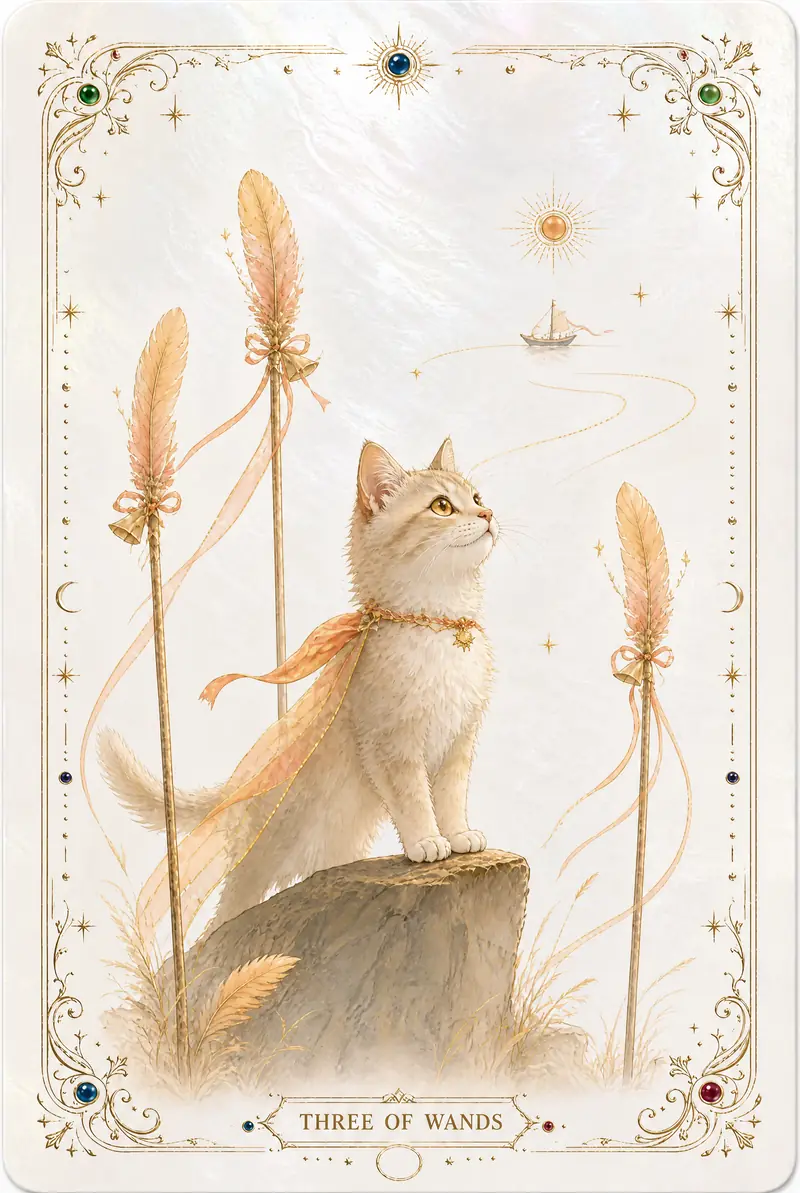
The ships have already set sail; what the moment calls for is waiting, with no more meddling.
The image
A figure with their back to the viewer stands on high ground or at the edge of a cliff, watching three merchant ships under sail moving farther away across the sea. Three wands stand beside them. The stance is steady, with no sign of anxiety (Rider-Waite-Smith).
Core meaning
- The plan set in the Two of Wands has been put into action. The merchant ships stand for results that have been sent out to the market and into other people's hands. All that can be done now is watch and wait; part of the control has already been handed over.
- The number three gathers the impulse of one and the planning of two into a new reality (echoing the Major Arcana card The Empress). It is the stage where the element matures. In Wands this shows as the solid feeling of having actually accomplished something. The figure stands strong and does not feel threatened, in contrast to the young competitors in the Five of Wands who are still proving themselves.
- Three ships rather than one suggest several lines of activity at once. Not everything is bet on one direction, and the expansion spreads its risk. The image can be read forward as sending the fleet out to explore new territory while staying behind to hold the base. It can also be read in reverse, as the fleet returning fully loaded and bringing the gains of the long voyage back into everyday life. Both directions, setting out and coming home, make sense.
- Unlike the Knight of Wands, who charges ahead with no regard for foundations, this card is about standing firmly on an existing base while continuing to reach outward with your interests. In love it can be read as keeping your primary commitment to the existing relationship while remaining open to new connections with people.
- Rachel Pollack sees this as one of the rare "inner" cards (gateway cards) in the Wands suit. The ocean evokes intuition of the unknown and the vast, the river symbolizes personal experience flowing into it, the ships represent the part of the self willing to explore deeply, and the person standing on the shore is a reminder that before setting out into the unknown, you need to be well rooted in everyday reality.
- For someone still troubled by past experiences, the card can also be read as making peace with one's own memories. The memories become ships sailing out onto open water, which is also a way of reconnecting with one's deeper emotional life.
- Because the figure has their back to the viewer and gazes into the distance, the card is easily read as a hint of parting. But since it rests on the firm choice made in the Two of Wands, even when it really does mean leaving or breaking up, it is closer to a sound decision of the "a short pain is better than a long one" kind. It does not have to be an ending to grieve over.
- The headband is there to separate emotion from reason and reminds the person to keep self-control. The checkered pattern on the clothing echoes this need for order and restraint. Once the direction is set, the bigger test is whether you can stay patient and go the whole distance step by step, without rushing.
- Money: financial plans are moving forward steadily, often involving activity across regions or fields (such as investing in another city or working with partners abroad). As long as you follow the direction you set earlier, progress is generally smooth with few obstacles.
- Health: one handbook treats travel, vacations and setting down everyday pressure as ways to improve health. If the question is simply asking for health advice, this card's answer is very concrete: starting now, walk more and move more.
- Both the sea and the sky are yellow in this card. The sky stands for abstract consciousness and the blueprint of thought, while the sea is closer to reality. Giving them the same color suggests that the ideas above are slowly taking shape as practical action below: "I am about to turn my ideas into reality."
- The high ground the figure stands on also symbolizes their existing status and resources. The venture in the Three of Wands does not start from zero; it goes a step further from an advantage already held.
Reversed
- The ships now rise above the figure's line of sight, and the risk rises with them. Without thorough preparation and the ability to adapt, an expansion that looked steady can easily overturn (reading from the image).
- The ships turn their bows and sail back toward the figure, which is often read as things being pulled back in: a crisis has passed safely, or the experience is better used for looking back and reflecting than for pushing further out (reading from the image).
- The person who once stood alongside turns and leaves the high ground alone, suggesting that a partnership can no longer hold. From here on, you are more likely to have to carry the work by yourself (blocked).
- Showing off too much and acting too confident can invite unnecessary trouble. Keeping a low profile is wiser now than continuing to stand out (negative meaning).
- Beneath smooth appearances, a good number of old problems have piled up. Rather than rushing forward with a new plan, first clear up what was never fully dealt with in the past (opposite meaning).
- For money, the reversal often points to delays in the plan, or to needing to catch up on lost progress before you can really move into a more practical position (a new job, a new home). It may help to look back and work out which financial channels suit you best, instead of rushing ahead. For health, it may be that putting off a decision (delaying a doctor's visit, for example, or going to an extremely strict diet) is slowing recovery. It may also be that your own health or the health of someone close is forcing a planned trip to be cut short or interrupted.
Correspondences
The number three: the "taking form" stage in Numbers in Tarot. Astrologically, the second decan of Aries; see Astrological Correspondences. In the Golden Dawn system, the card's esoteric title is "Lord of Established Strength"; see Esoteric Titles.
Views from different traditions
The Thoth system calls this card "Virtue," emphasizing that the action itself comes from a rightful, steady will. The Waite version leans more toward the story of standing on high ground and waiting for results from far away. The two angles do not conflict: one stresses the resolve before setting out, the other the bearing after setting out inferred.