Two of Wands
Number II · Element Fire · Correspondence First decan of Aries
Upright: planning, foresight, decision, early control
Reversed: indecision, holding back, blocked expansion
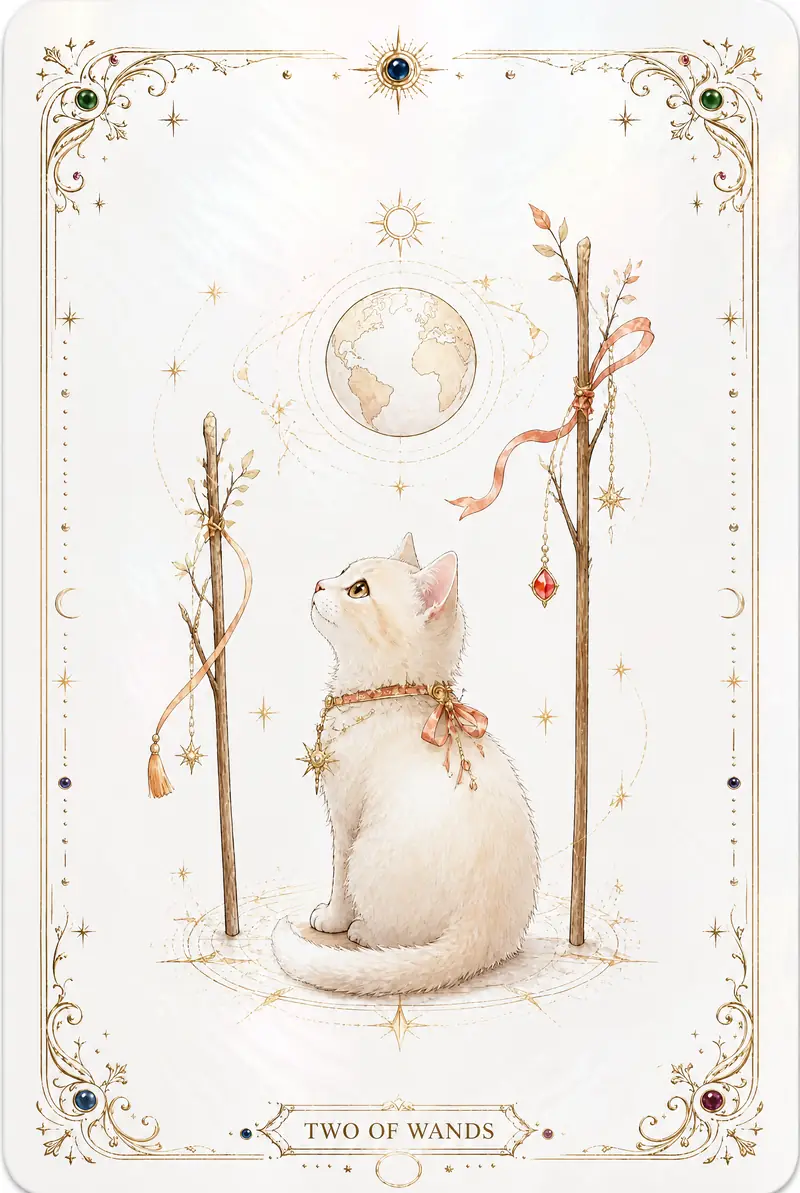
Already standing on the city wall; the question now is how far to look and how far to go.
The image
A figure stands on the battlements of a castle, one hand holding a wand fixed to the wall and the other holding a globe, looking out toward the distant sea and mountains. A second wand stands to one side. The whole picture takes an overhead view with a sense of command (Rider-Waite-Smith).
Core meaning
- The impulse of the Ace of Wands has settled into a first, modest foundation (the castle). The question now is whether to guard what you already have or to expand outward.
- The globe in hand symbolizes long-range planning and a broad view. The real tension in the picture is that even with "the world" in the palm of the hand, the expected satisfaction has not arrived.
- In fact this card is even more "successful" than the Three of Wands. The person stands on the battlements with results already in hand, yet feels bored and restless. The walls that should protect what they have built have become a cage around them, which is an especially stifling position for Fire, an element that by nature pushes outward.
- Waite compared this loss of interest to Alexander the Great, who is said to have wept after conquering the known world because he could not think what was left to do with his life. The Wands love of battle and challenge means that even after winning, a person may not be able to rest in the victory itself. The struggle was the point, and once the goal is reached, the heart cannot settle.
- The contrast with the Four of Wands (and the Ten) is sharp. In those cards people walk out beyond the high walls together, singing and dancing. Here one person stands alone on the battlements, shut in by their own achievement. Both stand on high ground; one leads to a shared celebration, the other to personal isolation.
- The two wands also suggest that the possibility of cooperation is starting to sprout, but control is still held firmly by one person and has not yet really opened up to others (compare the actual arrival of a third party in Three of Wands).
- The two wands differ in length. The shorter one stands freely, while the longer one is fixed to the wall. In the short term the fixed one is safer and more secure, and the free one's future is uncertain. The typical Wands temperament will choose the free one without hesitation, accepting a less than optimal short-term return in exchange for more room to grow.
- Comparing it with the Two of Swords shows two typical decision dilemmas. The Two of Swords cannot let go of the choice because it thinks too much and fears loss too much, and all the weighing traps it. The Two of Wands does not agonize at all, because it knows what it wants, and once it has a direction it goes after it, even if that means giving up the other options. These are the two typical faces of choosing: torn, or decisive.
- Money: if the question is about a major decision that needs money behind it, such as moving house or changing jobs, the card leans toward "act within your means, and if your heart is set on it, move." As long as your finances can carry it, there is no need to suppress the wish for a new environment.
- Health: a good time to shift your attention from whether to start to concrete action, such as joining a gym, taking up a regular sport or building a habit of daily walks, so that the body keeps pace with the wider ambitions.
- The shorter, freer wand stands on a rose cross. The cross itself represents faith and the energy of the four elements of the material world; the white rose symbolizes the power of the heart and spirit, and the red rose the power of action. Both paths can actually lead to growth. This person picks the one that offers more room to grow, even though it looks less safe.
- The gray wall the figure stands on matches the color of the second sephirah on the Tree of Life. It also suggests that they are starting from a certain height and with certain resources. This is not a start from zero where every step must be cautious, and that is part of what gives them the confidence to go after the free option.
Reversed
- The globe once held in the hand falls, symbolizing that something tangible is slipping away. Seen another way, it is also a chance to deliberately put down part of the responsibility and pressure (reading from the image).
- The figure turns to look back the way they came. This is easily read as wanting to return to familiar ground, or as a trip that is on its way home, with the gaze drawn back from the horizon to what is close at hand (reading from the image).
- The castle now stands higher than the person, suggesting that the limits this time come mainly from outside conditions. It is not that your ability falls short; you simply cannot control the situation for now (blocked).
- Hesitating too long and never landing anything lets opportunities slip away. Right now, taking one practical step matters more than waiting for a perfect plan (negative meaning).
- It can also go the other way: an unplanned opportunity suddenly appears, and if you are willing to open up and catch it, it may bring a pleasant surprise (opposite meaning).
- For money, the reversal says "don't move yet." First sort out debts and tighten spending, bring the focus back to the drive of the Ace of Wands, and only then talk about relocating or changing tracks. For health, it may be a reminder that you are neglecting your body, or that your surroundings are themselves dragging your health down. Put basic self-care back in place first, then start a new health plan.
Correspondences
The number two: the "balance and relationship" stage in Numbers in Tarot. Astrologically, the first decan of Aries; see Astrological Correspondences. In the Golden Dawn system, the card's esoteric title is "Lord of Dominion"; see Esoteric Titles.
Views from different traditions
In Aleister Crowley's Thoth system, the decan title of this card is "Dominion," emphasizing the side that has already taken control and is ready to give orders. This echoes the planner's view in the Rider-Waite-Smith image, globe in hand and looking into the distance [inferred: the two differ in emphasis but do not conflict].