The Chariot
Number VII · Element Water · Correspondence Cancer
Upright: willpower, control, breakthrough, determination, victory
Reversed: loss of control, competitiveness gone too far, resolve worn down from within, outside obstacles
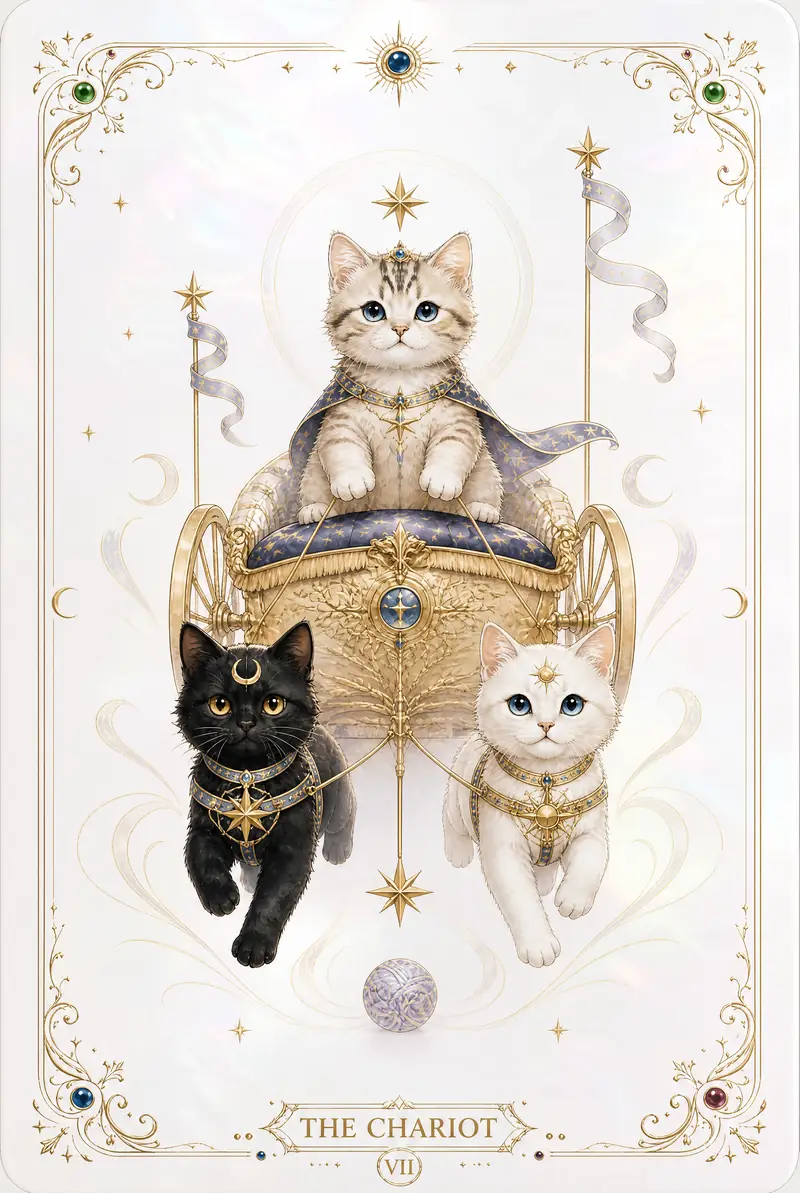
Forces pulling in different directions, bound into one drive by a single person's resolve.
The image
The charioteer wears armor with crescent-shaped shoulder plates, echoing Cancer and the Moon. In front of the chariot lie two sphinxes side by side, one black and one white, facing different ways. The charioteer holds no reins; he steers by will alone, with no ropes at all. The chariot and his crown are decorated with stars, suggesting that this victory goes beyond a simple contest of physical strength.
The white square in the middle of his breastplate stresses spiritual strength and also symbolizes stability and security, showing that this charioteer is no reckless brute. The waxing and waning moons on his shoulder plates echo the Moon, emotion and the subconscious, and they can also be read as a metaphor for life's ups and downs: the waxing moon, growing from partial to full, stands for gaining, and the waning moon, shrinking from full to partial, stands for losing. The journey will bring both gains and losses and is unlikely to be smooth all the way. Both sphinxes have manes (a feature only male lions have), symbolizing male strength, and they also have full breasts, symbolizing female strength; this also echoes Cancer's astrological rule over the breasts and chest. One reading of the city behind the chariot is that it is the destination he is about to reach. But it would make little sense for the charioteer to drive forward with his back to his goal, so it can also be understood as the country and home he protects behind him: he has set out to defend, and has no plan to invade uncertain.
Core meaning
- A mature social personality (the persona): the charioteer carries symbols from the six cards before him (the wand, the water and the canopy, the starry crown, the city, the shoulder ornaments, the lingam and yoni). This symbolizes that the lessons of each earlier card have been absorbed and built into a self-image used to deal with the outside world.
- Controlling opposites without truly resolving them: the black and white sphinxes face opposite ways, and the charioteer holds them in a tense balance by willpower alone. The victory here is in holding down inner conflict. The conflict has not been reconciled; real integration is left for later cards.
- The risk of rigidity and losing yourself: the image of the charioteer almost merged with his stone chariot is a warning. If the psyche bows to conscious will in everything, it can easily become stiff and fixed, and it can easily mistake this successful mask for the real self and then fear letting go.
- Mastering outer rules does not mean knowing your real self: Oedipus, who solved the sphinx's riddle, understood the universal truth about the stages of life, yet never understood who he himself was. The Chariot stands for this stage of maturity: "understanding how the world works, but not yet turned toward knowing oneself".
- Determination and self-restraint: keeping a clear sense of direction and discipline even in chaos or against resistance.
- Victory and breakthrough: after a stretch of effort, a clear and visible result or interim win arrives. It comes from mastering the situation, and the underlying conflict remains.
- The Merkabah practice: the Hebrew name for the chariot means "the chariot of God", from the heavenly chariot the prophet Ezekiel saw in his vision. This image was later extended to an inner "chariot of the soul" that everyone has. Whoever can drive it has the chance to pass through the heavens layer by layer and draw near to the divine, so it developed into a concrete method of meditation and practice and is more than a metaphor. In legend, the prophet Enoch was chosen by God for his outstanding virtue, rose to heaven and became the archangel Metatron, close to God; this stands as the example that "a mortal can walk this road too". This comes from the Kabbalistic mystical tradition and can serve as a footnote to the Chariot's meaning of a spiritual journey.
- The wheels are drawn square, and the base joins directly to the ground, which means this "chariot" could not physically roll forward at all. It is closer to a statue honoring a hero, for those who come after to admire and imitate, than to a vehicle for real battle. This detail strengthens the point that the Chariot's real battlefield is in the spiritual world; victory in the material world is only its more surface layer of meaning.
- What it means in practice: in career and money, it usually points to a steady growth curve that keeps climbing and getting better. In love, it often means two people willing to face difficulties together and protect the relationship side by side. It can also mean that both are too rational and used to arguing their case, so they come across as forceful with each other and do not know how to give way.
- The Chariot holds the "principles of consciousness" of each of the six Major cards before it, each with a specific symbol. The Magician corresponds to attention (where you focus is where power manifests), shown in the wand in the charioteer's hand. The High Priestess corresponds to memory (living inwardly and turning things over again and again), shown in the starry canopy and the moons on his shoulders. The Empress corresponds to imagination (God creating all things and a woman bearing life both begin by "imagining" something out of nothing), shown in his starry crown. The Emperor corresponds to reason (rules and principles), shown in his armor. The Hierophant corresponds to intuition (as a spiritual teacher), shown in the inscriptions on the armor said to come from divination before setting out. The Lovers corresponds to distinction (a sense of separateness lets us recognize and classify things), shown in the wings above the top-shaped emblem. The Chariot therefore symbolizes the state of having absorbed the lessons of the first six cards and set out, fully equipped, for spiritual practice inferred.
- The function assigned to Cheth is "speech". Speech has the power both to create and to drive things forward, which fits the Chariot's dynamic nature: it looks still, yet it is always moving ahead.
- Money, health and spirit: with money, the upright Chariot means that as long as reason can keep feelings under control, financial success is in your own hands. The key is to be clear about direction both before and after reaching the goal and not to give up easily. It is also often used to describe someone who has already succeeded. With health, this is one of two cards that one book treats as a possible warning sign of cancer (the other is The Moon). It is mainly linked to the stomach, the lymphatic system and the chest, and ongoing stress easily leads to indigestion.
- On the spiritual level, the Chariot stands for being pulled between practical demands and emotional needs. One side wants to push feelings down to be more efficient; the other longs for the tender connection of the Lovers. The card encourages setting some needs aside for now and staying with long-term plans, which will eventually bring a matching reward.
Reversed
- Picture association: upright, the charioteer firmly holds down the black and white sphinxes facing opposite ways. Reversed, if the two beasts split further and each goes its own way, it symbolizes that the internal conflict has outgrown the outside challenge. Often it is your own side that falls into disorder first.
- Picture association: the cape of ideals falls away and the moat water floods back into the castle. This suggests that the belief that drove you forward is draining away, so the first setback makes it hard to go on, and emotions easily get out of hand.
- Overdonescheming and tactics used in the wrong place, so that cleverness backfires. Constantly showing off victories or forcing others down brings even greater backlash and hostility.
- Blockedthe strength to control and push forward has clearly weakened. Straining to win now will get nowhere; keeping a low profile, holding what you have and stepping back in order to move forward is the more practical strategy.
- Turned inwardyour efforts may be easily harvested by someone else without the recognition they deserve. The will to fight stays pressed down inside and never really becomes action, which easily breeds resentment.
- Reversed, the card sometimes also points to a partner who is controlling, extremely unstable emotionally or even inclined to violence. The typical pattern is losing control once emotions take over, regretting it and apologizing afterward, and then soon doing it again. Even without physical conflict, it often shows as someone who cannot be reasoned with and flies into a temper easily, making it hard to see a stable future for the relationship. These warning signs are worth noting in a reading.
- Health when reversed is more specific: the reversed Chariot suggests that unprocessed grief, pain, anger or resentment is weighing on your health. "Do not cling" is the reminder of this reversed card: release the feelings that have not been expressed and clear the way back to the upright Lovers, so that emotions stop dragging the body down.
Correspondences
Cancer (a Water sign); Hebrew letter Cheth ח. For the full set of correspondences, see Astrological Correspondences and The Kabbalah and the Tree of Life.
Cheth literally means "fence", something that encloses a protected piece of land that can be farmed. It carries the double sense of drawing boundaries and guarding life, which matches Cancer's image of "a shell that protects the home". On the Tree of Life, Cheth connects Binah (Understanding) and Geburah (Severity). With a clear sense of right and wrong already in place, the next step is to clear away what does not fit and become strong. This echoes the Chariot's core meaning: using willpower to bind forces pulling in opposite directions into one drive and break through.
Views from different traditions
In the Marseille Chariot, two horses pull the chariot, and the picture is closer to a literal "triumphant charioteer" with no clear black-and-white opposition. Waite replaced the horses with two sphinxes, one black and one white, strengthening the more psychological reading of "mastering opposing inner forces" inferred.
- Waite borrowed this change from Éliphas Lévi, a pioneer of Kabbalistic tarot. Sphinxes carry this meaning better than horses: in Greek myth the sphinx outside Thebes posed riddles, and the question it asked was "what is man", which fits the mature personality the Chariot stands for.
- Advanced Golden Dawn reading: the combination of symbols on the charioteer's belt (the letter Cheth, the Cancer glyph and a half-moon) is the most direct evidence for this card's link with Cancer. The pair of crescents on his shoulder plates (waxing and waning, symbolizing increase and decrease, joy and sorrow), together with the shape of the breastplate, look closer to the glyph for Pisces. This does not mean the Chariot really corresponds to Pisces (the Moon is already card 2, and Pisces is already card 18, the Moon card). Waite uses the visual resemblance to stress what Cancer and Pisces share as Water signs.
- Cheth literally means "hedge" or "enclosure", and also "beast of the field". The city walls in the background and the square stone car that holds the charioteer fast both echo the sense of "enclosure", read as a visual metaphor for material and emotional constraint. The pair of sphinxes pulling the chariot corresponds to "beasts of the field"; this image was first brought into tarot by Éliphas Lévi, replacing the horses of the traditional picture.
- The crab's form echoes the composition of the whole card: the two claws correspond to the two sphinxes, the movable shell to the wheeled chariot, and the soft body to the charioteer's armor. This is thought to encode the actual animal of Cancer into the overall design.
- The starry canopy is an indirect hint at Cancer. Cancer is the only sign in the zodiac ruled by the Moon alone (just as Leo is ruled by the Sun alone), so the starry canopy points indirectly to the Moon's command of the night sky, and through that to its rule over Cancer's fate.