Eight of Swords
Number VIII · Element Air · Correspondence First decan of Gemini
Upright: self-imposed limits, learned helplessness, feeling stuck
Reversed: breaking free, seeing a way out, regaining control
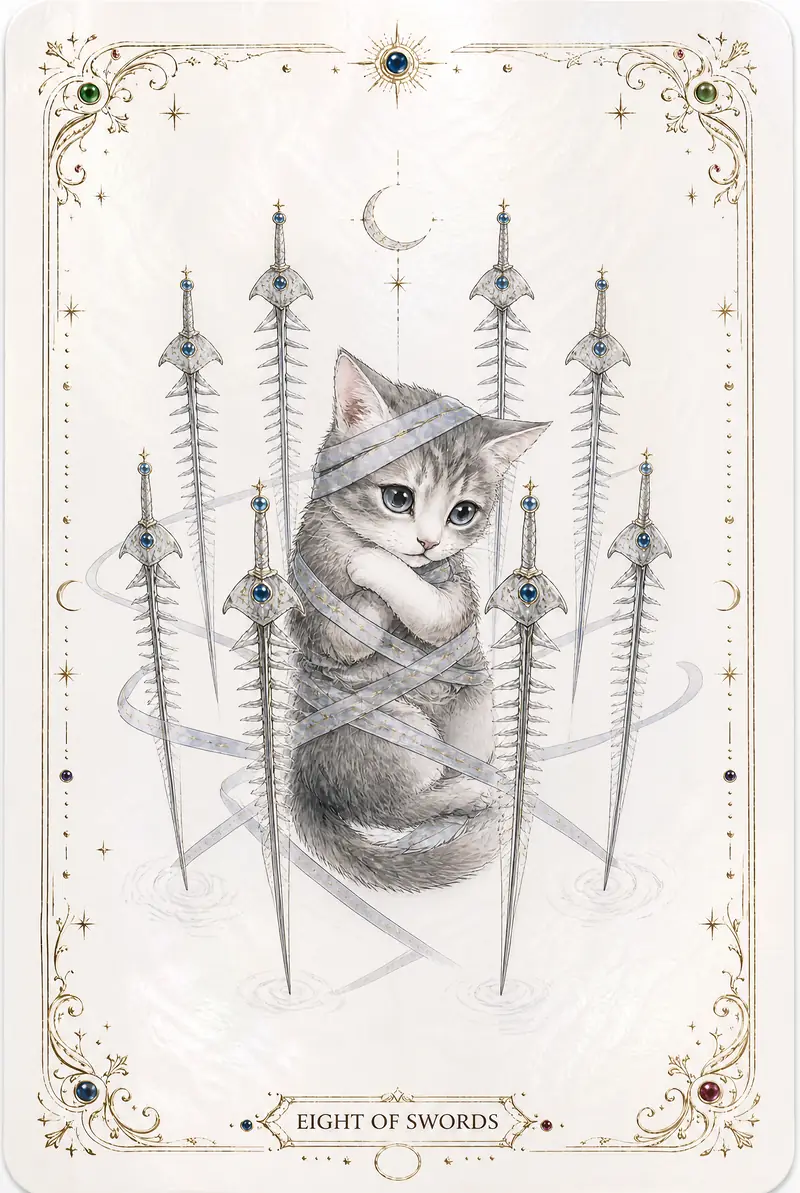
The ropes binding her are not very tight and the blindfold is not very secure; what really holds her in place is her own thinking.
The image
A woman with her hands bound by rope and her eyes covered stands alone inside a ring of eight swords stuck in the ground. A castle stands in the distance. The ground at her feet would not actually be hard to walk away from.
Core meaning
- The number eight is about strength gathering again and pushing forward (see Numbers in Tarot). The Eight of Swords is almost the textbook inversion of that shared meaning within the Swords suit: energy that should be moving forward is trapped by the person's own thinking and cannot move.
- The key detail is that this "prison" is largely psychological. The ropes are not tied very tight, there are gaps between the eight swords, and the blindfold does not seal completely. In theory she could work herself free or see a way out, but she has decided she cannot get out inferred.
- This is the Swords card most typical of being trapped. A person keeps telling themselves "I have no choice," "I can't do it," "nothing can change," and that story itself becomes the real shackle on their actions, stronger than any outside condition.
- Given the suit's link with thought, this card shows exactly how negative thinking patterns trap a person in practice. Catastrophizing, black-and-white judgments and learned helplessness are all real-life versions of this card.
- The distant castle suggests that rescue or a way out does exist. The person's attention is simply fixed on the trouble right in front of them, and they cannot see the bigger picture.
- Common concrete situations: being able to change jobs and thinking "I'll never find anything better," being in a relationship that is clearly unhealthy and thinking "if I leave I'll have nowhere to go." These thoughts are the real-world versions of the ropes and the blindfold.
- There are gaps between the swords wide enough to walk through. This detail is what most clearly separates the card from real physical imprisonment: what holds her is never the swords themselves. It is her conviction that she has no choice.
- The card is also often used as a reminder in the style of cognitive behavioral therapy: the first step out of the trap is to sort out which limits really exist and which are only assumptions in one's own head inferred.
- Pollack borrows the concept of "mystification" from theories of political liberation to explain this card. What really oppresses a person is often not a direct threat of force but a story that trains them to believe they are helpless and without options. Once that story is internalized, people actively cooperate with the illusion of being trapped, even in situations they could in fact leave.
- Pollack also reads this card as a gateway card to a particular kind of awareness: recognizing that one's perception is itself limited by the filters of the senses, language and culture. Many people can grant this ignorance in principle but rarely truly accept it. Being willing to face that limitation is the first step toward really knowing oneself and the world, and often the hardest step to take.
- The castle stands on a cliff. Another reading is that it represents a once familiar, secure way of life, from which the person is now moving away. That distance can be passive (the old security has been taken away and the person is trapped against their will) or active (the person has finally seen that many things they used to cling to do not really matter and has chosen to let go of old ways of thinking). Both readings hold. The key is to work out whose choice this distancing is.
- On a more practical level, people are often held back by outside judgments and expectations because they still care about what the outside world can give or take away: money, reputation, approval. Once someone truly stops prizing these stakes, the leverage others hold over them loosens as well. This and recognizing that one is trapped by a story are two sides of the same coin. One is about awareness; the other is about how to get free afterward.
- In money questions, the Eight of Swords often corresponds to real financial hardship: unemployment, spending more than one earns, being chased by debt. The point of the card is not how to turn things around overnight. It is a reminder to keep one's judgment intact even under this kind of real pressure, listening more to inner intuition instead of grabbing at anything in desperation.
- In health questions, the card is often linked with the concrete feeling of not being able to catch one's breath: asthma, tightness in the chest, low mood. When many choices pile up on top of heavy stress, people easily fall into this sense of being tied down by their surroundings. The suggested direction is to loosen one's attention first through meditation or similar practices, and only then work on regaining a sense of inner control.
- The robe also echoes the imagery of an initiation rite. The candidate is first bound with rope and blindfolded, speaks vows in answer to the guide's questions, and is untied only when the rite is complete. This symbolizes finally waking up amid the many limits of the material world and being ready to face the truth of the world. It is also why the card is often read as "the darkest hour before dawn."
- The eight swords themselves are the power of thought, and they can be understood in two ways. One is judgment and moral pressure imposed from outside, weighing so heavily that it is hard to breathe. The other is the reason and intelligence the person has never given up, even surrounded by limits. Both readings hold; the key is which side this "bound thinking" points to in the specific case.
Reversed
- Blocked: The castle in the background moves to the upper left. This time the outer limits really are more real and more defensive; they are not necessarily shackles the person imagined. The room to act according to one's own will really has shrunk.
- Overdone: All eight swords turn to point upward together. This can easily develop into a head-on clash or fierce opposition, or, conversely, into everyone uniting against an outside threat. If the trapped woman has already made it out of the ring, a breakthrough is truly possible, but the process requires extra care, and getting free will take more than a single step.
- Blocked: Unexpected situations are likely in this period and need to be handled calmly and with focus. Betrayal is also possible, and it is usually not sudden; it is old business carried into the present that is only now coming to the surface. An unease that is hard to put into words may come close to nervous exhaustion. Trying to open up a little will help.
- Turned inward: The truth is starting to come out. Stop fooling yourself; only by facing reality can you make the right judgment. As long as the person is willing to drop old ways of thinking, the deadlock can actually be broken, and success or failure often turns on a single shift in thinking.
- Blocked: Also avoid being pushed into hasty action by every piece of bad news. If your original judgment was right, it is better to hold to it than to throw yourself into disarray.
- Turned inward: In money questions, the reversal often means the hardest stage is over. Now is a better time to go back and cut some spending, or to work out a sustainable repayment plan with creditors, instead of staying stuck in an anxious story of being trapped by debt. In health questions, the reversal likewise points to having passed the low point and getting better, and it is worth staying open to any kind of care that might help.
Correspondences
Number eight, see Numbers in Tarot. Element: Air. Astrology: first decan of Gemini, see Astrological Correspondences. In the Golden Dawn system its esoteric title is "Lord of Shortened Force"; see Esoteric Titles.
Views from different traditions
The Crowley-Thoth system calls this card "Interference," putting more weight on outside forces limiting the individual's will. The Waite imagery and reading tradition put more weight on the trap being largely self-made and something the person can break themselves disputed. In actual readings, the two views often have to be weighed against the querent's specific situation to judge whether the greater limit is outside reality or the person's own perception.