Queen of Swords
Number Q · Element Air · Correspondence —
Upright: clear-headedness, independence, speaking plainly, insight from experience
Reversed: cutting remarks, closed off and isolated, overthinking that turns on itself
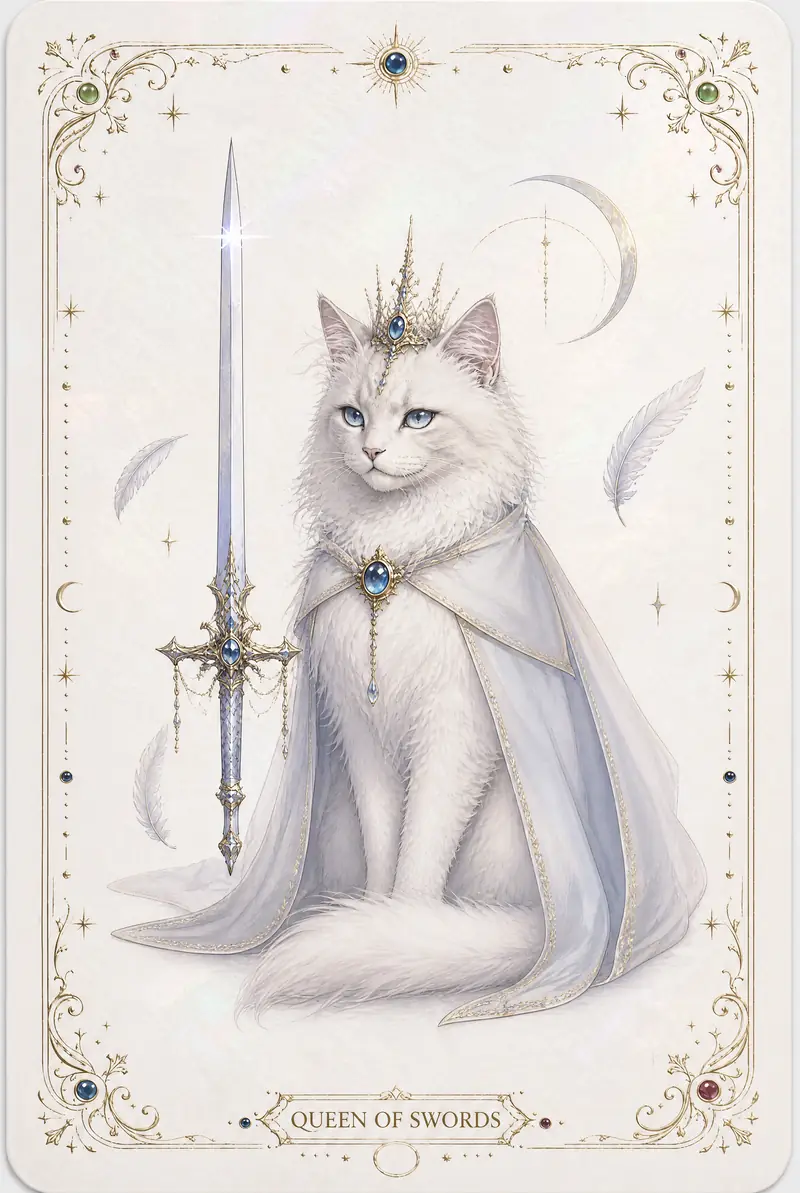
Her sharpness comes from having been hurt and still choosing to tell the truth.
The image
The Queen sits upright in profile on a throne carved with butterflies and a cherub. One hand holds a sword straight up; the other reaches forward. Her expression is sharp and restrained. There are clouds in the sky and a single bird in flight, and the overall mood is cooler than that of the other three Queens.
Core meaning
- In The Court Cards, the Queen rank corresponds to Water: inwardness, maturity, influence exerted in a gentle way. Combined with the Air of Swords, this pairing describes a clarity that has been tempered by feeling. Her perceptiveness is not the naive judgment of someone who has never been through anything. She has known loss and pain, possibly even a major bereavement (some traditions read the Queen of Swords as a woman who has suffered an important loss uncertain), and she has turned all of it into an insight free of illusions.
- This is the most distinctive form the Queen's shared character in the court system (nurturing, inward, gentle influence) takes in any suit. She does not comfort people with warmth; she shows care by telling the truth. "I won't lie to you, even if the truth is hard to hear" is how she communicates.
- Her outstretched hand is often read as an invitation, though it can also be a gesture of judgment. She is willing to listen, but at the same time she weighs whether what the other person says holds up. An emotional line of talk will have a hard time getting past her.
- Given the suit's link with thought and truth, the Queen of Swords sees through things most clearly of the four Swords court cards. She is independent, not easily persuaded, and used to judging by logic over emotion. She represents someone who has lived through things, is no longer naive, and speaks directly, even coolly.
- Compared with the runaway double Air of the Knight of Swords, the Queen's Water lets this Air settle. Her sharpness has been digested before it comes out; it is not blurted.
- Common concrete situations: a friend who has been through a divorce and still has her life clearly in order, an advisor whose directness can sting but who is right every time, a negotiator who is not easily moved by sweet talk on the surface. What this card stands for is someone who has been hurt and still chooses to see clearly, not someone who cannot be hurt.
- The King of Swords uses clarity to build outer structures and rules. The Queen uses hers more to read people, judge situations, and protect herself and those close to her. It is a sharpness closer to personal life.
- The card also often stands for a good mentor or advisor, someone willing to tell you an unwelcome truth because she believes that is more responsible than letting you go on living in a fantasy.
- Pollack points out the tassel on her left wrist that looks like a cut length of rope (compare the ropes in the Eight of Swords). She freed herself from confusion, doubt and fear by using the sword of the mind. This clarity is something she broke free into herself; she was not born with it.
- Pollack reads the hand stretched forward as a sign that even while she frowns at the world, she keeps an invitation open in her heart. She is willing to reach out and make contact; she just will not pretend everything is fine. This is what separates the card from simple coldness.
- Pollack also notes that, historically, women with little power have often suffered because of what men did, which is why the Queen of Swords is sometimes linked especially with women's experience (and is even read as widowhood). But grief and the courage it gives rise to have no gender. The card can just as well describe anyone, of any gender, who has been through a major loss and still chooses to face things with a clear head.
- In money questions, this type has a wide network and is good at asking around, comparing prices and finding the right channels. If you need to negotiate the price of a car or find a reliable professional (a lawyer, an advisor), she is the one to ask. In financial judgment she wants evidence and order, and vague talk will have a hard time getting past her.
- In matters of health and mental wellbeing, the most typical drain on this type in a negative state is not outside pressure. It is the mind turning inward to criticize itself. When a perfectionist is unhappy with herself, the sharpness she normally uses to analyze problems turns its aim on her, going round and round and making it impossible to focus. The practical advice is to steer this ability away from finding fault with herself and back toward solving concrete problems.
Reversed
- Blocked: The throne takes over the picture from the Queen herself. She is held back by some fixed condition, though the limit may be only in her head. It can also signal being trapped by someone else's malicious attack; the first step is to watch the situation calmly, then respond with precision.
- Turned inward: The sword now points downward, symbolizing a struggle turned inward. On the outside she still looks calm, but the internal conflict and opposition are already quite serious.
- Overdone: Doing whatever it takes to reach a goal, even deceiving or manipulating others, and paying a heavy price once found out. It can also be keeping up a falsely friendly surface while privately treating the other person as an imagined enemy, slandering them behind their back or stirring up trouble between people.
- Holding a strong bias about something, refusing to face the truth and clinging to a preset position, which makes rational judgment impossible. Being too cold and distant toward people; to improve a relationship, she will need to make the first move.
- There is also a relatively gentle side. The sword slips from her hand, and with her defenses lowered she becomes more approachable than when upright and more willing to show her softer side.
Correspondences
Queen = Water (rank) + Swords = Air (suit); see The Court Cards. Does not take part in the decan correspondences.
Views from different traditions
The Crowley-Thoth system keeps the name "Queen" unchanged, but the details of the elemental role of the Queen rank in the Thoth system differ somewhat from the Waite system, and the sources themselves do not agree on the specifics uncertain. This site does not set out the full Thoth elemental correspondence table here.