Knight of Swords
Number Kn · Element Air · Correspondence —
Upright: decisiveness, eloquence, quick decisions, sharp edges on show
Reversed: reckless aggression, action stalling, losing direction
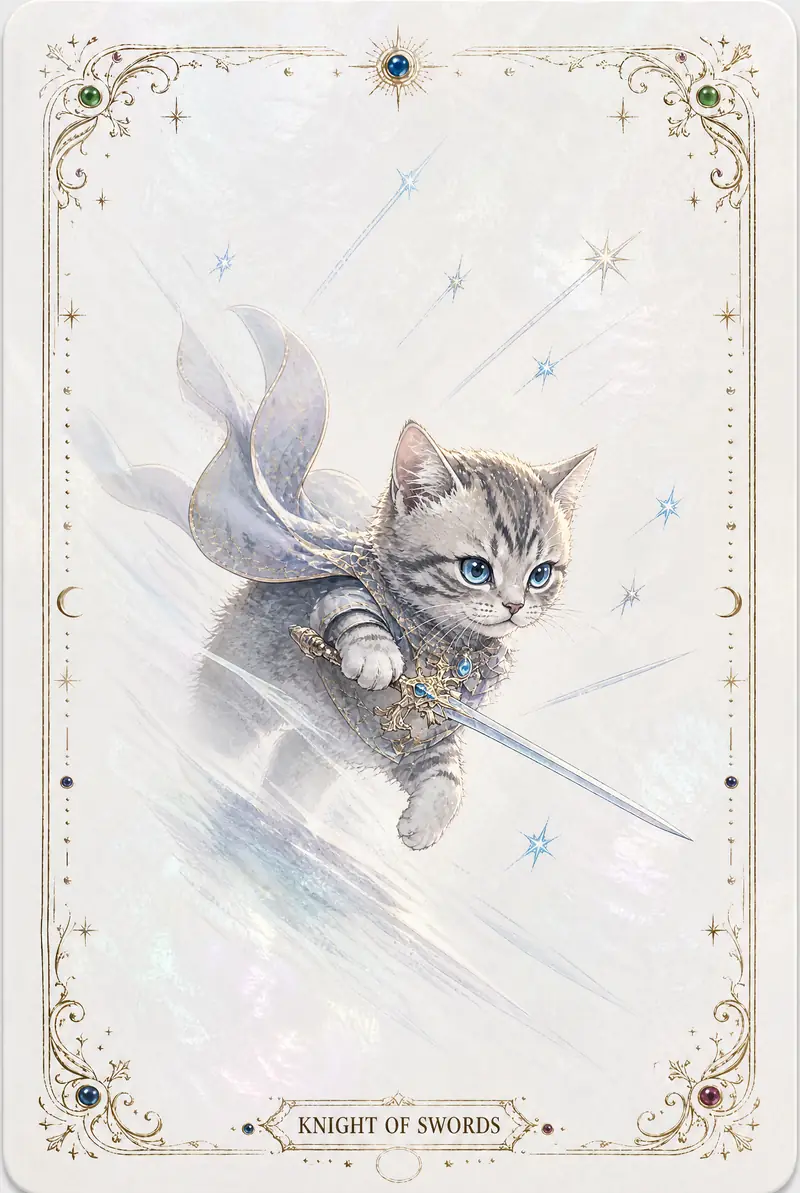
The moment a thought takes shape he has already charged off, and the brakes have not been fitted yet.
The image
The knight gallops at full speed, almost in a cavalry charge, his drawn sword raised high. Behind him the trees are bent this way and that by a strong wind, and the clouds are torn into strips. His horse moves more wildly than in any of the other three Knight cards.
Core meaning
- In The Court Cards, the Knight rank itself corresponds to Air: a single goal, an all-out charge, a tendency to go to extremes. Combined with the Air of Swords, this is Air doubled. Of the 16 court cards, it has the most concentrated mental energy and the fewest brakes.
- This double Air reads as an almost runaway acceleration of thought. Once an idea is settled, it is acted on immediately. There is none of the Page of Swords' hesitation ("let me figure it out first") and none of the Queen's or King's step of weighing the consequences.
- On the positive side, the Knight of Swords is eloquent and decisive, someone willing to charge into battle for a position. A cutting rebuttal in a debate or a snap judgment at a moment of crisis are both positive expressions of this card.
- On the negative side, this is also the Swords card most easily read as reckless: speaking without regard for the setting, arguing without leaving the other side any way out, proving oneself right whatever the cost. The doubling of Air shows up here as sharpness of mind completely overwhelming patience.
- As the second step in the court cards' progression of maturity, the Knight of Swords has more drive than the Page but less reflection and weighing of consequences than either the Queen or the King. He charges fastest, and he is also the most likely to charge in the wrong direction.
- Common concrete situations: deciding on the spot to rush off overnight to deal with a crisis, standing up immediately to argue the case on seeing something unfair, giving the other side no room to breathe in a debate or negotiation. There is no doubting this card's drive. The problem is usually whether the consequences were thought through first.
- Where the Page of Swords is still at the stage of gathering news, the Knight has already fixed a target and is charging at full speed. This jump from Page to Knight is the first real step in the court cards' progression from observation to action.
- The card is also often used to describe a personality that acts on an idea the instant it comes up. At its best this is swift and decisive; at its worst it is too impatient to let others finish what they are saying.
- His youth is also his freedom. He does not carry the weight of social responsibility like the King of Swords, and he has not been tempered by experience again and again like the Queen of Swords. So he can charge with everything he has, but he is also more likely to treat every encounter as a battle that a single all-out rush can settle.
- He is almost the opposite of the Knight of Cups. All his energy is directed outward into action, and being asked to stay quiet, be alone and do nothing actually makes him tense and uneasy. Behind his eagerness to attack there is sometimes a fear of failure, hidden by the posture of the charge. That fear comes out into the open only when he meets a problem that calls for long, hard work and cannot be knocked down in one rush.
- In money questions, this type is highly driven and always chasing the next new opportunity. Upright, that decisiveness can catch a market move that will not last. The risk lies in the same place: when a decision or investment goes wrong, this kind of person tends to cut ties quickly and leave the mess to others, rushing at the next opportunity without wanting to clean up. In a reading, this is a reason to ask the querent whether their ability to deal with the aftermath keeps pace with the speed of their attack.
- This type cannot sit still by nature and needs a steady supply of new goals to charge at. If forced to live an unchanging life for a long time, or made to rest because of illness, the suppressed drive easily turns into restless irritation. It is better to deliberately find a concrete outlet for that energy inferred.
Reversed
- Blocked: The galloping horse's momentum overpowers the knight himself. Things have already gotten out of control, and even desperate efforts to pull them back may be futile. Or, the other way around, the knight falls from his horse, the momentum suddenly disappears, and he becomes all talk and no action.
- Overdone: The sword now points to serious conflict or even disastrous consequences. Plunging in headfirst without assessing anything beforehand, he is quite likely to walk straight into a trap someone else has set. The environment itself is full of opposition, with no room for reconciliation or coexistence.
- Too proud and self-satisfied, holding to his own views and ignoring advice; once trouble comes, no one is willing to lend a hand.
- Turned inward: The opposite side is coming across as weak and ineffective, letting others push him around while refusing to change. It may also be a head full of counterarguments that cannot be spoken, held in until they ferment into passive resistance. When haste is defeating its own purpose, the first need is to calm down.
- Spending without restraint, squandering everything built up in the past in one go. The goal is unclear, the direction is wrong, and things are far less simple than he thinks.
Correspondences
Knight = Air (rank) + Swords = Air (suit), double Air; see The Court Cards. Does not take part in the decan correspondences.
Views from different traditions
The Crowley-Thoth system replaces the Knight rank with the "Prince," and its four ranks run Princess, Prince, Queen, Knight (the "Knight" taking over the role of the former King rank). This naming does not line up exactly with the Waite system, and readers consulting material on the Thoth deck should keep the mismatch in mind inferred. This site's card pages use the four Waite rank names.