Page of Swords
Number P · Element Air · Correspondence —
Upright: curiosity, alertness, passing on news, beginner's critical thinking
Reversed: careless talk, all talk and no action, prying into privacy
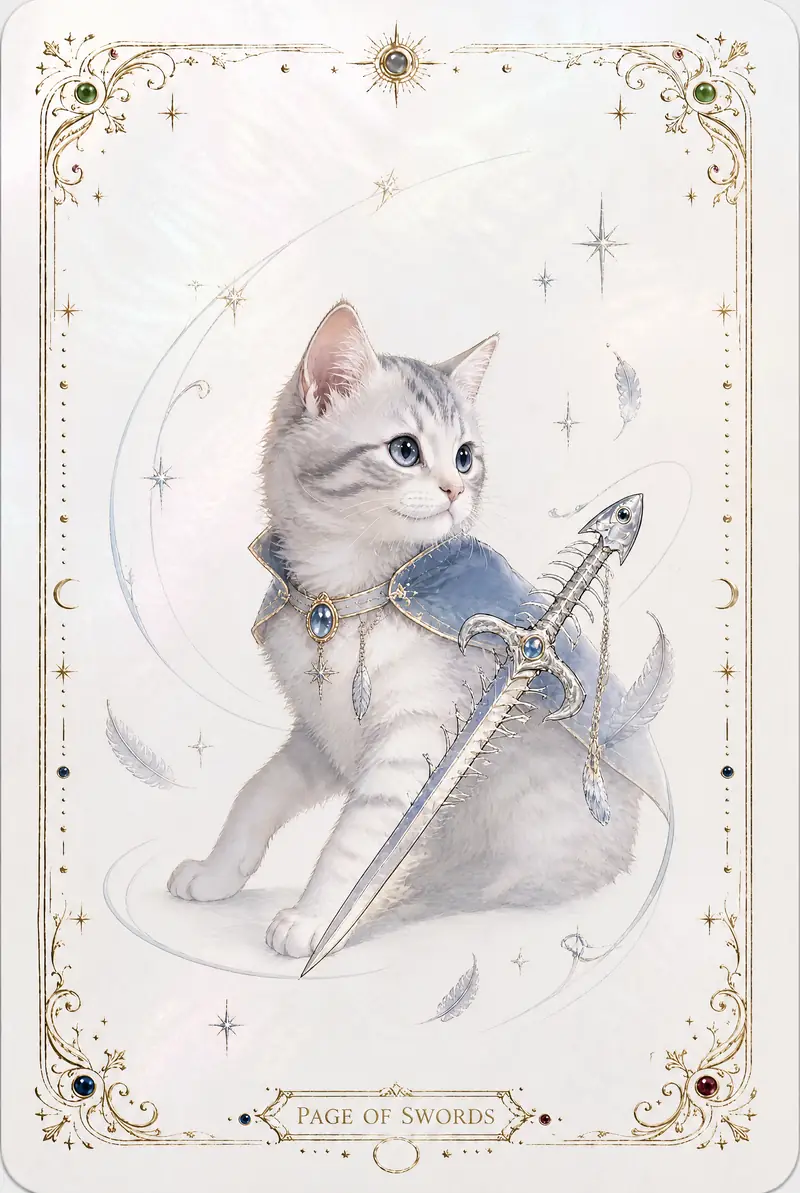
At the age when he wants to figure everything out, he has not yet learned which words to hold back.
The image
A young man stands high on a hill, gripping a sword in both hands. His stance is alert but not yet steady. The wind tosses his hair and the hem of his clothes, clouds churn in the distance, and a flock of birds is scattered across the sky by the wind.
Core meaning
- Under the double-element logic of The Court Cards, the Page corresponds to Earth: the learner, the beginner's stage. Combined with the Air of Swords, this card describes a young state with an active mind and sharp powers of observation but a mental foundation that is not yet solid. Earth here cannot hold Air steady, and his thoughts move far faster than his feet can keep up.
- This is what the Page's shared character in the court system (curious, bringing news, not yet mature) looks like in the Swords suit: someone extremely sensitive to information, gossip and new knowledge, quick to believe every rumor, eager to figure everything out, but not yet able to tell which things should be said and which should be held back.
- The unsteady grip on the sword and the watchful glance show a mind still braced to defend or strike back at any moment. It easily reads minor things as threats, or treats the slightest stir as big news.
- Given the suit's link with thought and communication, the Page of Swords often stands for news, rumors, a blunt or even barbed question, or someone who has just begun learning critical thinking and asks "why" about everything.
- As the least mature rank among the court cards, the Page has the least controlled Air of the four Swords courts. Its lack of control differs from the Knight's all-out charge. It is the scatter of thoughts that have not yet found a direction.
- Common concrete situations: a new hire asking around for gossip everywhere, someone on social media who shares every unverified story, a teenager who has just discovered arguing for the sake of it and cannot stop. The sharpness this card describes has not yet been matched with enough judgment.
- The flock of birds scattered by the wind echoes the way thinking works at this stage: with too many thoughts, they get in each other's way and the main point slips away. It takes time for them to settle into judgments that are actually useful.
- The card also corresponds to the early stage of training in critical thinking: finally learning to question and ask, but not yet learning to use that ability with goodwill and a sense of proportion.
- Pollack offers a reading somewhat different from "asking around." This Page's strategy is not to rush in and resolve conflict. He feels it is enough to rise above the problem, finding a high vantage point to watch from instead of actually getting involved and dealing with it directly. If the situation does not need to be taken very seriously, this detachment is an advantage. When a truly difficult problem comes along, watching from the sidelines falls short.
- Pollack gives Hamlet as an example. As a somewhat older "student," his stance of watching and mocking reflects the Page of Swords' character, but his situation actually called for the Knight of Swords' approach of taking action. This points to the Page's greatest limitation: he knows what to question but often lacks the will to actually step in and act.
- In money questions, this type of person reacts quickly and talks well, and is very good at bargaining to win concessions and chances to reach a goal; they do not come off badly at the negotiating table. The same quickness is also where financial follow-through can fail. Plans tend to stay at the level of talk, and agreements get made but are not carried all the way through. When judging this kind of situation, ask one more question: was what was promised actually done?
- In health questions, this type has plenty of energy by nature and a mind that will not switch off. Upright, it shows as liveliness and ease with people. When it turns negative, the restless mental energy easily becomes scattered attention and an inability to sit still. The practical advice is to steer the querent toward concrete tasks that use up this energy, instead of leaving their thoughts to spin idly.
Reversed
- Blocked: The rocky ground at his feet takes over the picture from the figure himself. His footing is not yet solid, and he is likely to fail when something truly difficult comes up. The sword dropping downward out of his hands suggests rushing into a fight with no preparation, lacking training and equipment, and being caught off guard by the unexpected.
- Turned inward: Too much suspicion and defensiveness make it hard to build sincere relationships and can lead to isolation. The sword pointing down may also suggest being hurt by rumors or bad news; watch for a potential challenger.
- Overdone: Speaking without thinking, spreading unverified news everywhere, or turning curiosity into prying into other people's private lives.
- An attitude that is too casual, overlooking key details and failing as a result. Surface-level smoke and mirrors may fool others but not oneself; steady, solid effort is what really counts.
- It may also point to obstacles in communication or expression, leading easily to misunderstandings, or to running into unexpected confusion.
Correspondences
Page = Earth (rank) + Swords = Air (suit); see The Court Cards. Does not take part in the decan correspondences.
Views from different traditions
The Crowley-Thoth system calls this rank the "Princess" and gives her the added meaning of opening into the material world and grounding Air's ideas in reality. Compared with the Waite system's simpler role of messenger or learner, this puts more weight on the rank's eventual task of turning thoughts into concrete action inferred. This site's card pages use the Waite name, Page.