Ace of Swords
Number I · Element Air · Correspondence —
Upright: clarity, breakthrough, truth, new ideas, getting straight to the point
Reversed: confusion, harshness, blocked decisions, obsessive overthinking
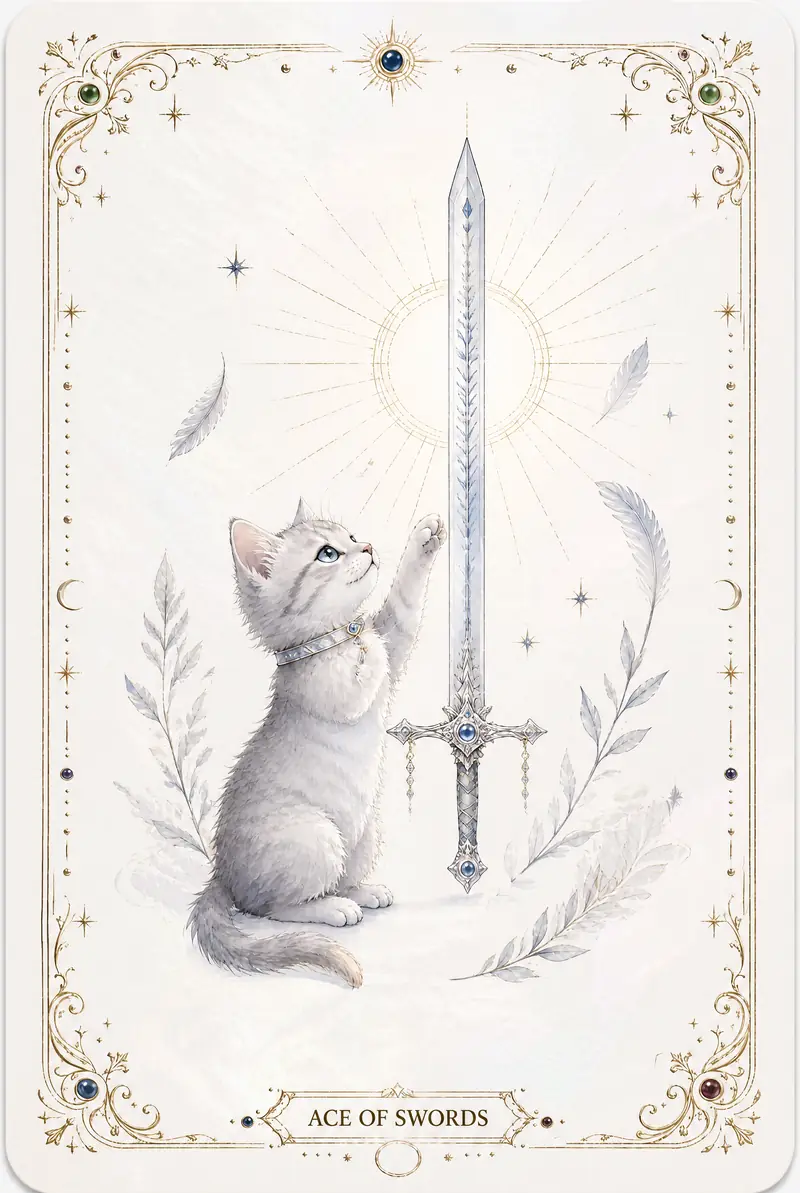
The sharpest moment of the Air element: the flash in which the truth suddenly becomes plain, with no compromise involved in reaching it.
The image
A hand reaches out of a cloud and holds a double-edged sword straight up, point to the sky. A wreath of olive and palm branches hangs around the hilt. Both edges of the blade are sharpened. Below are barren peaks and open wasteland. There are no figures in the picture, only the sword itself.
Core meaning
- This is the Swords suit at its least diluted (see Numbers in Tarot on the Ace): a pure mental breakthrough. A thought suddenly falls into place, or a single sentence cuts a confused situation cleanly in two.
- Given the suit's character (Swords = Air = thought, communication, truth), the Ace often corresponds to an insight or a decisive remark: the line in a negotiation that settles the matter, the argument a writer has finally worked out, the cause a diagnosis has finally found.
- The double edge is the detail that sets this Ace apart from the Aces of the other suits. Truth and clear thinking cut both ways: they can shed light and they can wound. The Ace of Swords does not promise that this clarity brings only good news inferred.
- Olive and palm appear together in the wreath. This suggests the clarity comes as a peace won after some kind of confrontation, after an unpleasant fact has been said aloud. It is not an insight that arrives for free.
- The Ace of Swords touches tarot's fifth element, Spirit, more than any other minor card. The sword points straight to the sky and pierces the illusions that cover the material world. The mountains below the wreath can also be read as abstract truth itself, free of the limits of personal opinion and experience, and not only as practical obstacles standing in the way.
- There is a caveat, though: once the intellect comes loose from intuition and feeling, it creates new illusions of its own. Real awareness needs the heart (the love that Cups represent) to work alongside it. Figuring something out with the head alone does not necessarily mean the truth has landed.
- The tight grip on the hilt allows another reading. Sometimes this card is less a calm rational breakthrough and more an extreme form of emotional drive itself. Love and hate both make people hold on hard, and both are difficult to control and direct.
- On a psychological level, this direct, sharp image of closing in on the truth is especially useful for people who habitually suppress anger or who have lived through abuse. It can help bring buried feelings back to the surface of awareness.
- The Ace is one of the few purely positive number cards in the deck, and one of the rare Swords cards where you do not have to work to find a positive reading. That fact only underlines how hard several later cards in the suit (the Five, Seven, Eight and Nine) are to read.
- Typical concrete settings: an exam or a thesis defense, a negotiation, a contract. Any occasion where words and logic settle the matter is a classic fit.
- At an abstract level the card is also a symbol of logic or reason itself: a thinking tool that cuts through appearances to the essence. Upright, the tool is being used well.
- The nine small red gems set in the crown are an often-overlooked detail. Red corresponds to Fire and the drive to act, and one needs nine more to make the complete number ten. The reminder is that this card only provides a good starting point. Its real value is realized by working steadily through the nine concrete steps that follow. Inspiration without grounded execution is not enough.
- The hand coming out of the cloud shows its back, the opposite of the Ace of Wands, which shows the palm. Wands stand for action, and once an action is taken it is out in the open for everyone to see. Swords stand for thought, and a thought stays hidden until it is spoken. This is why the Ace's clarity means, first of all, that the speaker has worked something out privately. It does not necessarily mean anything has been disclosed to others yet.
- In money questions, the Ace of Swords points away from impulsive investment decisions and toward a rational plan: first see clearly how conditions are changing, think the plan and its steps through, then act. In an outcome position it usually means "once it is clearly thought out, it will work," on the condition that it really has been thought through and you are not just assuming it has.
- In health questions there are two readings side by side. One is a clear understanding of your own physical condition, with good judgment. The other comes from the sword's resemblance to a scalpel and is often extended to mean surgery may be needed. The card does not commit to either; in a reading, use the other cards to decide whether it means "seeing clearly" or "time for the knife."
- In Western alchemy, the four elements were created in this order: Fire, then Water, then Air, then Earth. Fire is the original drive to act; Water is the belief and love that push that drive into form; Air is the child of masculine Fire and feminine Water and carries duality from birth. This is one way, from elemental philosophy, to explain why the Ace of Swords is drawn as a double-edged sword: language and thought are never forces that run in one direction only.
- The six yellow falling leaves arranged symmetrically above the hilt (three on each side) also carry meaning. Yellow corresponds to Tiphareth (Beauty), the sixth sephirah on the Tree of Life, and points to balance and nobility. Six is also the number of time: sixty minutes in an hour, twenty-four hours in a day, twelve months in a year, nearly every unit of timekeeping a multiple of six. The outline of the six leaves also matches the shape of the Hebrew letter Yod, which stands for initiative and first potential.
- A small triangular point on the blade, easy to miss, appears only on the Ace and not on the Two, Three or Four of Swords. It symbolizes Fire infused into Air: a workable plan that carries the force to act, as opposed to an idle idea. This is what allows the Ace to lead to success. The blade is of moderate length, suggesting the idea is clear enough, neither long-winded nor oversimplified. The blade narrows in the middle and widens toward both ends, suggesting the idea starts out simple and will be refined over and over later on.
- The cloud can be read two ways. One is muddled thinking that has not been sorted out yet, a head full of thoughts that will not fall into order. The other is the divine itself: in the middle of the confusion, a sudden inspiration, as if someone had given you a nudge and it all clicked.
- The purple and blue peaks below echo wisdom and the Great Work, and also stand for breadth and dimension. If the six leaves represent time, the mountains represent space. Once a good idea is truly put into practice, its value can outlast the limits of time and place.
Reversed
- Blocked: The range of peaks moves from the background to the top of the picture, and the outer obstacles pile up and become hard to untangle. This insight is not a wall you can push over by yourself; before it can be put into practice there is usually a heap of difficult practical problems to deal with first.
- Overdone: The sword now points downward and stabs from above. Holding the sword becomes being struck by it. The direction has flipped, but the sword's capacity to wound has not gone away, so verbal attacks, blame or even formal discipline are more likely to land on the querent. The wreath falls along with the position of control it stands for, which often points concretely to losing your say, being sidelined at work, or being pushed out of a job.
- Overdone: Thinking is still urgent but has lost its direction. The harder you try to sort things out quickly, the more tangled they get, so this is a bad time for major decisions. In love, it can mean clinging to a relationship that should have been let go long ago, where holding on only adds to the strain.
- Blocked: Rational judgment has temporarily failed, and the moment to strike first has already passed. Rather than rushing to take the initiative, it is better to stay put and wait for the other side to show its hand.
- Turned inward: A lack of confidence and frayed nerves begin to show. The worry that "I can't do this" is often harder to deal with than the situation itself.
- Blocked: In money questions, the reversal often points to too many scattered ideas and a plan that never comes together, so a new project keeps getting delayed. Rather than pushing ahead, go back and sort out the old accounts and basic problems first, and only then think about starting again.
Correspondences
Number one (Ace): the suit itself, undifferentiated Air energy; see Numbers in Tarot. Element: Air. The Aces do not take part in the decan correspondences; see Astrological Correspondences.
Views from different traditions
In the Marseille tradition and other earlier decks, most number cards simply arrange the suit symbols in a geometric pattern, with no figures or scenes. The Marseille Ace of Swords is a single sword with decorative flourishes. The Rider-Waite-Smith deck was one of the first to give all 40 number cards a narrative scene, and details like the hand from the cloud and the wreath are inventions of the Waite system, not imagery that tarot has always had inferred.
In traditional divination texts, the Ace of Swords reversed is also often associated with pregnancy and childbirth, with further meanings of prejudice and injustice. These uses are fairly rare today.
Rachel Pollack likes to read the Ace of Swords alongside the Ace of Cups. Intellect on its own tends to spin in place; only when it is balanced by the love and intuition of Cups does it avoid mistaking clarity for truth itself.