Two of Swords
Number II · Element Air · Correspondence First decan of Libra
Upright: stalemate, avoidance, defensiveness, indecision
Reversed: truth coming out, decision paralysis, emotions out of control
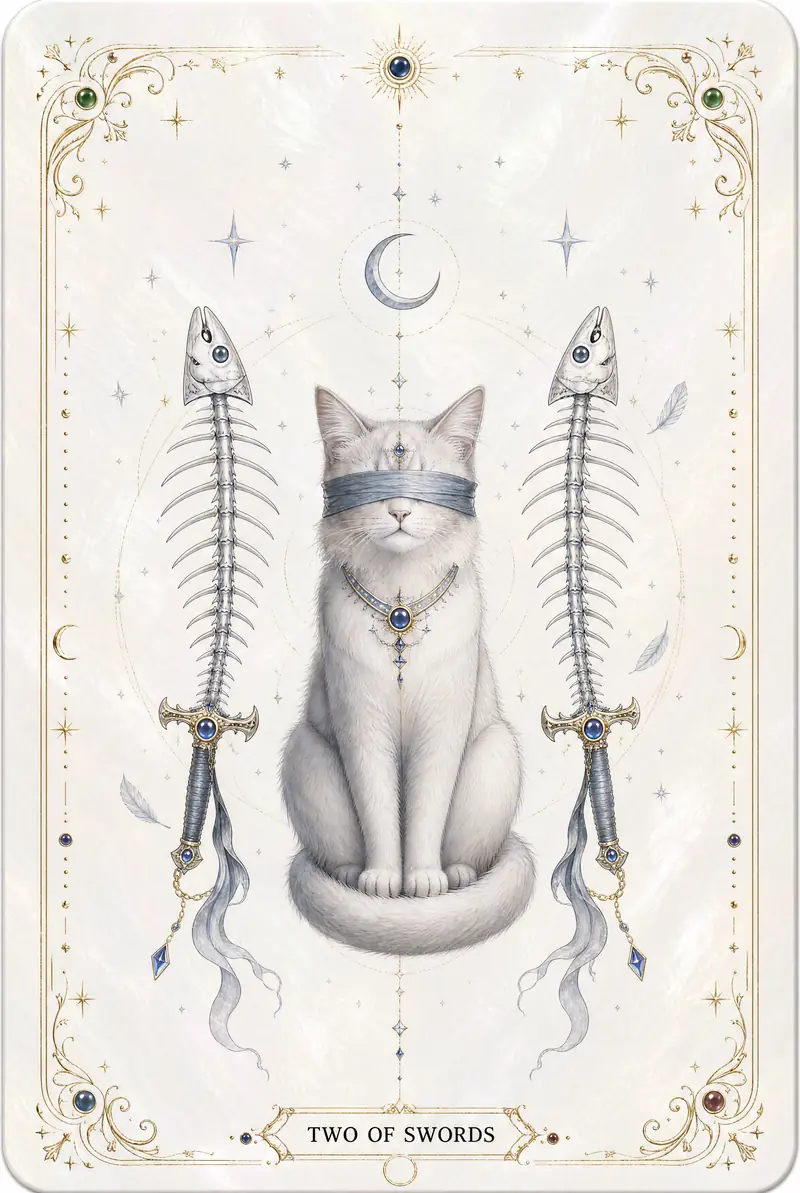
The blindfold is about readiness: she can see well enough, but she is not yet ready to face a choice that has to be made.
The image
A blindfolded woman sits on a stone bench by the sea, arms crossed, two swords balanced on her shoulders. Behind her are a rolling sea and a crescent moon. She sits upright, but the posture is tense.
Core meaning
- The number two is where relationship and contrast first appear (see Numbers in Tarot). In the Swords suit, the contrast is a standoff between two thoughts or two options, neither able to win the other over. It is a very different thing from the open connection of the Two of Cups.
- The woman tied the blindfold on herself. She does it so she does not have to choose between "enemy" and "friend," because actually making that choice is the first step needed to start dealing with people again. The blindfold is a deliberate choice not to look, trading avoidance for a little breathing room.
- Pollack reads a physical paradox in this posture. The crossed arms lock up the heart, and the gray robe seems to merge with the stone seat, a sign that feeling has been completely shut away. The heavy swords also push the body's center of gravity up from the solar plexus in the belly to the chest, which makes breathing shallow and the body stiff. The more feelings are suppressed, the more emotional a person tends to become, because thinking and acting no longer start from the body's center. They start from a tight chest.
- Pollack also compares this card with the High Priestess of the Major Arcana. The two sit in similar postures, but the High Priestess looks relaxed and at ease while the Two of Swords is wrapped in tension. A veil separates the High Priestess from the water of the unconscious behind her. Nothing separates this blindfolded woman from the restless pool of emotion at her back, although that water is much shallower than the water behind the High Priestess.
- The card can also be compared with Justice (11, which reduces to 2). Justice holds only one sword, a sign of a clear and unmixed mind, and is never blindfolded; she chooses complete honesty. The Two of Swords uses two swords and a blindfold to avoid an either/or choice, which is the exact opposite of Justice's willingness to face the truth head on.
- Common question situations: knowing a decision is due and still not saying where you stand, two people with things left unsaid between them, keeping up a surface peace through silence. Examples: knowing the relationship should end and putting off saying so, knowing it is time to quit and continuing to wait and see. The answer is there; the person does not want to face its consequences.
- The crescent moon in the night sky is traditionally linked with uncertainty and shifting moods. It suggests this choice still carries a strong emotional component and cannot be settled by reason alone inferred.
- This is also one of the few Swords cards that presents inaction itself as its upright meaning. Upright does not mean the problem is solved. It simply describes the present state of "not decided yet."
- The two swords rest on her shoulders and never actually clash or draw blood. This detail shows the standoff has not yet hurt either side. Not deciding is itself a strategy for avoiding harm; the price is that the decision is postponed indefinitely.
- The Thoth title, "Peace," points to the psychology behind the stalemate. It is less a matter of being unable to think it through and more an active choice to preserve a surface calm by not choosing. Someone who cannot let go of either direction and does not want to be the first to hurt either side may simply choose neither. This kind of indecision is sometimes a form of self-protection, an attempt to keep both sides, and not just weakness.
- In money questions, the Two of Swords typically corresponds to an either/or choice where neither option looks better. When the two options seem to lead to similar results, it is often because rational factors such as changing conditions and long-term consequences have not yet been fully counted, and the options are not really equal. In a reading, it is worth suggesting that the querent fill in the missing information first instead of rushing to decide on a feeling.
- In health questions, the card often points to a need to step back and think calmly. The issue may not be the illness itself so much as an undecided question, such as whether to accept a particular treatment or make a lifestyle change. The crescent moon also hints that the answer may not come from wide-awake analysis; it may come while relaxing or even after sleep. The card also notes that physical and mental energy is low right now, so this is not a good time to force a decision.
- The stone bench she sits on deserves attention too. Compared with the Empress's soft, large cushion, the stone bench looks cold and dignified. It can be read as a medium of manifestation and also echoes a careful, serious, by-the-book attitude.
- The small island visible beside the bench can be read as consciousness slowly rising out of the ocean of the unconscious. Most of the time people are run by the unconscious, and only after a certain amount of focused effort do they reach the edge of conscious awareness. This detail echoes the figure's process of sorting her thoughts and slowly turning vague feelings into clear ideas.
- The decan this card corresponds to is not ruled by Venus, the ruler of Libra, but by the Moon alone. Each sign's first, middle and last ten degrees have their own decan ruler, and the Two of Swords, as the first decan of Libra, falls under the Moon.
Reversed
- Turned inward: The sea has risen above the level of her head; emotion has overwhelmed reason. A decision made by following strong feelings now is likely to be a misjudgment, so the first step is to calm down.
- Blocked: Both swords now point down at once. The querent is pulled by two opposing outside forces and is caught with no way forward or back, unable to satisfy either side. This is more passive and more painful than the simple suspense of the upright card.
- Overdone: This is a period when lies or deliberate concealment are likely. Do not take other people's accounts on trust, and do not make major decisions on the limited information in front of you. In extreme cases it can point to betrayal, being sold out by someone you trusted, or a rupture within your own side.
- Blocked: The cost of long avoidance begins to show. Problems that were never dealt with have become harder to handle. Delay is no longer an option; the issue has to be faced directly.
- Turned inward: The stalemate can in fact be broken, though the process may be more painful. If the current state cannot hold, it is best to think through the worst case first. Sometimes the card also signals that the truth is about to come out, and facing what becomes visible will take both courage and wisdom.
- Blocked: In money questions, the reversal sometimes means none of the options is attractive, more than an inability to choose. Hedging between both spreads attention and resources thin. Rather than forcing an answer, drop the half-hearted options and go back over the pros and cons of each plan rationally.
Correspondences
Number two, see Numbers in Tarot. Element: Air. Astrology: first decan of Libra, see Astrological Correspondences. Libra is itself an Air sign, so Air is doubled here, and the card's suspended decision is to some extent the result of too much Air and too little grounding inferred. In the Golden Dawn system its esoteric title is "Lord of Peace Restored"; see Esoteric Titles.
Views from different traditions
The Crowley-Thoth system calls this card "Peace," stressing the temporary calm the blindfold brings more than the stalemate itself. The Waite imagery and naming put more weight on the tension of a decision on hold. The emphasis differs, but the two views do not really conflict inferred.