Three of Swords
Number III · Element Air · Correspondence Second decan of Libra
Upright: heartbreak, the shock of truth, betrayal, grief
Reversed: suppressed grief, inability to move on, beginning to heal
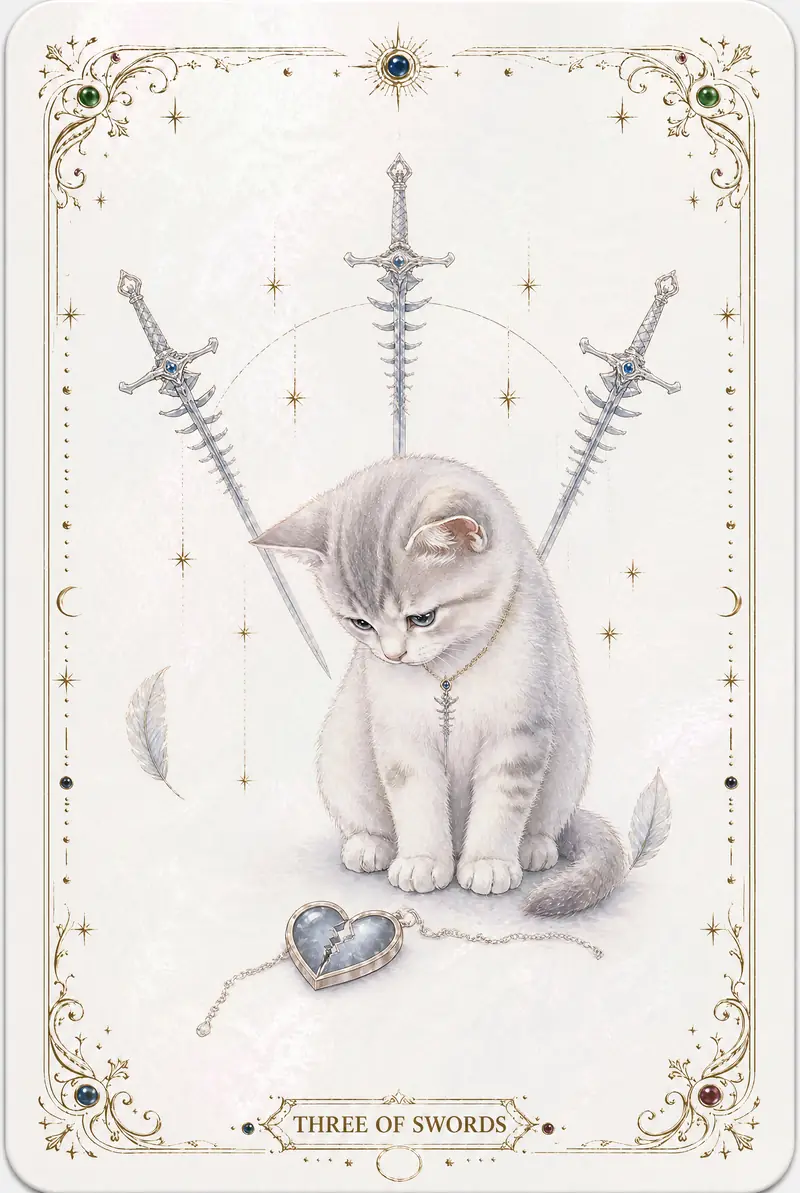
When avoidance can no longer hold, the truth lands and the pain finally takes a shape.
The image
A bright red heart hangs in midair, pierced by three swords from different angles. Behind it are dark rain clouds and slanting rain. There are no figures; the heart alone bears the pain.
Core meaning
- The number three is about first taking form, often with a third party stepping in (see Numbers in Tarot). In the Swords suit, that third party is often a hard truth that is difficult to bear, or an uninvited fact such as betrayal or rejection.
- This is the moment when the suspended tension of the Two of Swords finally bursts. Avoidance can no longer hold, the truth or the bad news arrives for real, and the pain takes on a definite shape, like the heart pierced by swords in the picture.
- There are three swords and not one. This suggests the pain usually has more than one cause: several things piled on top of each other (betrayal plus disappointment plus public humiliation), or several layers of the pain flaring up at once.
- The rain clouds are a weather element that is rare in this deck. They suggest the pain is more like weather that has to be waited out. It will pass, but for now there is nowhere to hide from it.
- Common contexts: a breakup, a rejection, being hurt by someone you trusted, hearing bad news. In each case the truth hurts, and the pain itself is the start of seeing clearly.
- Common concrete situations: betrayal by the person you trusted most, hearing "actually, I always…" at the end of a relationship, a family member saying something true that breaks your heart. The card often speaks of hurt that comes from someone close, which is one reason it feels so painful inferred.
- This is also one of the few Swords cards whose central image is a part of the body (the heart). The pain is made concrete enough to almost feel, instead of an abstract statement that someone is sad.
- The card also makes a point about the suit: Swords deal in truth, and truth is not always gentle. The Three of Swords is the card where "the truth hurts" shows most directly.
- Faced with real grief, there is only one healthy response: take the pain deep into the heart instead of pushing it away. Acceptance comes first, and only then can love and courage slowly transform it. This is also the difference between the Three and the Nine of Swords. The Nine asks how to keep going after a great hurt; the Three answers that the first step is to let it into the heart and not shut it out.
- The three swords are actually drawn differently above and below the heart. The upper part is double-edged; the lower part narrows to a single edge. The upper part stands for the objective event itself, which is neutral and open to several readings (a breakup does not necessarily mean you were not good enough, and criticism is not necessarily aimed at your worth). The lower part is the experience after it has been taken inside and digested, where it is often reduced to the single most hurtful reading, such as "I don't deserve to be loved." Much of the pain this card describes comes less from how serious the event is and more from unconsciously choosing the most hurtful way to understand it.
- A well-known tarot author has described reading for herself after a family member died and drawing this card together with the Three of Cups. At first she took it to mean fighting sorrow with joy and friendship. Later she realized the two are connected and do not oppose each other: acceptance and love can turn the pain itself into joyful memories and a deeper attachment to life.
- In money questions, the Three of Swords usually points to a real loss or a hard blow at work: a promotion that did not come through, sudden layoffs, an opportunity you were sure of that went to someone else. The point of the card is not only that money is gone. It is also the sense of loss as the hopes pinned on a specific goal break along with it.
- In health questions, the card is a reminder that grief really does wear down the body: it disturbs sleep, suppresses appetite and clouds judgment. It is a typical sign of emotional pain turning into physical depletion. When it comes to specific body parts, it is often linked with tightness or discomfort in the heart and chest, but most of the time it points to long-held low mood more than to actual organic disease. It should not be treated as a medical diagnosis in a reading.
- The details of the clouds and rain also carry a numerical echo. Besides the three dark clouds there is a fourth, less noticeable one, and the raindrops keep appearing in groups of three and four. Three is the number of loss and limitation, four the number of stability and good fortune. Three layered with four suggests the storm will pass and a rainbow will follow.
Reversed
- Turned inward: The dark clouds move from the top of the picture to the bottom. Inner confusion and worry will not go away. Thinking is not clear right now, so do not force yourself to work things out or make major decisions.
- Overdone: All three swords turn to point upward together, and the direction of the harm may reverse too. The querent may be the one who said or did something hurtful and set off a new conflict, and not simply the one on the receiving end.
- Turned inward: The grief has not been spoken. It has been pushed down while the person pretends to be fine. It may look like letting go, but it is closer to avoidance than to having actually dealt with it.
- Blocked: The situation will not become clear for a while. Mental pressure combines with a sense of isolation and distance, and the querent can easily be pushed to the edge of breaking down. What is needed is some distance and rest, not grim endurance.
- Blocked: The three swords fall out of the heart. This can also mean the most painful stage is over and healing has properly begun. Being able to talk about what happened without falling apart is a real step on the road to recovery inferred.
- Turned inward: It may also mean not yet being willing to admit that something is over, holding back tears so the feelings do not burst out. To get out of this, the querent needs to start again from what they honestly think and feel.
- Turned inward: It may also be a flat denial of ever having failed or been hurt, pushing all the blame onto others and refusing to admit there is anything to review or learn on their own side. The upright lesson is to accept the pain and learn from it. The reversal refuses even to admit "I failed," which makes the growth that should come from the experience even harder to reach.
- Blocked: In money questions, the reversal often points to an old wound that has not healed. Resentment over a past loss or setback still lingers. That lingering sense of loss can make the querent overly pessimistic about their finances, or especially sensitive to similar situations now. Before acting, think one step further instead of letting old feelings lead.
Correspondences
Number three, see Numbers in Tarot. Element: Air. Astrology: second decan of Libra, see Astrological Correspondences. In the Golden Dawn system its esoteric title is "Lord of Sorrow"; see Esoteric Titles.
Views from different traditions
The Crowley-Thoth system names this card simply "Sorrow," which matches the intent of the Waite imagery. It is one of the few Swords cards where the Waite and Thoth schools agree closely on the core emotion inferred.