Four of Swords
Number IV · Element Air · Correspondence Third decan of Libra
Upright: rest, pause, healing, stepping back
Reversed: forced return, excessive avoidance, a mind that will not settle
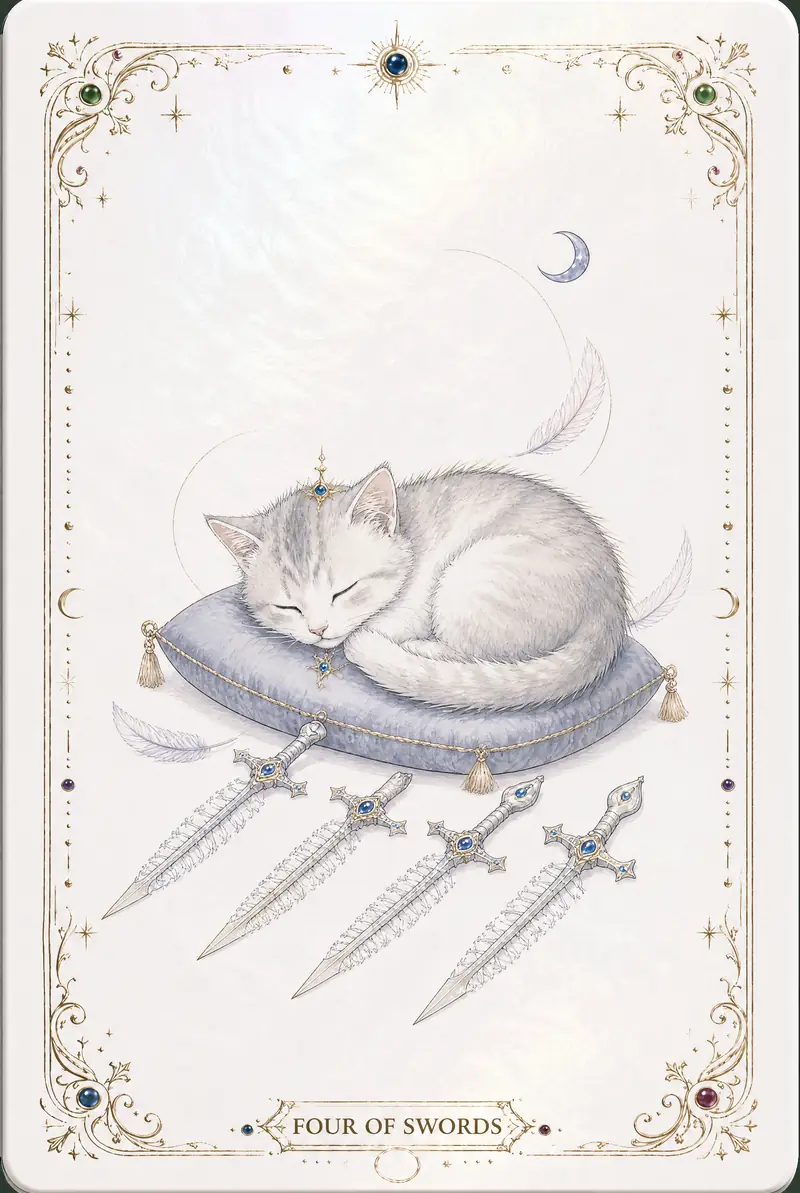
Before the next conflict begins, repair yourself first.
The image
A knight lies flat like a tomb effigy, hands joined in prayer. Three swords hang on the wall beside him, and a fourth is carved along the side of the tomb below. In the stained-glass window a figure is giving a blessing. The whole scene is quiet and solemn.
Core meaning
- The number four is about structure settling into place and standing firm (see Numbers in Tarot). In the Swords suit, this stability is not a calm life that arrives right after the Three of Swords. It is a deliberate and necessary pause, a time when the body or mind needs to lie down and rest completely.
- The knight lies as if in a tomb, but this is not death. It is a strategic retreat: stepping away from the battlefield for a while (whether the conflict is real or inside the head), stopping the thinking and the arguing, and repairing oneself first.
- The three hanging swords stand for disputes and thoughts that have been put away for now. The fourth is hidden under the tomb, suggesting that part of the conflict has not really been resolved. It has only been pushed out of sight and will still need to be faced when the rest is over.
- The blessing in the stained-glass window links the card with meditation, healing and spiritual retreat. The Four of Swords is often read as a concrete suggestion: turn off the phone, step back from socializing, and get a proper sleep.
- This is the only clear chance to catch one's breath before the run of difficult cards from the Five to the Nine of Swords. Without real rest, it is easy to slide straight into the conflict of the Five.
- Common concrete situations: being forced to take leave after a serious illness or an intense stretch of work, each person going home to cool off after a heated argument, a retreat or time alone needed for mental health. What they share is that the pause is necessary for recovery, and it is not laziness or avoidance.
- A knight's effigy usually represents a historical figure who was once a brave fighter. Even the toughest people have times when they need to put their weapons down completely and simply lie still, and there is no shame in this kind of rest.
- The card is also often used as a reminder to the querent: before the run of difficult energy from the Five through the Nine of Swords arrives, rest is a necessity, not an option.
- The stained-glass window above the sleeping knight shows Christ healing a supplicant. Pollack connects this detail with the Fisher King of Arthurian legend, whose wounded body mirrors the sickness of the whole kingdom and who can be healed only by the Grail from outside. She also thinks of Sleeping Beauty, the princess who sleeps out of fear of life and who likewise can be woken only by outside intervention.
- Pollack points out that withdrawal has two sides. If the aim is to recover strength, it can bring real healing. If it is only escape, shutting oneself away physically or emotionally, the retreat can become a self-built wall that in time can be broken only by outside force.
- The three hanging swords point to the positions of the third-eye chakra, the throat chakra and the solar plexus. This echoes a martyrdom legend handed down in Western esoteric tradition, in which a craftsman who guarded a central secret was killed for refusing to reveal it and was then in some sense "reborn." The card can therefore also be read this way: some things cannot or will not be said right now, and that silence has a cost, but after getting through this hurdle the person returns more mature inferred.
- The rest this card describes is sometimes not simple healing but a strategic restraint: swallowing an insult for now and staying out of the line of fire, instead of fighting to the bitter end out of pride when the odds are clearly against you. Holding back keeps open the chance to turn things around later. Acting on a moment's anger often ends in being completely crushed, with no room left even to breathe.
- In money questions, the card's message is less about whether to act and more about stopping to review. Pause new commitments, look back at past efforts and judgments to see which actually worked and which only made noise at the time, and recalibrate your very idea of success. This matters more than rushing into the next step.
- In health questions, the Four of Swords is often quite literally a recovery period after illness or surgery, or a stretch of clearly low physical energy. The card suggests treating this forced slowdown as a final reminder that the direction of one's life needs to be reconsidered, more than as something to simply get through.
- The sword faintly visible under the bed runs parallel to the line of the knight's spine. It can be read as an awakening power, corresponding to the life force of kundalini. On the surface he is resting and paused, but deep in the body a force is quietly building, and when the rest is over he will return stronger.
Reversed
- Blocked: The swords on the wall move to the very top of the picture. Conflict is closing in again, the querent is pulled back into the fight, and there is no way to keep avoiding it. Reality has interrupted the rest.
- Turned inward: The three swords on the wall now point upward. The real problem is internal. Settle the parts of yourself you have not yet sorted out, and then you will have the capacity to handle storms outside. Otherwise, guarding only against outside threats leaves other things neglected.
- Blocked: Poor sleep and no real rest for body or mind. If the querent does not find a way to relax soon, the stress can lead to a breakdown over time. Avoidance and isolation also let problems keep getting worse until they are hard to clean up.
- Overdone: It can also show up as never being satisfied or wanting too much. This is a time to practice knowing when to stop and to tell apart what you really need from what you merely want.
- Blocked: The harm can actually be prevented. With enough preparation before a problem arises, losses can be kept to a minimum. This is also a good time to put ideas into practice, provided the plan is thorough and the execution careful.
- Overdone: In money questions, the reversal sometimes reflects having rested enough but being unable to stop chasing. The querent has seen which past approaches were inefficient, yet rushes to pursue bigger returns with greater risk and investment. That attitude is not necessarily wrong, but the price is often another round of Three of Swords pain and loss, and it is wise to be prepared for that.
Correspondences
Number four, see Numbers in Tarot. Element: Air. Astrology: third decan of Libra, see Astrological Correspondences. In the Golden Dawn system its esoteric title is "Lord of Rest from Strife"; see Esoteric Titles.
Views from different traditions
Some sources read this card simply as an image of death or ending uncertain. The mainstream Waite reading puts the weight on rest more than on ending. In medieval funerary art, the effigy on a tomb is a common posture of prayer for eternal rest, not a scene of actual death inferred.