Five of Swords
Number V · Element Air · Correspondence First decan of Aquarius
Upright: dishonorable victory, humiliation, bullying
Reversed: reconciliation, lingering resentment, letting go of the fight
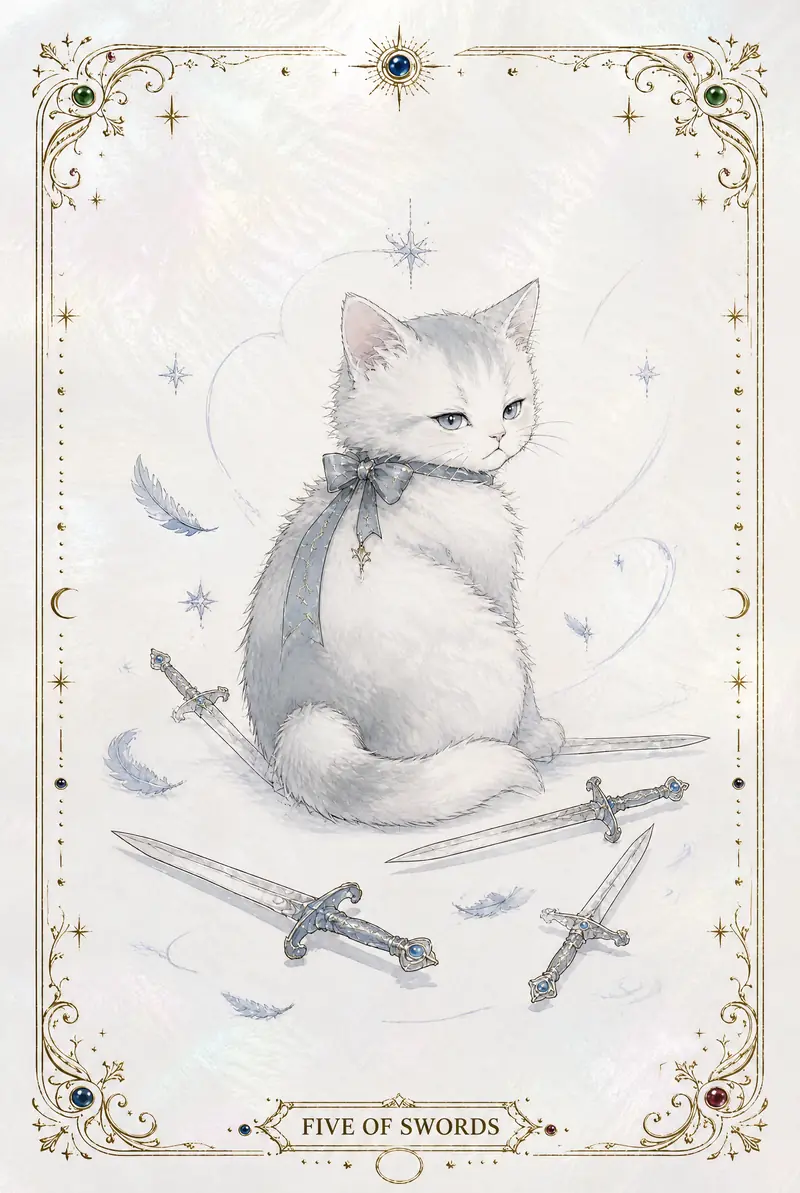
Whoever wins this argument may have just lost the relationship.
The image
In the foreground a man with a smug sneer bends to gather five swords scattered on the ground. In the background two figures turn and walk away, heads down. Dark clouds churn over the sea, and the wind has blown them into ragged shapes.
Core meaning
- The number five is about stability breaking down, challenge and imbalance (see Numbers in Tarot). Conflict is already the Swords suit's central concern, so a five here makes this almost the most openly conflict-laden card in the deck.
- This is more than a general falling-out. The picture shows a specific scene: one side "wins" the dispute by ignoring the rules and showing no mercy, and the price is that the others leave humiliated and resentful. He won the argument and lost the relationship.
- The man's sneer is the key detail. He knows his win is not honorable, and the picture makes no attempt to dress it up. The Five of Swords shows the ugliest side of conflict as it is and does not look away.
- Given the suit's focus on communication and conflict, the card often corresponds to saying things in a fight that should not have been said, getting ahead at work by putting colleagues down, or insisting on "winning" a family argument without regard for the other person's feelings.
- This card opens the cluster of clearly difficult number cards in the Swords suit (the Five through the Nine). To be honest about it, the hard meanings of these cards fit the pictures better than the positive readings do, and there is no need to force them into something cheerful.
- Common concrete situations: attacking an opponent's character in a debate just to win, grabbing credit and shifting blame in a team project, dredging up old grievances in a family fight so the other person cannot answer. These "wins" often leave long-term rifts that outweigh whatever the argument was worth.
- The card is not only about conflict between two people. It can also be read as exclusion or bullying within a group: a majority ganging up to humiliate one person is another concrete form of this card.
- The clouds torn apart by the wind are another of the Swords suit's rare uses of bad weather as an emotional backdrop. They echo the card's atmosphere: things look settled, but the storm clouds have not cleared.
- The Five of Swords is often held up as an example by critics who say the Rider deck is too negative. But the card matters precisely because it is true to life. Almost everyone, at some point, really goes through the defeat of winning an argument and losing their dignity, or of being beaten by someone who played dirty. It is a lived experience more than an abstract lesson.
- Pollack notes that while the smug figure in the foreground can be the focus of this card, people more often identify with the two figures turning away. Their weakness and sense of shame are usually closer to the experience the card really describes than the winner's satisfaction is. The "enemy" is not necessarily a specific person either. It can be a whole situation, or even an inner sense of inadequacy.
- The card's esoteric title is "Defeat." Comparing it with the Five of Wands, titled "Strife," makes the difference clear: the Five of Wands has no winner, while the Five of Swords spells out who won and who lost. Note that the man already holds three swords and two more lie on the ground. He has done this before. The conflict in this place and his winning streak are a recurring pattern, not a one-off accident, and he himself is the habitually combative character.
- The card can describe more than outside conflict between people. It can also describe two thoughts fighting it out inside one person. For example, someone knows they should let go, yet the thought "the situation is actually pretty good" keeps pushing down the urge to leave, and again and again they "defeat" the truer voice inside. This kind of victory is just as short-lived. After a while the thought comes back, and the cycle repeats, which is very draining.
- In money questions, the Five of Swords often shows how disputes over money eat away at relationships. If one partner in a joint investment insists on their own way and ignores everyone else's views, then even if the goal is reached in the short term, the usual result is blame, countercharges and lasting resentment afterward. In a reading, the card is a reminder to weigh not only "can I win" but also "how much of the relationship will be left after I win."
- In health questions, the card often ties physical imbalance to unresolved trouble between people. As long as disagreements and distance with those around the querent are not truly resolved, their health will have a hard time settling down. In a reading, it can be worth asking whether an unresolved relationship conflict is weighing on the body.
- Comparing it with the Five of Wands shows what is distinctive about this card. The Five of Wands has no winner, and its esoteric title is "Strife." The Five of Swords has a clear winner and losers, and its title is "Defeat." Wands describe the friction of different energies falling out of step with each other; Swords describe a victory won by trampling on someone else's self-respect.
Reversed
- Overdone: The once-smug winner now holds his swords pointing down. This time the querent may be the one at a disadvantage or even the one who gets hurt. Winner and loser have traded places, and the upper hand is no longer secure.
- Blocked: The defeated figures move to the top of the picture, putting more weight on loss and on how hard it is to recover. Pushing on with the fight now will only make things harder. Ending it and leaving early is the more practical choice.
- Overdone: This is a period when the querent's reputation can easily suffer. Others may exaggerate or misunderstand, but it is also worth asking whether there really was some misconduct on their own part. Fixating on winning helps no one, and a moment's bravado usually brings trouble afterward.
- Turned inward: This dispute actually has no real winner. Everyone grabs and fights, and in the end nothing is gained. Rather than staying tangled up in it, a cautious response or a period of rest is better. Sometimes it shows up as excessive shyness or low self-worth, being too afraid of conflict to say what one really thinks, the exact opposite of the aggressive upright card.
- Turned inward: The winner's three swords fall together, symbolizing a willing laying down of the fight. Both sides are ready to make peace instead of escalating further. Among the reversals of this rather difficult run of number cards, this is a common healthy turn.
- Turned inward: The reversal can also mean being afraid to face the conflict itself. That may mean not daring to clash with others (for example, politely giving away an opportunity that should have been fought for and then resenting it later), or not daring to face one's own true thoughts (for example, suppressing the wish to break up only because the thought feels surprising or embarrassing to admit). This avoidance brings only a surface calm, and the suppressed problem will come back sooner or later.
- Blocked: In money questions, if the question is whether to keep going, the concrete advice of one popular handbook is to stop first. This card is basically not one that brings real gains. Reversed, it is better to step back into the reflective stance of the Four of Swords and reassess the decision, instead of rushing to recover losses or doubling down.
Correspondences
Number five, see Numbers in Tarot. Element: Air. Astrology: first decan of Aquarius, see Astrological Correspondences. In the Golden Dawn system its esoteric title is "Lord of Defeat"; see Esoteric Titles.
Views from different traditions
The Crowley-Thoth system names this card "Defeat," with its viewpoint on the two people leaving the field. The Waite composition and naming are more neutral, and the reader's viewpoint can rest on either the winner or the losers inferred.
In early divination texts, the Five of Swords reversed was also often linked directly with death, funerals and burial processions, and from there with grief, pain and dejection. This approach stands in sharp contrast to the modern reading of laying down the fight and reaching reconciliation, and it is rarely used now.