Six of Swords
Number VI · Element Air · Correspondence Second decan of Aquarius
Upright: transition, moving on while still hurting, leaving for good reasons, things gradually calming down
Reversed: unable to leave, unfinished business, plans blocked
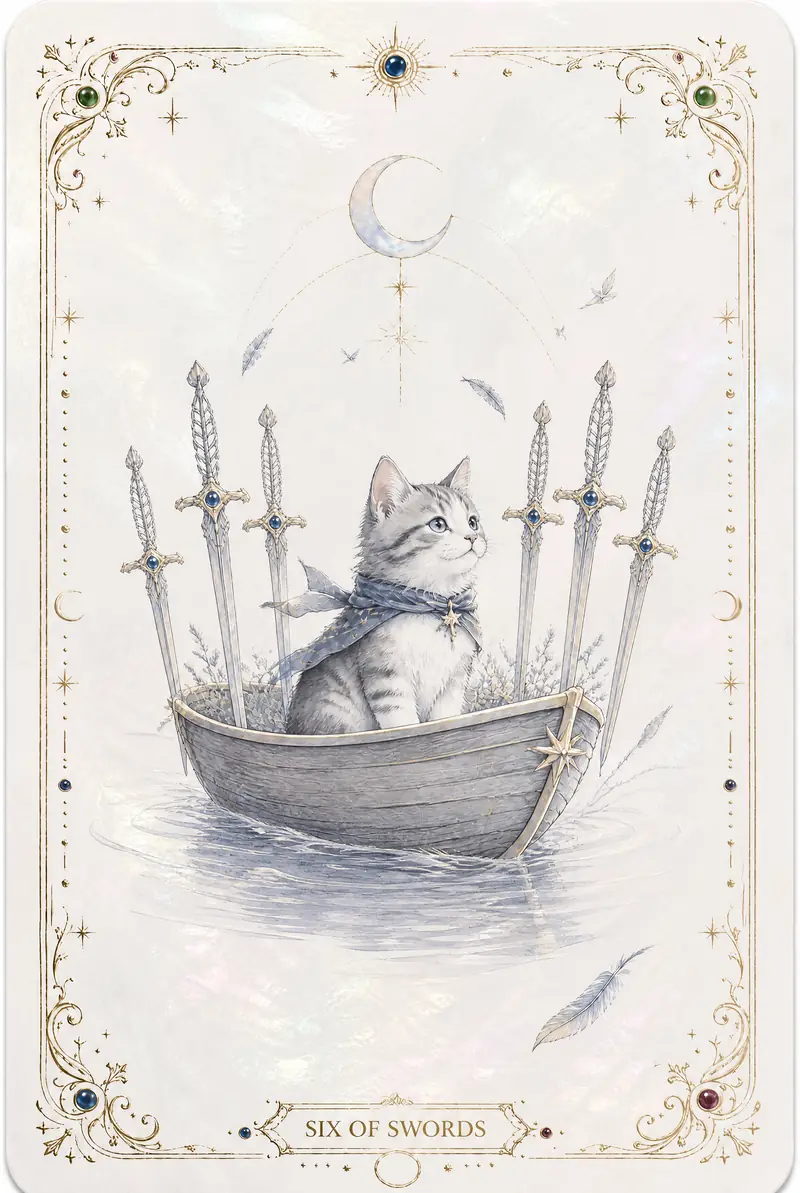
Setting out with old wounds, rowing toward calmer water.
The image
A ferryman poles a boat carrying a cloaked woman with her head bowed and a child, moving slowly toward the far shore. Six swords stand upright in the boat. The water behind them is rough; the water ahead is growing calm.
Core meaning
- The number six is about repair and balance after conflict (see Numbers in Tarot). The wound left by the Five of Swords needs a clear act of leaving before it can really begin to heal, and the Six is the moment of setting out.
- The key detail is that the six swords in the boat travel with it. The problem is not left behind. When someone leaves a relationship or a predicament, the lessons and pain of that experience are still in the same boat; only the direction has changed.
- The woman's bowed head and her refusal to look ahead show that this transition is not easy or pleasant. It is more like a necessary move made in tiredness and silence: changing jobs, moving house, settling down again after a relationship ends.
- The waves behind the boat contrast with the calm water ahead. The promise of the Six of Swords is restrained. It does not say everything is fine. It says things are moving in a better direction and have not arrived yet.
- Given the suit's focus on thought and communication, the card can also be read as a shift in thinking: ideas start to move out of the old tangled framework, and the person chooses rationally to leave instead of being pushed out passively.
- Common concrete situations: moving to a new city with children to start over, healing alone after ending an exhausting relationship, changing jobs to leave an environment that has worn you out in body and mind. These changes are rarely easy, but they are steps that have to be taken.
- The ferryman is always in the picture, but he is usually not seen as the querent. He is more like the circumstances, the timing or even fate pushing this crossing along, and the querent may not fully control the pace of the change inferred.
- Coming right after the conflict of the Five, the Six's "moving on" is conditional: only after going through conflict and harm can there be a real move and transition.
- Pollack compares the ferryman with Charon, who in Greek myth carries the dead across the river of the underworld. The boat can therefore also be read as a deeper journey, almost spiritual in meaning, and not only a practical change like moving house or changing jobs.
- Pollack also offers a quieter reading. The sorrow is not necessarily a fresh wound. Sometimes it is a grief that has been carried for a very long time, so long that it no longer causes sharp pain and has become part of life itself. In that case, "crossing over" means learning to live with it, more than getting over it.
- The ferryman's pole is black, which Pollack reads as potential: nothing has been finally decided yet, and everything is still possible. Staying quiet and still is exactly how to avoid wasting this energy and opportunity while they are still unformed.
- The ferryman can be read more than one way. He can be family standing by and carrying the load in a time of crisis. He can be a more abstract image, the querent's own willpower doing the work of rowing. He can also be someone paid for their services, standing for outside resources and help. The pole stands for focus and determination, and the passengers' bowed heads, not looking ahead, are a reminder that some things on this road have to be actively accepted, since not everything can be controlled.
- The swords stuck in the boat can also be read as holes already driven through the hull. The boat sets out damaged and has to be rowed slowly so it does not capsize. This echoes the real point of the card: before the wound has healed, the harder you try to get out quickly, the more likely you are to fail and hurt yourself a second time.
- In money questions, the Six of Swords often corresponds to a stage where you can finally breathe after a period of turmoil. There is now some room to pay down debt and save toward goals. More important, the querent finally understands how past spending habits led step by step to the current situation, and that understanding is itself where financial recovery begins. The ferry imagery also often points concretely to a job opportunity in another region or to business travel.
- In health questions, the card signals a healing period after a time of stress, on the condition that the querent first asks whether the things that wore them out really matter that much. Letting go of unnecessary worries and attachments is itself a necessary condition for the body to get better. Time alone may not be enough.
- The swords in the boat also have a more positive reading. A sword can stand for wisdom, talent and nobility, something only the truly capable deserve to carry. Even if this crossing begins with an earlier failure or humiliation, the intelligence and worth that belong to the querent are not taken away by a single setback.
Reversed
- Blocked: The waves in the background rise to the top of the picture. The surrounding environment is going through considerable turmoil, and a plan to deal with it is needed in time to get through safely. Passively waiting for things to calm down is no longer enough.
- Turned inward: All six swords now point upward. At this stage it is especially important for everyone on the inside to stand together and face outward as one. If each person goes their own way and the group falls into disarray, getting out of trouble becomes harder. A capsized boat is also a reminder that unexpected incidents may come up along the way. They are not necessarily devastating, but they are enough to keep the querent busy coping.
- Blocked: Knowing it is time to go and being unable to move, held in place by practical conditions (money, responsibilities, fear). Outside forces have interrupted a necessary transition.
- Blocked: Keeping feelings bottled up only makes them heavier; it is better to talk to someone you trust. This is also not a good time for travel by water or long journeys. If another way is possible, take it.
- Turned inward: Help from others may not come in time, and the querent will mostly have to rely on their own efforts. It may also be that, rather than keeping things quiet and hidden, it is better to lay everything out in the open, since things are often easier to solve once they are public. When something appears to have been put behind you but the old matter has not truly been let go, rest and recovery are often the real remedy. Running around trying all sorts of methods can make the problem more complicated.
- Blocked: In health questions, the reversal warns that stress and tension are becoming more and more visible. Unless the querent actively lets them surface to be seen and dealt with, through meditation, prayer or something similar, the mental pressure will sooner or later turn into real physical wear. Examining one's thoughts and beliefs about oneself is often more to the point than examining the symptoms.
Correspondences
Number six, see Numbers in Tarot. Element: Air. Astrology: second decan of Aquarius, see Astrological Correspondences. In the Golden Dawn system its esoteric title is "Lord of Earned Success"; see Esoteric Titles.
Views from different traditions
The Crowley-Thoth system names this card "Science," stressing an orderly, repeatable method for dealing with difficulty, as opposed to the tired, emotionally colored migration shown in the Waite picture disputed. The Thoth version is cooler and more methodical; the Waite version puts more weight on the emotional heaviness of the journey itself.
In traditional divination texts, the Six of Swords reversed was also once linked with a marriage proposal or a declaration of love, and in particular situations could point to self-criticism. These uses are fairly rare today.