Seven of Swords
Number VII · Element Air · Correspondence Third decan of Aquarius
Upright: deception, going it alone, holding something back, cutting corners
Reversed: being found out, coming clean, deeper self-deception
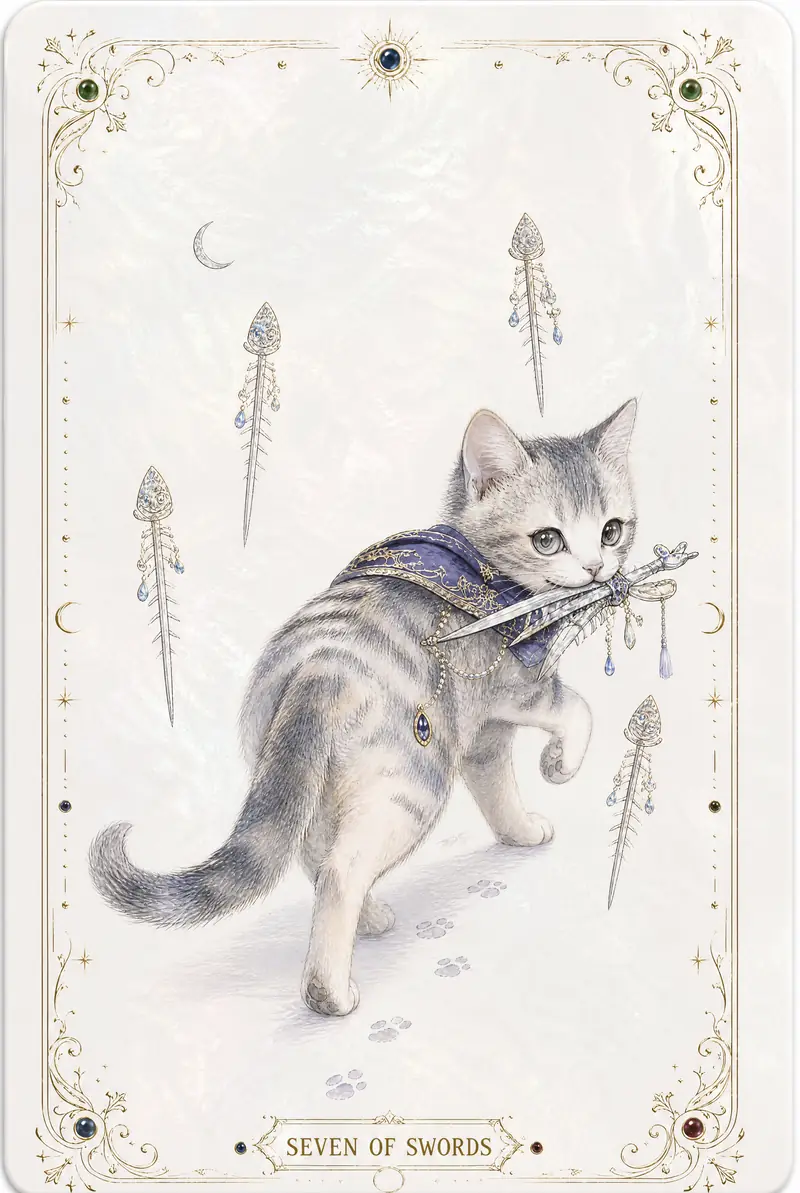
Not every clever move can stand being brought into the light.
The image
A man tiptoes away from a camp of tents, carrying five swords in his arms. Two swords he did not take are still stuck in the ground behind him. He looks back over his shoulder with the sly expression of someone who has gotten away with it.
Core meaning
- The number seven is about stopping to assess the situation and judging before acting (see Numbers in Tarot). In the Swords suit, this assessment often heads in a less than honest direction: working out how to sidestep a direct confrontation, how to get something for nothing, how not to get caught.
- This is the Swords card that clearly stands for deception: quietly taking what is not yours, hiding part of the truth, taking a shortcut instead of honestly facing a problem that needs dealing with. To put it plainly, the core of this card is some form of dishonesty.
- The detail that he takes only five swords and leaves two deserves attention. The plan is not perfect, and the traces left behind mean the risk of being found out never goes away. This is a lucky escape with holes in it, not a clean victory.
- Given the suit's focus on communication and truth, the card can also be read as communication where the cards never go on the table: choosing to talk around things, hold something back and leave things unsaid, instead of saying it clearly face to face.
- There is also a more neutral reading: working alone, not relying on a team, quietly preparing something without announcing it. None of this is necessarily malicious; the person simply does not intend to make their strategy public inferred. Still, the glance back over his shoulder supports reading this as an action taken with a guilty conscience.
- Common concrete situations: cheating on an exam, keeping key information from teammates on a joint project, seeing two people at once without being honest with either. The card does not shy away from the judgment that this is doing something that cannot bear daylight.
- The military camp in the background suggests the act takes place in a setting that is supposed to run on rules and collective spirit. That makes the private scheming stand out even more and makes it easier to discover.
- The Seven of Swords is also often used to prompt the querent to look at themselves: are they avoiding a problem that should be dealt with directly in a similar way?
- Pollack points to two details that are easy to miss. First, the man could not even take all the swords in the camp. This incompleteness suggests his scheme cannot really solve anything; at best it buys a temporary escape. Second, more important in the picture than the deception itself is the sense of isolation. He acts alone, without seeking anyone's help and without wanting to.
- The card can also be read as an almost habitual secrecy. Hiding things has become an instinctive reaction, and often there is no reason behind it that could actually be stated; the person is simply used to not laying out their plans and intentions.
- The two swords left behind allow more readings. They can be a deliberate show of smugness ("even if I leave you two swords, you can't turn this around"). They can also be a sign that his conscience is not entirely gone: he took the bulk but did not wipe the other side out, as if leaving them a way to save face so things do not end in a complete rupture. Whether the tactics in this card are merely shrewd or somewhat unkind often depends on the motive behind holding back.
- The red hat and shoes suggest a man whose mind works fast and whose feet keep up. He can act on an idea the moment he has it. That is the key to how he uses clever tricks to turn a situation around with little effort: a crafty idea is useless without the speed and decisiveness to carry it out.
- In money questions, the Seven of Swords is not only a warning about whether someone is deceiving the querent. It also asks whether the querent is avoiding homework they should be doing. Putting money in without checking carefully, cutting corners to save trouble, or simply hiding part of the financial truth are all typical concrete forms of this card. In a reading, remind the querent to fill in the information that needs verifying before jumping in.
- In health questions, the card often marks a time to reexamine how one is caring for oneself. Habitual methods may not be addressing the real problem, only covering symptoms without treating the cause. The card encourages finding the real cause or trying a different treatment instead of pushing on with the same old approach that has limited effect.
- The pattern on the man's clothing is a shapeshifter symbol, standing for the ability to change one's form and disguise oneself. It echoes the card's core traits of hiding real intentions and being able to lie.
- The decan for this card is the Moon in Aquarius. The Moon stands for emotion and the subconscious; Aquarius is free-ranging and full of ideas. Together they suggest that this man is actually quite clever inside, always hiding all kinds of crafty ideas in his head, though he never puts them on display.
Reversed
- Blocked: The military camp moves to the upper left of the picture. There is actually an opening in the present outside situation, and some creativity is needed to seize it and consolidate what has already been gained, instead of sitting back while the chance slips away.
- Overdone: The sword thief walks in the opposite direction. This is a reminder that the thing to watch this time may be the querent's own use of questionable methods, not only other people's. If all five swords he was carrying fall to the ground, it means the hard-won results could not be held, and a single slip may lead to bigger trouble.
- Overdone: The current success may only be temporary. Without knowing when to quit while ahead, the querent may end up losing on both counts. This is also a period when rumors and malicious slander can easily spring up. There is no need to pass on things that are uncertain, and no need to rush to set the record straight. Overconfidence makes it hard to see the truth, so an objective third party's opinion will help.
- Turned inward: It can no longer be hidden. The secret is exposed, or the person chooses to come clean and stop going in circles. It may also be that a guilty conscience starts to act up, and even without being caught the person decides on their own to return what was taken, apologize or change course.
- Blocked: Going step by step is the safer course. Most of the difficulties are still within the querent's ability, so there is no need to back down before trying. It may also be that the person thought clever tricks would get them what they wanted, only to outsmart themselves and waste their effort without success.
- Turned inward: In money questions, the reversal sometimes has less to do with a scam than with being too afraid of being scammed. Fear of losing out makes the querent cling to old, proven methods, and they miss new opportunities that deserve consideration. In that case, listen to other workable options before deciding, and do not let caution itself limit financial growth.
Correspondences
Number seven, see Numbers in Tarot. Element: Air. Astrology: third decan of Aquarius, see Astrological Correspondences. In the Golden Dawn system its esoteric title is "Lord of Unstable Effort"; see Esoteric Titles.
Views from different traditions
The Crowley-Thoth system names this card "Futility," leaning toward the idea that the scheming is wasted effort in the end and will come to nothing. The Waite system puts more weight on the act of deception itself than on how it turns out in the end inferred.