King of Swords
Number K · Element Air · Correspondence —
Upright: fair judgment, rational authority, clear structure, not swayed by emotion
Reversed: using logic to bully, cold and unfeeling, manipulative sophistry
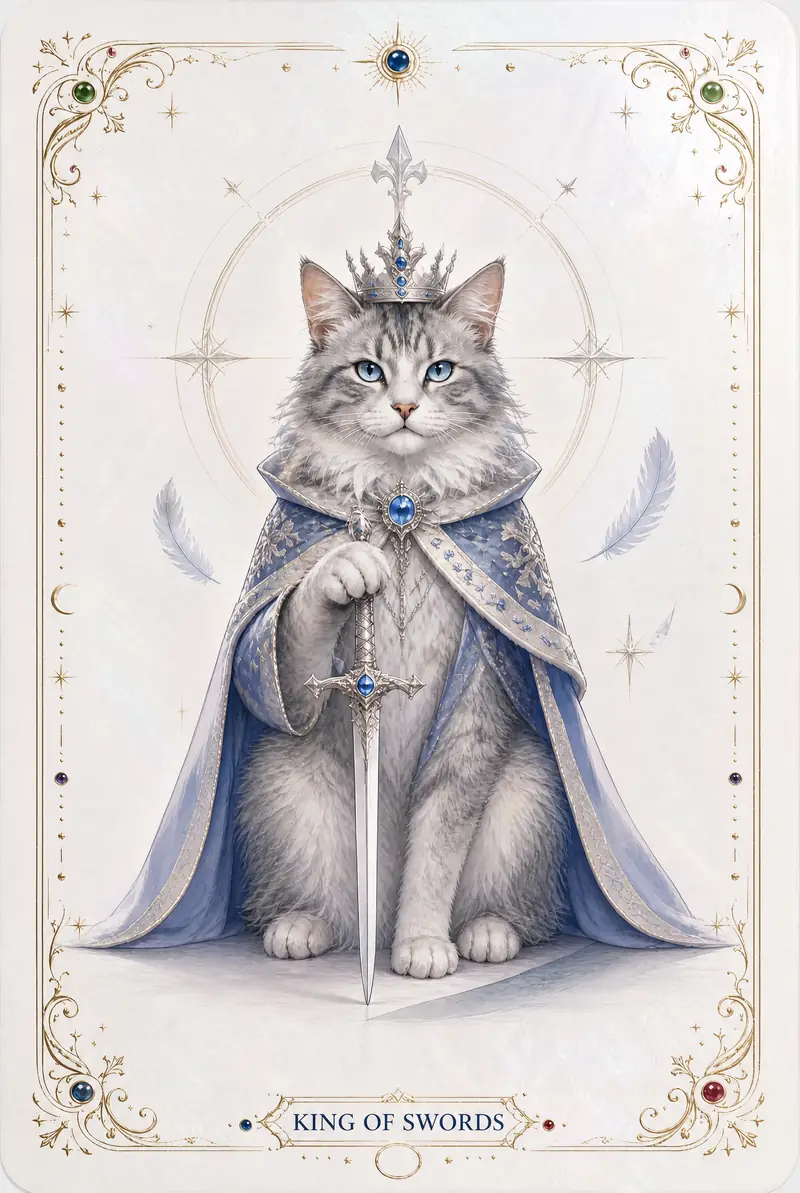
His authority comes from arguments that hold up, without leaning on charm or resources.
The image
The King sits upright on a throne carved with butterflies and crescent moons, holding his sword straight up, looking directly ahead, dignified and restrained. The sky is clear apart from a few drifting clouds. Of the four Kings, his expression shows the least emotion.
Core meaning
- In The Court Cards, the King rank corresponds to Fire: dominant, outward, using the suit's energy with authority. Combined with the Air of Swords, Air and Fire are friendly and strengthen each other, as elemental dignities puts it. This is the court card where ruling by reason shows up in its purest and least obstructed form.
- This is the most typical form the King's shared character (authority, control, structured influence) takes in the Swords suit. The King of Wands wins people over with personal charisma and willpower; the King of Pentacles wins them over with material resources. The King of Swords relies on logic that holds up. His authority comes from "you cannot refute the case I am making."
- Given the suit's link with thought and truth, the King of Swords often stands for a judge, a lawyer, a critic or a manager who has to make fair rulings: someone who turns abstract principles into concrete rules and expects everyone, himself included, to follow them.
- His restrained, emotionless expression is why the card is easily read as cold. But that calm is what the position requires. As the peak of the court cards' progression of maturity, the King of Swords is past the Knight's reckless impulses, and he does not need to reach clarity through inner digestion as the Queen does. He turns clear judgment directly into outer rules and rulings.
- Compared with the runaway double Air of the Knight of Swords, the King's Air has been given direction and structure by Fire. He is the most stable card in the suit and the least prone to emotional swings.
- Common concrete situations: a judge who rules fairly and shows no favoritism, a manager whose rules are clear and enforced to the letter, someone who in any debate speaks only to the evidence and never to which side they are on. The authority in this card rests on reasoning itself, more than on position or personal charisma.
- As the only one of the four Swords court cards with Fire added, the King's decisiveness can look close to the Knight's impulsiveness, but the two are entirely different. The Knight is pushed along by his thoughts; the King actively uses his thoughts to build order.
- The card also often stands for the people who set up rules and institutions: lawmakers, policymakers, designers of organizational structures. Their reach usually extends beyond the matters they can personally control.
- Pollack reads this card as the hands-on executor in the human world of the Emperor from the Major Arcana. The Emperor is the archetype of order, law and social structure itself; the King of Swords puts those principles into practice in everyday governance and judgment.
- The two birds behind the throne are an emblem shared by the four Swords court cards. They symbolize the mind rising above the passion of Fire, the emotion of Water and the material desire of Earth. Pollack also notes that this rising can bring aloofness. The throne seems to stand among the clouds, which can lead someone to trust too much in the strength of their mind and look down on other people's confusion. In private relationships this often shows up as a domineering husband or lover who likes to control their partner.
- At its best this card echoes Justice from the Major Arcana. The two are among the few figures in the deck who look straight at the viewer, and both stand for a commitment to truth and a demand that intellectual honesty actually be carried into action. Cleverness alone is not the point.
- In money questions, this type judges by facts and logic and is not easily moved by emotional sales pitches, which makes him a good cautious gatekeeper. Reversed, though, the card describes talk that pours out like a flood, persuasive but without a factual basis. In a reading, this is a reminder to tell whether the querent is being swayed by smooth talk or by an argument with real substance.
- In matters of health and mental wellbeing, a common reversed state is having taken on far too much, with an overloaded mind that leads to scattered attention and an inability to see anything through. This can be understood as a sign of exhaustion from overusing Air. The advice is to cut back and narrow the focus first, instead of continuing to take on new projects.
Reversed
- Blocked: The distant clouds overshadow the King himself. Outer conditions still hold a great deal of uncertainty, and the atmosphere may carry a chill of hostility. The sword slipping from his hand symbolizes power passing out of his hands; he may be "promoted" into a position with a title and no real authority.
- Overdone: The sword now tilts to one side. Judgment is no longer fair or objective, and he handles things high-handedly or with excessive force, which easily provokes a backlash.
- The environment is full of broken faith and ingratitude, and it is hard to find anyone truly trustworthy, so in the end he can rely only on himself. It may also show up as being too indecisive to win people's trust.
- Turned inward: Demanding too much of others without considering their abilities or feelings, and putting enormous pressure on people without realizing it.
- Too self-confident to consult people with real expertise. Small mistakes can still be repaired, but big ones may be beyond fixing. This is a time for extra caution; it is not yet the moment for a final decision.
Correspondences
King = Fire (rank) + Swords = Air (suit); Air helps Fire burn more strongly. See Elemental Dignities and The Court Cards. Does not take part in the decan correspondences.
Views from different traditions
In the Crowley-Thoth system this rank is called the "Knight," and it occupies the energetic position of the Waite King. The naming is systematically out of step with the Waite system; see the note in Knight of Swords. This site's card pages use the Waite names.