Two of Cups
Number II · Element Water · Correspondence First decan of Cancer
Upright: mutual attraction, partnership, reconciliation, equal giving
Reversed: unrequited love, imbalance in a relationship, broken communication, feelings left unsaid
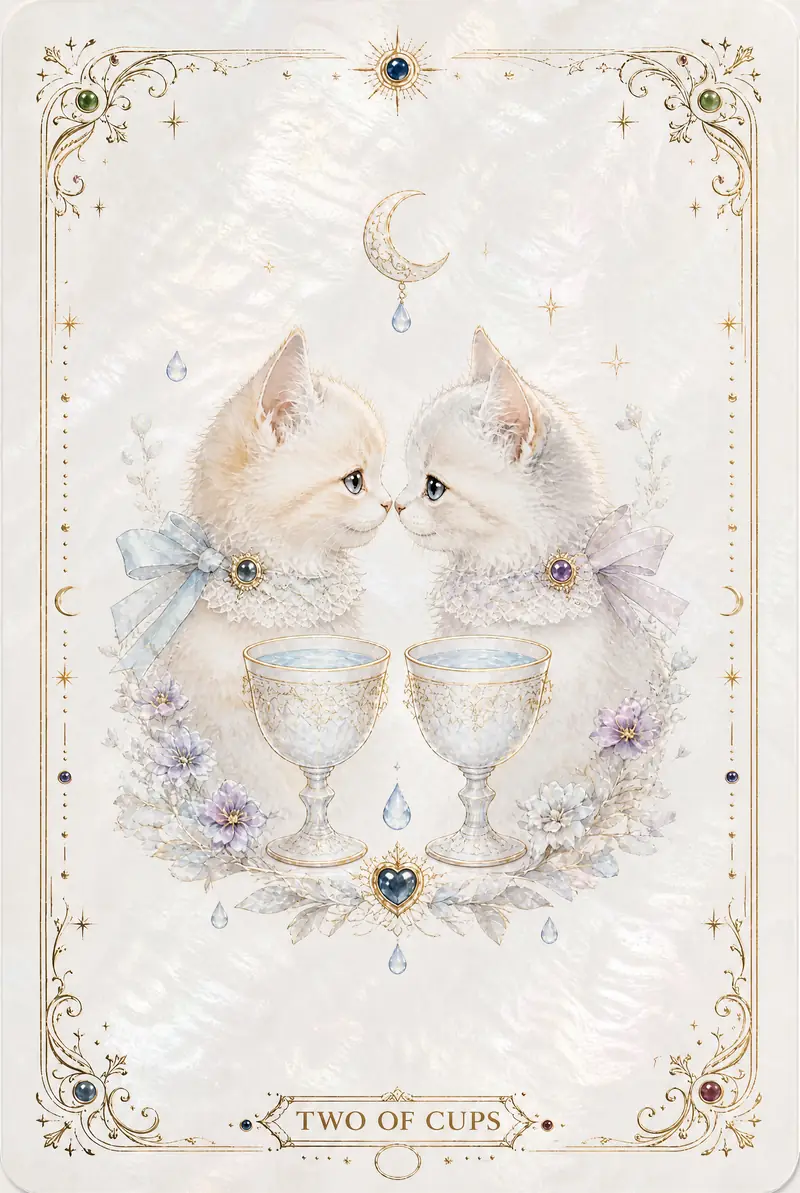
Two hearts truly see each other for the first time.
The image
A man and a woman stand facing each other, each raising a cup toward the other as if exchanging cups or making a toast. Above them floats a short staff wound with two snakes and topped with a lion's head and a pair of wings. In the background are a small house and, above it, a red lion with outspread wings.
Core meaning
- Pollack sees the Two of Cups as a simpler version of The Lovers from the Major Arcana. The Lovers shows the great power of a mature love relationship, while the Two of Cups focuses on the beginning of a relationship: a flutter of attraction, the first pledge of a friendship. It is lighter than The Lovers, but it is also about how two people combine their qualities and create something larger than either of them.
- Pollack reads the staff above their heads as a winged lion joined to Hermes' twin-snake staff, the caduceus. The lion stands for sexual desire and life force, and the wings for spirit. Sexual desire draws people toward love, and love gives that desire a higher meaning.
- In the picture the man stands for action and doing, and the woman for feeling, sensitivity and the appreciation of experience. Only when the two qualities come together does life gain value. This reading can also apply to one person, as an inner integration of the active side and the feeling side, which does not necessarily require another person.
- Pollack points out that the man in the picture resembles The Fool. The Two of Cups sometimes says that skill or experience already gained becomes real success only when it connects with a search for the spiritual roots of life; otherwise it is just skilled repetition.
- The card is not limited to romance. It can be any moment when two people reach understanding, make peace or agree on something: a partnership formed, a friendship growing warmer, a reconciliation after an argument.
- It corresponds to the first decan of Cancer. Cancer's own character, which values emotional bonds and a sense of belonging, further strengthens the card's emphasis on being understood and accepted inferred.
- In the picture one person reaches out first and takes the active role, while the other is more passive and waits for the cup to be offered. This is often used to map the dynamic of who moves closer first, between the sexes or in any relationship. The active side takes the lead in the relationship first, and if the passive side never gets an equal response, there is a risk of one-sided giving that ends with losing both the person and what was invested.
- The equality this card stresses is about how it feels to each person, more than about objective amounts. Many cases of "I give more and they don't appreciate it" come down to giving things the other person does not actually want or value, more than to someone giving too little. Constant eager attention, for example, can make the other person feel pressured or even put off. In a reading, look at whether what is given is right for the other person, as well as how much is given.
- If the card is mapped back to the second sephirah on the Tree of Life, Chokmah (Wisdom), what follows is a boundless love for everyone, which does not quite match the one-to-one scene in the picture. This is typical of the Waite deck: the images sometimes follow the Golden Dawn system and sometimes lean toward the artist's own intuition. When the two disagree, go with the image. See Numbers in Tarot for more.
- In money and career questions, the Two of Cups often means a harmonious partnership or working relationship. Both sides are generous, do not keep score and do not take advantage of each other. In a specific workplace situation it often points to a close, smooth working relationship with one colleague.
- In health questions, the Two of Cups means good physical health rooted in emotional balance. Having people nearby who truly value and care for the querent is often key to keeping this healthy harmony.
- The winged lion above the figures is a symbol of the goddess Isis. The lion corresponds to the fixed Fire sign, and the wings call to mind the eagle (the symbol of Scorpio after spiritual awakening). Together they also represent the blending of Fire and Water energies.
- The twin-snake staff also corresponds to the staff of Hermes (Mercury to the Romans, linked to the planet Mercury and to communication). It carries the alchemical image of sulfur and salt being reconciled by mercury, which echoes the way communication can bring two opposite qualities into harmony.
- The figures' clothing is symbolic too. On the left, blue and white robes with a green headband stand for Water qualities (peace, nurturing, sensitivity, warmth toward others). On the right, red hair with orange and black clothing stands for Fire qualities (drive, and reason mixed with optimism). The belts at their waists stand for vows and fidelity; they separate the nature of the upper body from that of the lower body and represent self-restraint within the relationship.
Reversed
- From the image: the house that stands for security moves toward the top of the picture. The need to possess and feel secure is magnified, and when it is not met, jealousy can grow (overdone).
- From the image: the staff that stands for communication turns inward, suggesting the relationship needs more reflection and listening. The current conversation has not yet reached the real issue.
- From the image: the cups are still held at the same height, but they can no longer hold anything. On the surface the relationship still looks equal, but there is no feeling in it anymore, only going through the motions (turned inward / blocked).
- Negative-meaning approach: arguments and suspicion make full trust difficult, or desire clouds judgment so the querent cannot see how the other person is really responding.
- Opposite-meaning approach: this is not a good time to take the initiative. Being more passive and waiting to see what happens works better. Cooperation and partnerships are unlikely to go smoothly, and many decisions will have to be made alone.
- Opposite-meaning approach: it is sometimes read as a temporary separation, distance caused by business travel, study or a trip. In particular cases it really does point to a breakup or the end of a relationship.
- Money and health: in partnerships or working relationships, the reversal often means the two sides see the division of money differently. If the querent cannot agree with everyone on the team, the first step is often to find one person who truly understands and supports their view. In health matters, it suggests that a current relationship (a partner or collaborator) is draining the querent's energy and wearing down body and mind. It is worth asking whether the other person's demands have gone beyond what the querent can carry.
Correspondences
Two is the number of relationship and balance; see Numbers in Tarot. The card corresponds to the first decan of Cancer; see Astrological Correspondences. Its esoteric title in the Golden Dawn system is "Lord of Love"; see Esoteric Titles.
Views from different traditions
The Waite image puts special weight on images of union (the twin-snake staff, the winged lion), and later readers often extend it to a soulmate-style deep bond. Crowley's Thoth system names the card simply "Love," which points in much the same direction. Some readers caution against reading every Two of Cups as fated love; in everyday settings it more often describes an ordinary but sincere bond between two people inferred. A simpler approach holds that the difference between the upright and reversed Two of Cups is small to begin with and need not be forced; at most the reversal adds a note of unsatisfied desire. Rachel Pollack goes further: if the card is read as a picture of the self, upright is the union of the active side and the feeling side, and reversed is their split. This self-integration reading is the framework she uses for the twos throughout her book.