Ace of Cups
Number I · Element Water · Correspondence —
Upright: new feelings, the beginning of love, intuitive awakening, creative flow, an open heart
Reversed: suppressed feelings, giving that comes to nothing, numbness, love left unsaid
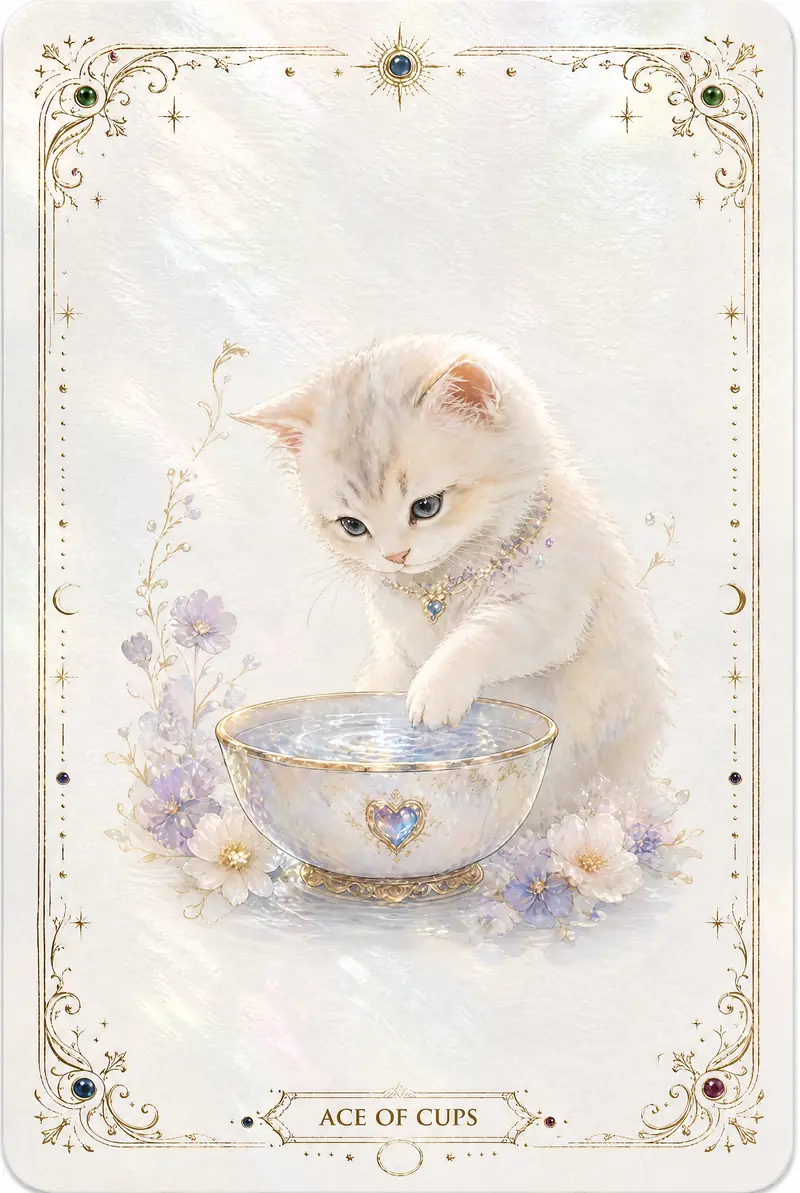
The Cups energy in its purest form: the moment the heart opens.
The image
A hand reaches out of a cloud holding a cup. Five streams of water pour from its rim into a pond full of water lilies below, and a white dove carrying a round wafer flies down toward the cup. There is no person and no situation in the picture, only the act of giving itself.
Core meaning
- The Ace of Cups marks love as the foundation of life. If the Ace of Wands (Fire) creates the world, the Ace of Cups (love) is the force that gives that world its value. The card's most direct meaning is a time of happiness and love, a gift of joy.
- It is often read as a new relationship, a flutter of attraction, a sudden rush of creative inspiration, or a heart that has been dry for a long time filling up again. The emphasis is on the moment the tap has just been turned on. A relationship that is already stable and growing belongs to the Two and the Ten of Cups.
- The five streams suggest that this emotional energy overflows in more than one direction: love, intuition, empathy, creativity and spiritual connection. The card is often read as the entrance to the whole world of feeling and intuition, and it is not limited to romance.
- In the Waite image the dove carries a communion wafer, which echoes a deeper layer of the Arthurian legend. What truly held Arthur's kingdom together was the Grail hidden in the land, more than any moral structure such as chivalry. Once the knights treated the Grail as a prize to conquer and hunt down, it withdrew and the kingdom fell apart. The Cups element, Water, stands for receptivity, and the legend makes the point that love and life cannot be seized; they can only be received. The Ace of Cups is a reminder to first become a vessel that can hold what comes, rather than to go out and fight for it.
- Unlike the cards from the Two onward, the Ace has no one responding yet and no concrete situation. Its only job is to show that this energy exists. Where it flows and what relationship it becomes are the story of the cards that follow inferred.
- A tip from practice: if the question is about a long relationship that has gone flat and settled into something closer to family, and the Ace of Cups appears, it may mean a breakthrough and a return of warmth. It is also worth checking whether one partner has started to feel drawn to someone outside the relationship. The Ace is about the starting point of a heart that has just been moved, so in a stable relationship it is a signal to ask one more question.
- When the Cups suit appears in health readings, it can point specifically to the endocrine system, the blood and other bodily fluids, and to psychological illness brought on by emotional or interpersonal stress. For women, the image of the cup as a vessel can extend to the uterus, the ovaries and menstrual issues.
- In money questions, the Ace of Cups often means feeling satisfied with one's current finances, especially when income is tied to an interest, creative work or a business one loves. The emotional satisfaction of earning matters more here than the size of the numbers.
- In health questions, the Ace of Cups is a positive sign that points to emotional balance. That balance lets the spiritual side and everyday life fit together, and it shows up as physical contentment and stability.
- When Cups cards land on seemingly worldly questions such as work or money, they still call for an emotional angle. Whether the querent likes it, whether it makes them happy and whether it can satisfy them are the key points of a Cups reading. Wands, by contrast, emphasize will and vitality, and Swords emphasize logic and weighing options.
- The symbol on the golden cup can be read as an upside-down letter W (for water, for the initial of Waite's name, or for wish). It is also linked to a combination of Hebrew letters carrying two meanings, "water" and "a vessel that bears sacred life." The three bells on the cup echo the magical tradition of calling in good energy and driving out negative energy, and they also stand for three as the first spiritual number.
- The lotus in the water below the cup symbolizes love, purity and spiritual awakening. The wafer in the dove's beak bears a cross, representing the meeting of the four elements, the four directions and the two poles of yin and yang. This suggests that the love is taking shape in the material world and is being expressed through visible, tangible action, more than through an abstract wish.
- Look at the posture: the hand supports the cup and does not grip it. In the Ace of Wands and the Ace of Swords, the hands that reach out are gripping, which stresses personal agency and control. The open, supporting hand of the Ace of Cups stands for carrying, accepting and holding up, in keeping with Water as a feminine, passive element. Its way is to receive, and control is not the point.
- The five streams correspond to the five elements and also symbolize freedom and change. The twenty-six drops scattered beside the streams correspond to YHVH, the four-letter name of God, and stress that this love is selfless, noble and undivided: a divine, universal love rather than small personal affection.
- In health readings, the card can also suggest edema. Any symptom involving fluid retention or water metabolism can be explained through the Water nature of the Cups.
- In career questions, the Ace of Cups reads as a heartfelt sense of anticipation and belonging toward a new job or opportunity: the querent likes the work itself, shares the company's culture and feels there is room to grow. The satisfaction comes from meeting good mentors and friends and from a steady stream of new joys, more than from the salary.
Reversed
When Cups cards are reversed, the overall tone shifts from "able to hold" to "unable to hold." With the cup upside down, the water cannot stay in it, and most details of this card's reversal follow that direction:
- From the image: the overturned cup blocks the dove and the wafer flying in from above. Love or ideals that should be pouring out are held down and left unsaid, which can slide into disappointment and low mood (turned inward).
- From the image: the water empties out but cannot flow back into the pond, a picture of one-sided giving that receives nothing equal in return. The more care the querent puts in, the emptier it can feel (blocked).
- Negative-meaning approach (misuse): taking good luck and smooth progress for granted and having no plan for change, which leaves the querent open to a harsh wake-up call.
- Negative-meaning approach (excess): the floodgates of feeling or desire open too wide, which can slide into self-indulgence and calls for some self-control.
- Opposite-meaning approach: it can also mean dissatisfaction with the present and an inner emptiness. In that case the reversal is urging the querent to make a change, but the new situation is not yet stable and will take real effort to adjust to before it can succeed.
- Money and health: in money matters, the reversal often means an irregular, on-and-off income, or putting so much into a hobby that it wears away the original pleasure. In health matters, it suggests that the root of the problem is likely an emotional or spiritual lack. Before working on the body, it helps to check whether emotional and spiritual needs are being looked after.
- In career questions, the Ace of Cups reversed is the deadness that follows when the novelty wears off. The people around are listless too, there is no one easy to talk to, no pleasant surprises and no visible room to rise, only hanging on to make a living.
Correspondences
The Ace is the suit itself and takes no part in the decan correspondences (see Astrological Correspondences). Its element is Water, and as a number it is the suit's most undivided root state; see Numbers in Tarot.
Views from different traditions
The Waite image carries clear Christian communion overtones; the dove with the wafer is often read as a symbol of the Holy Spirit descending. Crowley's Thoth system treats the card with more emphasis on the abstract energy of love itself and plays down specific religious symbols [uncertain: the two schools emphasize different things, but the core meaning of the card as the source of love and feeling does not conflict]. In traditional cartomancy, the Ace of Cups reversed is also often read as a change in the nature of something: friends becoming lovers, one affection replaced by another, even a change of government. Any upheaval that moves from one state into another can fall under this line of thought. Rachel Pollack approaches the card through the Arthurian legend and reads the reversal as a collapse in the manner of the Grail leaving the kingdom. Unhappiness, violence and chaos often come from failing to recognize what life has already given, or from reacting violently when the moment called for quiet acceptance.