Six of Cups
Number VI · Element Water · Correspondence Second decan of Scorpio
Upright: nostalgia, innocent giving, reunion with old friends, simple joys
Reversed: stuck in the past, refusing to grow up, a reunion with mixed motives
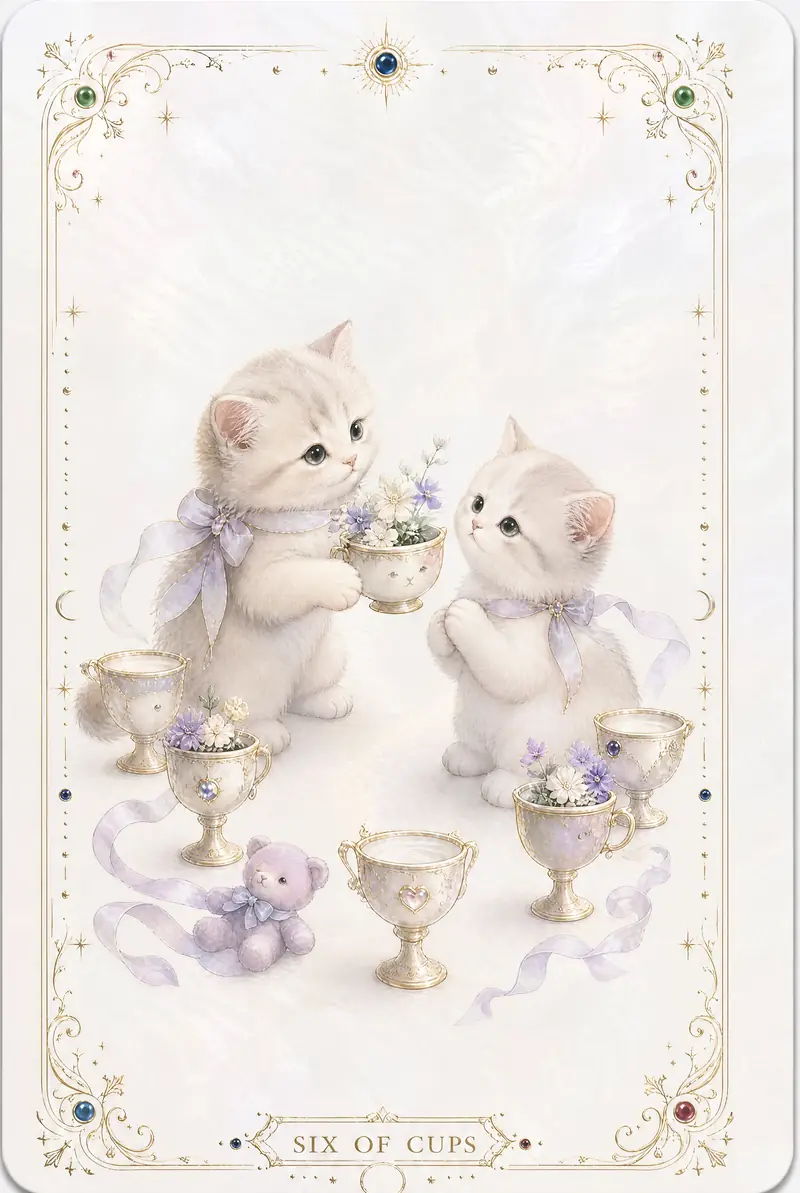
One child hands another a cup filled with flowers: a reunion with the age of innocence.
The image
Two children stand in a garden. One holds out a cup filled with white flowers to the other. Five more cups, also filled with flowers, stand around them, and in the background an adult figure is walking away.
Core meaning
- Six is the number of harmony, the answer to the loss of the Five. In the Cups it means healing the present self with warm memories: nostalgia, childhood, innocent giving, a kindness with no calculation in it.
- It is often read as meeting an old acquaintance again, hearing from an old friend, picking up a long-neglected hobby, or simply being healed by plain, simple joy.
- Pollack cautions that nostalgia does not always equal true memory. Sometimes we idealize the past and look at it through a filter of safety and happiness. Childhood is often the product of this second attitude: it is remembered as a time of complete safety, with older people providing everything that was needed.
- The act of giving is the heart of this card: sharing with no thought of return. This differs from the equal exchange of the Two of Cups and is closer to a child's unthinking generosity.
- Pollack reads the number six as the relationship between giving and receiving. In the Cups, the card shows someone like a teacher or protector passing wisdom and a sense of safety to family, students or friends. It can also be seen as the past handing a gift of memory to the future.
- Six is also often linked to the psychological idea of the inner child: getting back in touch with the self whose hopes had not yet been worn down by reality inferred.
- One detail in the picture is easy to miss. The child giving the flowers wears gloves, and the child receiving them does not. Following the etiquette that a person of lower rank removes their gloves before a superior, while a superior need not remove theirs, the child of higher standing in the picture is actually the one without gloves. The giver is paying respect to the innocence in the other child that the world has not yet worn away. See the pattern of "six as giving across a difference in status" in Numbers in Tarot.
- In card order, the Six can be understood as following on from the Five. The Five faces the shadow and negative emotions head on. The direction the Six offers is to accept and acknowledge that shadow, without suppressing or running from it, and then find a way to turn it into something useful. The open window in the picture echoes this willingness to accept oneself.
- In love readings the card often points to a few specific situations: a relationship with an age gap (the two children are of different sizes, so either partner may be the older one); one partner willing to care for the other selflessly, including with gifts of money; a love that began in youth, such as childhood sweethearts who end up together, old friends who meet again at a class reunion, or an old friend who has quietly waited for years and finally sees the relationship blossom. These give more specific story lines than a general sense of nostalgia.
- In money questions, the Six of Cups points to a period of financial stability, but the real point is less the numbers than the emotional security that stability brings. A person who can be warm and easygoing with others often has a solid financial base behind them.
- In health questions, the Six of Cups reads as balanced health and a harmonious emotional life supporting each other. Relaxing and resting in a familiar, comfortable place is itself the remedy this card prescribes.
- The upright castle stands for the masculine and for transcendence, and the low house for the feminine, for nurturing and for security. Placing them side by side echoes the image of masculine and feminine joined that often comes with the number six, and also the hexagram, which is made of two overlapping triangles for Fire (masculine) and Water (feminine).
- The soldier symbolizes protection, and the five-petaled white flowers symbolize the purity and beauty of the material world. Five corresponds to the pentagram, the microcosm of the human body with its head, two hands and two feet.
Reversed
- Clinging too much to the past, using memories to avoid a present that needs facing, refusing to grow up or move on (overdone).
- It may also go the other way: a reunion that should have happened does not, an old friend cannot be reached, or someone comes back with less than innocent motives (blocked).
- Bringing up an old bond in a calculating way, as in "you owe me," which loses the innocence this card should have.
- Idealizing a relationship so much that the memory is polished beyond reality.
- Using nostalgia as an excuse to avoid adult responsibilities, putting off whatever needs doing now with "things were better back then."
- Money and health: in money matters the reversal often means that an unstable financial base leaves people without closeness or a willingness to cooperate, and emotional security is weakened as a result. In health matters it often suggests that emotional loss or an unstable relationship is dragging down physical health. Being forced out of comfort and into change is painful, but it may in turn push the querent toward healthier, more supportive new habits.
Correspondences
Six is the number of harmony; see Numbers in Tarot. The card corresponds to the second decan of Scorpio; see Astrological Correspondences. Its esoteric title in the Golden Dawn system is "Lord of Pleasure"; see Esoteric Titles.
Views from different traditions
Crowley's Thoth system names this card "Pleasure" disputed. The Waite system leans toward nostalgia and innocent giving, while the Thoth system puts more weight on enjoying the present moment, so the two schools emphasize different things. Another reading takes the Six of Cups reversed as getting back together with a former partner. Such a reunion, though, is usually not a simple continuation of the old relationship; for both people it is closer to a completely new emotional experience.