Five of Cups
Number V · Element Water · Correspondence First decan of Scorpio
Upright: grief, regret, focusing on loss, missed chances
Reversed: acceptance and moving on, sinking into self-pity (two opposite directions `[disputed]`)
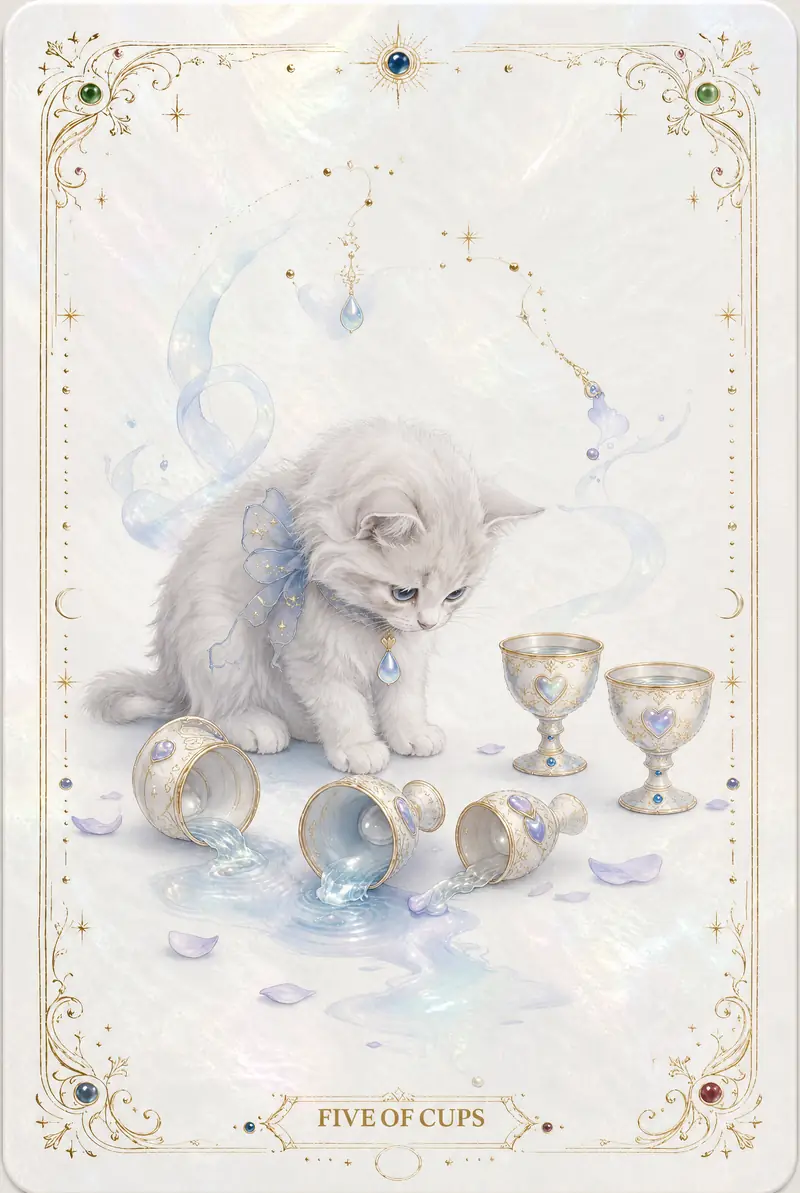
Staring at the three spilled cups and forgetting to turn around and look at the two still standing.
The image
A figure in a black cloak looks down at three overturned cups, their wine spilled. Behind the figure stand two cups that are still whole, but the figure does not turn to look at them. In the distance a bridge leads across the river to a castle.
Core meaning
- Five is the number of conflict, where stability is broken. In the Cups it becomes a concrete emotional loss: a breakup, a betrayal, a missed chance, regret. It is the card in the suit that writes about pain most directly.
- The core is less the loss itself than attention being completely taken up by what was lost, so that the two remaining cups go unseen. The card is often read as saying that grief is not wrong in itself, but sinking into it keeps a person from seeing what can still be rebuilt inferred.
- The figure is androgynous, with no clear male or female features, which suggests that grief itself has no gender. Black is the color of mourning. The figure must first understand and accept the loss. Were the three cups knocked over through recklessness and carelessness, or through taking happiness for granted? The card gives no answer, and asking that question is itself part of accepting the loss.
- Pollack reads the river in the picture as the stream of sorrow, while the bridge stands for consciousness and resolve, leading from the past (the loss) to the future (a new beginning). The card completes its turn only when the figure can accept the loss, turn around, pick up the two cups still standing, cross the bridge and walk toward the house in the distance that stands for stability and continuity.
- This is also a gateway card that stirs a deep sense of loss and separation. Myths all over the world of a fall from paradise or of exile echo this same feeling.
- Among the Major Arcana cards linked to the Cups, Death also takes facing loss as its theme, and the two cards can shed light on each other. See the suit and Major Arcana table in The Minor Arcana.
- The psychological idea of loss aversion helps explain the emotional intensity of this card. People naturally feel a loss more sharply than the pleasure of an equal gain, and it usually takes about three times the equivalent compensation before the feeling settles. What is special about this card is that the fallen cups (three) really do outnumber the standing ones (two). So this is more than loss aversion inflating the feeling; the loss is objectively larger than what remains. In a reading it helps to tell the two apart: is the querent's pain magnified by a cognitive bias, or have they truly lost more this time?
- It can also be read as the loss that comes with hidden knowledge. Learning more and seeing more clearly does not always bring more happiness. Having seen certain truths, a person may find that the false, cheap pleasures of the past can no longer satisfy them. This loss of happiness need not come from any concrete material or emotional loss; it comes from finally facing truths the querent was unwilling or unable to see before.
- In money questions, the Five of Cups often points to real losses caused by emotions being so taken up with relationship troubles that there is no attention left for money. For questions about a career or an investment, this card usually predicts a disappointing result. Take particular care when a relationship ends and shared property has to be divided; the person in the most emotional turmoil is often the one who loses out when assets are split.
- In health questions, the Five of Cups warns that grief that has not been properly dealt with can turn into a health risk. Many people, because of their surroundings or habits, are allowed only a brief period of mourning before they must return to daily life as if nothing happened. The card is a reminder that giving loss time to be truly processed is itself an investment in health.
- The black cloak also hints at a self-protective kind of wallowing. The figure could choose to face things with optimism, but instead wraps up more tightly in sorrow, and may even get a self-harming kind of satisfaction from chewing over the pain again and again. When this card appears, it is worth asking whether the querent is caught in this unhealthy emotional loop.
- The card can also point to the shadow side of the personality coming to the surface. Desires and impulses long suppressed in the unconscious start to become conscious, and the person suddenly thinks "so this is how awful I am" and falls into self-doubt. These seemingly selfish traits are, at bottom, attempts to secure resources and live better, just in the wrong way. Accepting them and making friends with them helps more than pushing them away and denying them.
Reversed
disputed The two readings in the literature directly contradict each other. The opposite-meaning approach holds that the reversal means finally turning around and accepting the two remaining cups: letting go of unrealistic expectations and seeing that nothing was truly lost. The negative-meaning approach holds that it means sinking deeper into self-pity and going over the pain again and again without getting out (overdone). Other readings are also possible:
- From the image: the bridge that should lead to outside help does appear, but a river still blocks the way halfway. Outside alliances or support cannot be reached for now, and the obstacle remains (blocked).
- From the image: the querent is easily carried along by other people's sorrow, to the point of not being able to tell whose grief is affecting whom. If even the two cups still standing fall over, very little is left, and it is time to prepare for the worst.
- Negative-meaning approach: holding on to a plan that no longer works and refusing to revise it. The harder the querent insists, the more likely it ends in failure. It may also be the moment to use this bad news to see the situation clearly, which is the only basis for real change.
- Opposite-meaning approach: finding other things to take the mind off the loss often lifts a low mood faster than staring at the loss itself.
- Money and health: in money and health matters the reversal is usually on the positive side. In money it reads as gradually recovering from past losses and seeing through them that money was never able to fill an emotional or spiritual gap. In health it reads as emotions having settled into a more balanced state, with the support of family and friends or a steady, regular life as the anchor of recovery.
- One angle on the reversal goes further than sinking into self-pity. On the surface the querent seems to have moved past the grief, but in fact they refuse to admit the loss and keep up a forced, self-deceiving optimism. Examples include ignoring the obvious faults of a partner, or stubbornly rejecting criticism that deserves reflection. In the short term these psychological defenses feel good, but in the long run the problem is not solved and only gets worse the longer it drags on.
Correspondences
Five is the number of conflict; see Numbers in Tarot. The card corresponds to the first decan of Scorpio; see Astrological Correspondences. Its esoteric title in the Golden Dawn system is "Lord of Loss in Pleasure"; see Esoteric Titles.
Views from different traditions
Crowley's Thoth system names this card "Disappointment," which states the card's emotional tone more bluntly than the Waite image does inferred. In older fortune-telling books, the Five of Cups reversed was sometimes used for matters of family and bloodline, such as family background or relatives by marriage, though this meaning is rarely used in modern readings. Pollack also notes that the figure's posture and black clothing closely resemble The Hermit of the Major Arcana, and that both stand for remaining upright in the midst of grief or injustice. From the angle of awareness, the card also echoes the truth and acceptance of responsibility that Justice represents.