Seven of Cups
Number VII · Element Water · Correspondence Third decan of Scorpio
Upright: too many choices, daydreams, idealization, possibilities not yet grounded
Reversed: making a clear-headed choice, retreating deeper into fantasy (two opposite directions `[disputed]`)
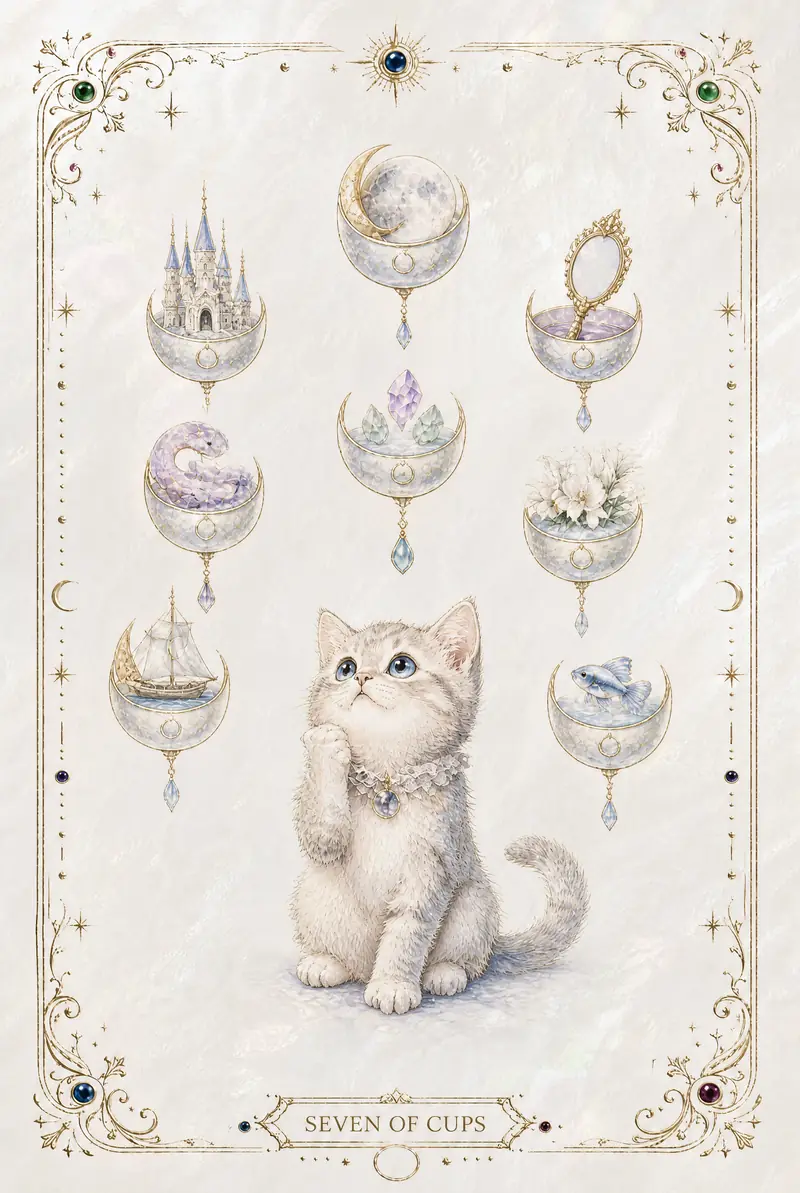
Seven cups float in the clouds, each holding a tempting vision, and none of them is real.
The image
A shadowy figure faces seven cups floating in the mist. In the cups appear a face, a veiled figure, a snake, a castle, a heap of jewels, a laurel wreath and a monster. The figure seems to be hesitating over which one to choose.
Core meaning
- Seven is the number of assessment, stopping to look at the situation before acting. In the Cups it means facing many emotional or desirable possibilities, none of which has touched the ground yet: daydreams, too many choices, idealized hopes.
- The card does not say these wishes are false. It points out that for now they all remain in the imagination and have not been tested. The seven cups float in the clouds, with no footing on the ground.
- A key point that is often missed: the daydreams lack meaning, but not because their content is empty. The visions in the card cover nearly every category of fantasy (wealth, glory, fear, adventure, even archetypal figures and the snake), and such images often come from deep archetypal needs. The real problem is that they have not yet connected to anything outside the self.
- Common situations: talking about many ideas without actually moving any of them forward; rehearsing so many possibilities in one's head that deciding becomes harder; being drawn to glittering options (the jewels, the laurels) while ignoring the shadow side (the snake, the monster) that is also among them.
- Given the intuitive nature of the Cups, the card also points out that the line between intuition and fantasy is sometimes blurry, and it calls for telling apart real inner longings from daydreams that are only an escape from reality inferred.
- The images in the seven cups (beauty, hidden knowledge, a glowing soul, the security of a tower, wealth, a wreath of glory, a dragon that takes courage to face) are all things people commonly want. The card's point is that these are only tools and paths, and none of them is the destination; the place truly worth reaching is the growth of the soul and spirit. Once the tool itself becomes the goal (chasing money for its own sake and forgetting what it was for), a person becomes the tool's servant instead of its master. Knowing when one has just enough matters more than piling up more.
- In readings about career or reputation, the card can also warn that rising higher than one's character can support invites disaster. Success gained through shortcuts, deceit, arrogance or coldness may really go smoothly and look impressive for a while, but with a shaky foundation it rarely lasts. Once exposed, it collapses back to where it started, and the cost is usually higher than the cost of steady, honest progress.
- In money questions, the Seven of Cups is less about whether to give up financial goals and more about first working out whether those goals can actually meet the querent's real material and emotional needs. Clarifying inner needs first, then checking whether the current financial plan fits them, often matters more than charging ahead blindly.
- In health questions, the Seven of Cups is often read as physical symptoms that come from a failed search for some deep spiritual satisfaction or emotional need. The remedy it usually prescribes is to take time to review whether needs on every level, inner and outer, are being looked after. When they are in balance, the symptoms ease.
- In money questions, it can point specifically to traps like Ponzi schemes and shady peer-to-peer lending platforms: promises of high, steady returns, encouragement to recruit others and invest more, and a cash chain that breaks as soon as payouts stop. The card is a reminder that money does not fall from the sky, that any judgment made with the help of divination is only an aid, and that real success comes from one's own steady effort.
- In career questions, it can point specifically to being lured by the big promises of insurance sales, social-media reselling or commission-only sales jobs. Hearing that the top seller earns a fortune every month, the querent forgets their original career goals and chases that figure, only to find after joining that very few people actually make that kind of money.
- The clouds have a double meaning as well. On the surface they stand for confused, unclear thinking, but clouds are also where divine consciousness dwells. This suggests the card is really a prompt to look inward and see clearly what one truly wants.
- The seven visions can also be matched one by one with the planets: Venus (temptation, linked to The Empress), Mercury (lies, echoing the snake of deceit at The Magician's waist), Mars (anger, linked to The Tower), Jupiter (vanity, linked to the riches of the Wheel of Fortune), Saturn (coldness, linked to the skull hidden at the bottom of The World, prosperity built on the sacrifice of others), the Sun (arrogance, linked to whether the hero of The Sun grows complacent after slaying the dragon) and the Moon (betrayal, linked to how many people have betrayed the faith that The High Priestess represents). This set of correspondences points to several common human weaknesses; success gained through them may come quickly, but it does not last.
Reversed
disputed One common reading is that the illusions are finally cleared away and a clear choice is made, moving from inner tangle to clear-headed action. Another reading is sinking deeper into unrealistic fantasy and using daydreams to avoid real decisions that need facing (overdone). It may also be read as:
- A choice left hanging for a long time is forced to a close by outside pressure;
- An option that once seemed tempting is seen for what it really is and willingly dropped;
- The indecision itself becomes a comfort zone: as long as no choice is made, there seems to be no responsibility for failure in any direction.
- Money and health: in money matters the reversal has two common directions. One is a reminder to step back into the stable period of the Six of Cups, rest and recover, and set out again once ready. The other is a hint that the financial goal the querent is clinging to may not bring real satisfaction in the long run, and that it is worth considering letting it go. In health matters the reversal often means that spiritual or emotional needs have been neglected for a long time in pursuit of financial stability, and physical discomfort is the reminder of that neglect.
- Another reading of the reversal goes further than sinking into fantasy. The querent has lost all awareness, mistakes a state of self-deception for a dream come true, and cannot feel that anything is wrong. When the truth finally comes out, the fall is harder than it would be with the upright card.
Correspondences
Seven is the number of assessment; see Numbers in Tarot. The card corresponds to the third decan of Scorpio; see Astrological Correspondences. Its esoteric title in the Golden Dawn system is "Lord of Illusionary Success"; see Esoteric Titles.
Views from different traditions
disputed Crowley's Thoth system names this card "Debauchery" and labels it more directly as negative indulgence and excess than the Waite system does. The Waite image is relatively neutral and stresses the need to discern among many options, without assuming the outcome must be negative. In more divination-oriented traditional practice, the Seven of Cups reversed is also often linked to planning, suggesting that this stage is suited to thinking things through and making plans, and it is not yet time to put them into action.