Eight of Cups
Number VIII · Element Water · Correspondence First decan of Pisces
Upright: leaving by choice, seeking deeper meaning, walking away from surface achievements
Reversed: wanting to leave but unable to, procrastination, repeated escapist departures
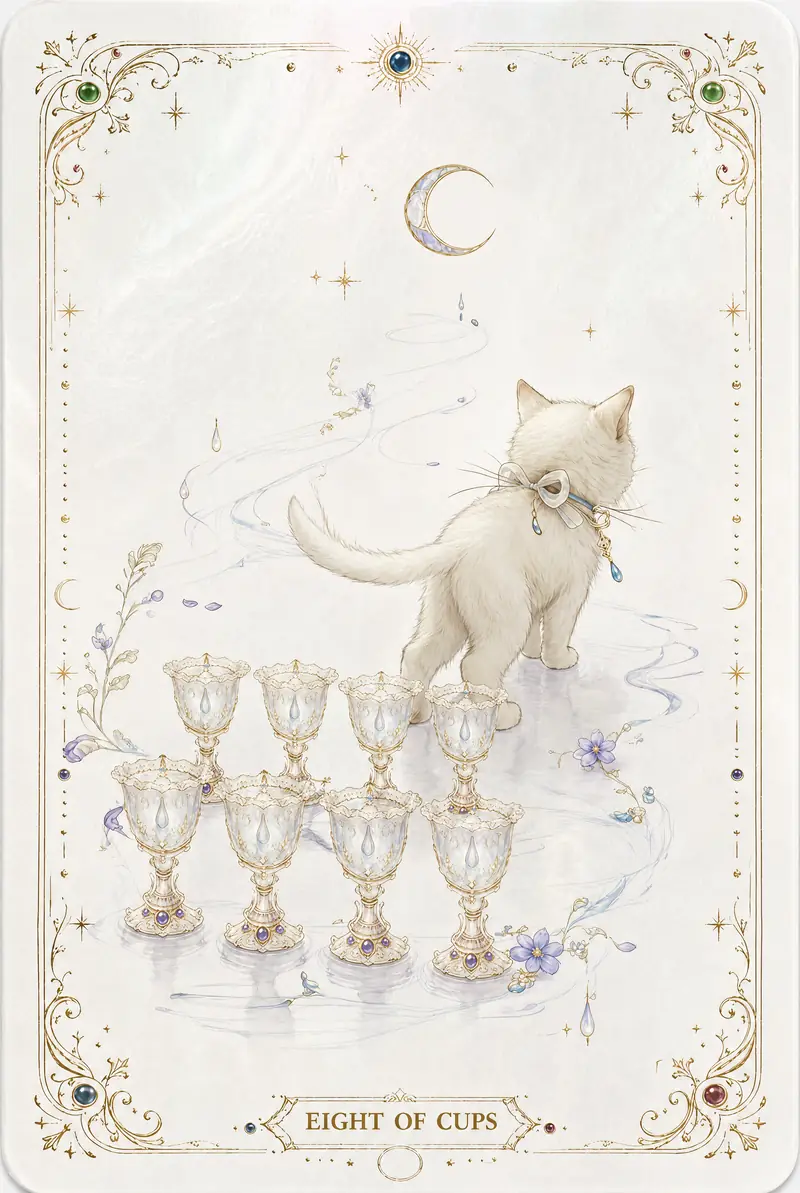
Eight cups stand there intact, and still he turns and walks into the mountains at night.
The image
A man leaning on a walking staff walks away from the viewer toward the mountains. By the river at his feet he has left eight cups neatly arranged (with one gap in the row). Overhead hangs a moon with a human face, partly covered.
Core meaning
- Eight is the number of moving forward and drawing things to a close; after the assessment of the Seven, action begins. In the Cups it reads as leaving on purpose once one has thought things through. Even though everything on the surface still stands (all eight cups are intact), the person chooses to turn away.
- This is a card of giving up and leaving by choice, unlike the passive loss of the Five of Cups. Here the leaving is the person's own decision, usually because they have realized that the achievement or relationship in front of them cannot answer a deeper inner longing.
- Pollack points out that the standing cups have not actually fallen (compare the two intact cups of the Five), yet the man already knows it is time to go. This is one of the deepest functions of Water's intuition: sensing that something should end and that it is time to move on, before things run dry or the surroundings collapse.
- The body overhead looks at first like a moon in the night sky, but on a closer look it is a solar eclipse: the moon is passing in front of the sun, a sign that a period of inner awareness is taking over a life of outward action. The figure also resembles The Hermit of the Major Arcana. To reach the Hermit's high wisdom, one must first leave the ordinary things of life behind.
- Pollack reads this card as a gateway card that works somewhat like the Three of Wands. Both use the image of setting out on an unknown journey. In the Three of Wands, Fire is drawn toward Water; in the Eight of Cups, Water is drawn toward Air. The first breaks the small ego and frees the spirit of exploration. The second leaves the haze and ambiguity of Water and climbs the Hermit's mountain toward a concrete grasp of abstract principles.
- The card is also often linked to modern situations like burnout: every outward measure of success has been met, but the querent knows clearly that they feel empty inside inferred.
- The esoteric title, "Abandoned Success," points to the psychology behind the departure. What the person really hoped for was the completeness of nine (echoing the Nine of Cups that follows). With only eight in front of him, the missing one makes everything count for nothing. This near-compulsive high standard also matches the resemblance between the figure's posture and The Hermit (linked to Virgo and the pursuit of perfection). What pushes him to turn away is the feeling that falling one short is failure. The sense that this place no longer suits him is secondary.
- The card only confirms that the act of leaving has happened. It does not promise that the outcome will be better. Whether it is quitting a job to start a business, breaking off an engagement to follow love, or trading a safe investment for a riskier one, the Eight of Cups only says that the querent found the courage to take that step. Whether it was worth it and whether it works out are for the following cards to answer.
- In money questions, the Eight of Cups often points to thinking about leaving a job or giving up an existing investment or source of income. The emphasis is less on whether to go and more on thinking seriously, after leaving, about where new income will come from. Only then is lasting growth and satisfaction possible.
- In health questions, the Eight of Cups often suggests trying a new way of looking after one's health and leaving behind old methods that are familiar but not necessarily effective. The logic behind the card is that spiritual and emotional strength is the real foundation of physical health, so any effort to care for body and mind should start on that level.
- There is another way to read the body overhead. The points of the waning crescent face downward, symbolizing driving out and letting go, and it holds the full moon in its center. The idea is that you have to let go in order to receive: the man already knows he must first put down the imperfect things in front of him before he can keep walking toward a truly complete goal
[disputed: this coexists with Pollack's eclipse reading]. - The water in the background symbolizes the evolution of the astral plane and feminine power, while the mountains stand for masculine strength and upward striving. The staff in his hand echoes The Hermit and is linked to the willpower of Fire. It is both a weapon against evil and a support on this pilgrimage.
Reversed
- Knowing it is time to leave but being unable to go: afraid of change and the unknown, the querent would rather stay in an unsatisfying situation than take that step (blocked).
- Making a show of leaving while actually putting it off again and again, wavering and never truly committing.
- It may also be excess in the other direction: running away over and over, turning to leave at the first discomfort and never giving anything a chance to take root.
- Using "let's wait a bit longer" as an excuse, waiting a long time while nothing truly moves forward.
- Money and health: in money matters the reversal often means wavering again and again over whether to stay or go, advance or retreat. The solution is often to go back to the work of the Seven of Cups and first get clear on what the querent truly values (for example, whether security matters more than familiarity). Only then can a real choice be made. In health matters it often means confusion about which approach to use to maintain or improve health, swinging between different options. Here too the querent needs to do the homework first, compare and analyze carefully, and then make an informed decision.
- The reversal also often shows up as passive-aggressive self-contradiction. The querent knows the relationship or situation is wrong and inwardly wants to leave, but will neither say so openly nor truly accept the situation. Instead they keep finding fault and picking fights to torment the other person and vent their frustration. This twisted behavior does not solve the problem; it only highlights the querent's inner conflict and inability to face their own real feelings.
Correspondences
Eight is the number of moving forward; see Numbers in Tarot. The card corresponds to the first decan of Pisces; see Astrological Correspondences. Its esoteric title in the Golden Dawn system is "Lord of Abandoned Success"; see Esoteric Titles.
Views from different traditions
disputed Crowley's Thoth system names this card "Indolence," a more negative reading than the Waite system's: lack of energy and stagnation, with no purposeful departure in search of meaning. The Waite system reads it as an active, meaningful departure, so the two schools judge the card's direction in opposite ways. It is worth noting that in older fortune-telling traditions the Eight of Cups reversed sometimes points to positive occasions such as banquets and celebrations, occasionally with a touch of inventive creativity. This does not fit the "wanting to leave but unable to" reading, which shows that interpretations of this card's reversal have always differed.