Ten of Swords
Number X · Element Air · Correspondence Third decan of Gemini
Upright: total ending, hitting bottom, being forced to let go
Reversed: a drawn-out ending, refusing to accept it, starting to recover
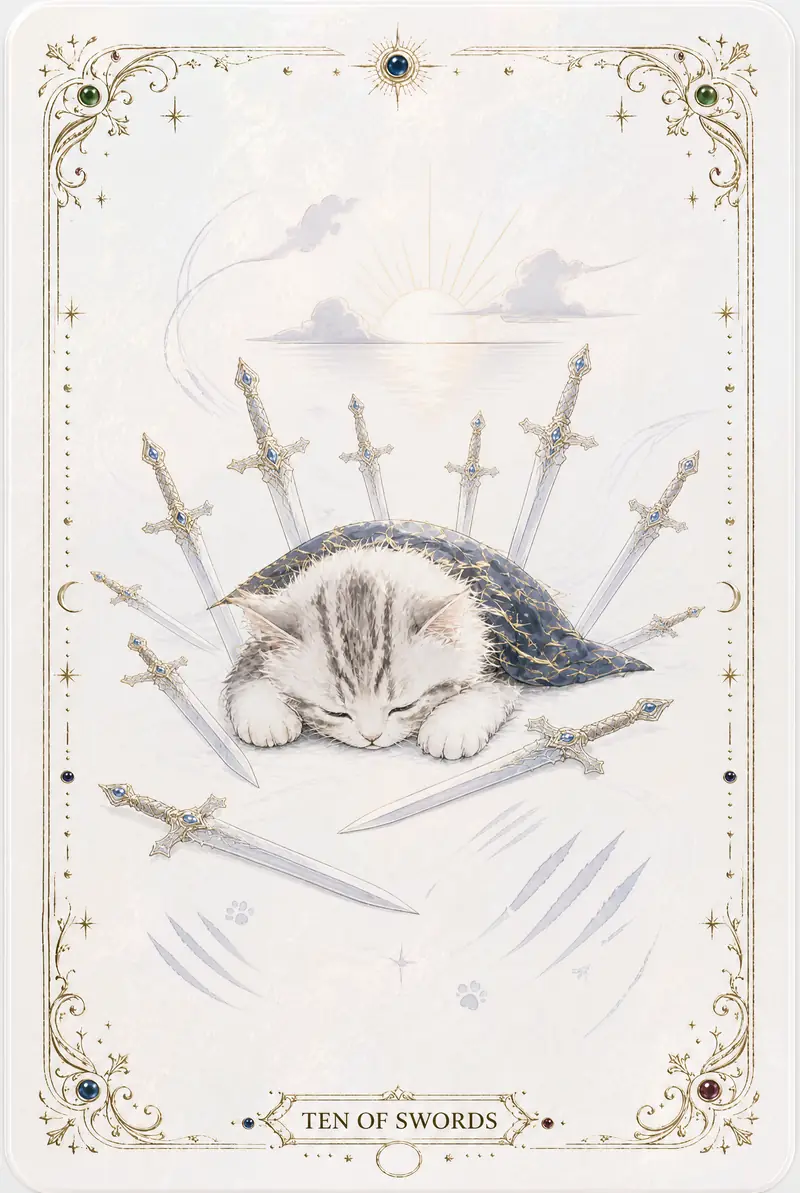
There is no room left for things to get worse; what remains is the light on the horizon.
The image
A man lies face down on the ground with ten swords in his back. The sky is dark and heavy, but a thin line of golden dawn shows along the horizon, and the sea in the distance is calm.
Core meaning
- The number ten is about a cycle reaching its end (see Numbers in Tarot). The Ten of Swords shows that end in its most unsparing form. This is not completion as a full harvest; it is an ending in which someone is completely knocked down.
- All ten swords are already in, with no room for another. The card says things cannot get worse than this. Something has fallen as far as it can fall, and there is no need to fear it getting worse, because there is no further down to go.
- Unlike the deliberate rest of the Four of Swords, the ending of the Ten is usually not chosen. Outside circumstances, other people's choices or the course of events force things to this point. That is what separates these two Swords cards, both of which are about stopping.
- The line of dawn on the horizon is an easily overlooked but important detail. The darkest hour of night is also the one closest to dawn, and hitting bottom means there is no direction left except up inferred.
- Given the suit's link with truth, the card can also be read as a harsh but clear-eyed end to an illusion. Some fantasy, some relationship, some fact the person refused to admit has finally been shattered by reality, and self-deception is no longer possible.
- Common concrete situations: a relationship that ends in the most humiliating way, a project that fails beyond any hope of recovery, a lie exposed in public. The card does not suit minor setbacks. It corresponds to a failure that is unmistakable and can no longer be denied.
- Unlike the Nine of Swords, whose anxiety stays at the level of imagination, the Ten says the imagined worst case has actually happened. In a sense this is also a release: there is no more need to fear "what if it happens," because it already has.
- The card is also often used to describe a stab-in-the-back betrayal: harm that comes from behind, from an unexpected direction, instead of in an open confrontation.
- Pollack offers an angle that deserves special attention. The card does not necessarily point to death or violence as such. The extremity of the picture shows more about how a person reacts to their trouble than about how objectively bad the trouble is. Ten swords cover nearly the whole body, with one even beside the ear. The exaggeration looks more like adolescent melodrama, self-pity and hysteria: "no one has it worse than me," "my whole life is ruined." Compared with the Nine of Swords, the dark clouds in the distance have cleared and daylight shows through. Compared with the Five and the Two of Swords, the water here is calm. These details all suggest the situation is not actually as hopeless as the picture first appears.
- Why does the Swords suit grow heavier toward the end instead of reaching a full harvest at the ten like the other suits? One explanation is that Swords correspond to the mind and perception. The more one knows, thinks and sees through, the more easily one notices the unfairness of the world, other people's schemes and the bind of one's own situation. This is the deeper reason the suit's number cards lean negative overall and reach their extreme at the ten, beyond the pictures simply happening to look grim.
- The fallen man's hand makes the same gesture as the Hierophant's blessing. The physical, material self has died, but the gesture suggests the spiritual side has not died with it and may continue in another form. This echoes the common reading that hitting bottom is the starting point of some kind of transformation and not the end, though that transformation can only begin after the total failure has been admitted.
- In money questions, the Ten of Swords plainly corresponds to a complete collapse: a business that cannot survive, being forced into bankruptcy, years of effort finally overwhelmed by the wider economy. The card does not shy away from how total this is. One practical technique: if the Ten of Swords falls in the outcome position, draw one more card and place it beside it to help judge what comes next. This extra card usually gives a concrete sense of direction that winter will not last forever, more than empty reassurance.
- In health questions, the card's extreme imagery needs careful handling. Most of the time it corresponds to back and neck pain and complete exhaustion, the body warning that it has reached the breaking point of depletion or collapse, and that it is time to plan seriously how to rebuild one's health. Only when at least three other strong cards appear alongside it, such as Death, the Tower, the Three of Swords, the World, Judgement, the Six of Swords or a blank card, is there reason to cautiously consider something more serious. Do not read the Ten of Swords alone as the worst case.
- The water in the picture has its own place. In nearly every myth, a person who dies travels to another world, and a river marks the crossing along the way. The water here likewise stands for the soul's transition, echoing the idea that the material self dies while the spiritual self continues in another form.
- The sand stands for a fixed law: everything that begins also ends. The Ten of Swords shows one such ending. Because the suit is Swords, this ending happens at the level of thoughts, forms and concepts, and is not death in the literal sense.
Reversed
- Blocked: The morning light on the horizon moves from the distance to the top of the picture. A turning point is already emerging, and now the priority is to actively seize this new opportunity and turn the crisis into a chance, instead of staying stuck at the bottom.
- Overdone: The ten swords now enter the victim's back from below. This suggests the harm this time is more likely to come from inside, or from several unseen sources, with no warning and little chance of guarding against it in advance. Sometimes the querent may be the one doing the harm, dealing someone else a heavy blow, and in that case honest self-examination is called for.
- Blocked: The improvement in front of you may be only a last brief rally. A short-term gain cannot make up for a long-term loss, and in that case it is better to stop early and cut losses. This is also not a good moment to push for change. Forcing change now may bring even more pain; it is better to wait patiently for things to turn on their own.
- Turned inward: Separation and ending are often the better choice. A short, sharp pain is better than a long, drawn-out one. Letting go of past hurt makes room for a new beginning. It is also time to face reality bravely and stand up again after hitting bottom.
- Turned inward: In particular situations, this may also correspond to a sudden insight after hitting bottom. The process turns out to be less painful than expected and even brings unexpected gains.
- Turned inward: In money and health questions, the reversal often carries the same signal: the hardest stage is over, provided the querent really drops the old thinking and makes new plans. With money, that means paying off old debts and rebuilding the structure. With health, it means facing the outdated attitudes to life and the suppressed fears that are dragging the body down. Both require actively making changes instead of waiting passively for things to get better on their own.
Correspondences
Number ten, see Numbers in Tarot. Element: Air. Astrology: third decan of Gemini, see Astrological Correspondences. In the Golden Dawn system its esoteric title is "Lord of Ruin"; see Esoteric Titles.
Views from different traditions
The Crowley-Thoth system calls this card "Ruin" and leaves almost no room for a positive turn. Because the Waite picture adds the dawn on the horizon, it keeps open the possibility of a rebound after hitting bottom disputed. Both approaches exist side by side in common practice. Which one to use depends on whether the querent more needs their pain acknowledged right now or more needs to be given hope.
In traditional divination texts, the Ten of Swords reversed was also once associated with power, authority and influence, though usually bringing harm more than benefit.