Ten of Pentacles
Number X · Element Earth · Correspondence Third decan of Virgo
Upright: family legacy, structural abundance, inheritance, long-term stability
Reversed: inheritance disputes, a shaken foundation, valuing material things over feelings
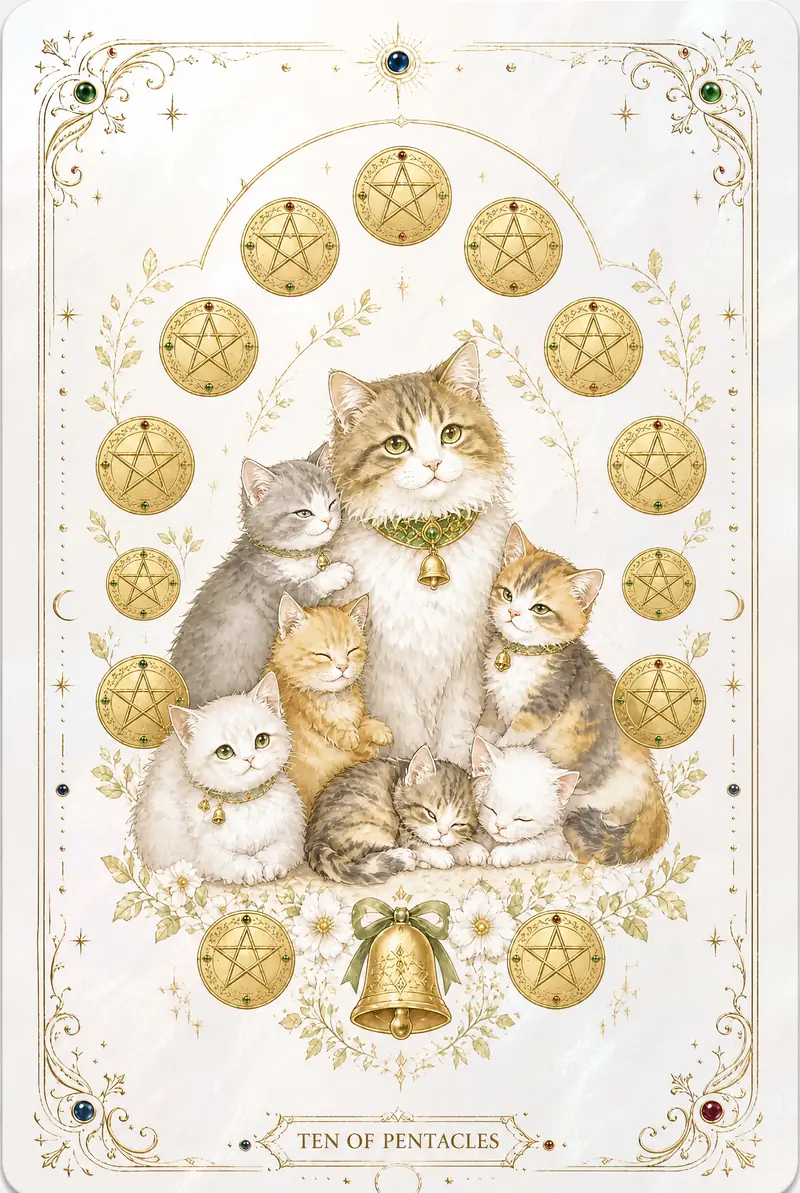
An old man and his dogs keep watch under the archway as three generations of a family pass through. The story of Pentacles has reached the level of the family.
The image
In the courtyard of a prosperous town, a white-haired old man sits beside an archway with two dogs nestled against his legs. On the other side of the arch a couple stand talking, and a child plays, tugging at the mother's skirt. A family crest is carved at the top of the archway, and ten pentacles are scattered around the edges of the scene and on the ground, as if they were part of the background itself.
Core meaning
- Ten is the stage of completion, the end of a cycle (see Numbers in Tarot). In Pentacles, material security has expanded to the scale of a family or a long-standing community. It is no longer one person having money. Several generations now share a solid foundation.
- The pentacles are no longer held in anyone's hand. They are scattered across the whole scene, which suggests that at this stage wealth has become part of the environment itself: houses, inheritance, social standing. This is structural abundance, more than a number in a bank account.
- This is the richest and most layered card in the Minor Arcana in its symbolism. The ten pentacles are arranged in the pattern of the Kabbalistic Tree of Life, the only time this arrangement appears in the whole deck. The archway is also carved with a relief of scales (the symbol of the Justice card), hinting at a subtle force that keeps the everyday world from falling into chaos.
- Rachel Pollack reads this family as not really communicating. The man and woman face opposite directions, the child clings to the mother but looks away, and no one notices the old man outside the arch. They take their present comfort for granted and may even find the security so dull it feels suffocating. The fulfillment of the Ten of Pentacles therefore carries a layer of distance that is easy to miss.
- The old man outside the arch recalls the "god in disguise" theme found in cultures around the world: a god or angel appears as a beggar to test people's generosity and hospitality and afterward leaves a magical gift. Pollack connects him with Odysseus in Homer's epic, who returns home disguised as a beggar, as a reminder that true reality is often ancient and mysterious, hidden just outside the everyday life we take for granted.
- Compared with the one-person abundance of the Nine of Pentacles, the Ten extends that abundance to the whole family. It is the only number card that clearly brings in a view across several generations.
- Pollack reads the archway itself as a gateway. The card's point of view places us outside the gate, standing with the mysterious old man. By merging with this card, we can pass through that gateway and see that the small dramas of our daily lives are also roles assigned to us by birth and society.
- The symbols drawn on the old man's robe, such as the magic squares of Mercury and Saturn, stand for the ability to keep earning from wisdom and experience. Even when he is old and no longer does the work himself, he can keep earning income from his professional reputation, from sharing experience or from royalties. This is a higher-level source of wealth than simply working for wages.
- The two dogs are a bridge between the old man and the child. The child holds a dog's tail, and a dog's paw rests on the old man, so one end is joined to the beginning and the other to the end. This echoes the saying in the Sefer Yetzirah (the Book of Formation) that "the beginning is fixed in the end, and the end in the beginning." The complete ending of the Ten of Pentacles is also the starting point of the next cycle.
- In career readings, the difference between the Nine and Ten of Pentacles is worth noting. The Nine is abundance from doing well on a personal level. The Ten stresses whether that achievement can be repeated, turned into a team effort and passed on: whether the querent's results have grown from "one person carrying it all" into a system that can keep running and be handed over to others.
- On money, the upright card means finances that are secure and still growing. This is the harvest stage brought by past effort and a careful, practical financial structure. As an answer about starting a new business it suggests success, and if the question is about borrowing money for a new investment or venture, it suggests the funds are about to arrive. On health, the Pentacles way of staying well is to secure future health through steady upkeep and a practical routine. Sometimes it also suggests that monthly spending already includes the cost of a gym or health insurance.
- The man, the woman and the two dogs in the picture together show the dual nature that belongs to the material world: cold and hot, dry and wet, soft and hard can all be clearly told apart. This contrasts with the idea that the divine world is one. As the last card of the Minor Arcana, the Ten of Pentacles marks the end point of the movement from divine unity to full material duality.
Reversed
- The figures in the picture move to the top. Reversed, this puts more weight on people as the key to whether things succeed or fail. There may well be open and hidden power struggles inside the group or family, despite the harmony on the surface. This is the blocked type.
- The opening of the archway turns to the other side, a sign of an exit to the outside. This can also be read as breaking free of tradition or family duty and taking a path that does not fully depend on the family business.
- If the ten pentacles are arranged in a way that departs from their original order, it suggests that this abundance is starting to go beyond the purely material. It can also mean leaning too far toward the spiritual and neglecting the material foundation that should be kept solid.
- From the angle of the negative-meaning method: a major mistake with money may bring a sizable financial loss, and it needs to be fixed early before things get worse. Jointly held property can also easily cause disputes among family members, until only shared interests remain and no real emotional bond.
- From the angle of the opposite-meaning method: the large sums being handled may not belong to oneself, and they need to be handled with extra care. It may also be that there are no steady rules to follow right now and everything feels more like gambling. More patience is needed to finish things steadily, without rushing.
- From a money and health angle: reversed, finances may be fairly tight. In a career question, it may mean losing a job, or needing quite a while to find work that pays well. When the economy goes into a recession, this reversed card tends to appear in spreads month after month, which is a reason to remind the querent ahead of time to control spending over the next few months. On the health side, the career may be harming health: hours may be too long or the workplace itself unhealthy. Money troubles can also be one of the ongoing sources of stress that lead to health problems, or poor health may in turn be blocking chances to earn.
Correspondences
The number is ten (completion; see Numbers in Tarot). The element is Earth. The astrological correspondence is the third decan of Virgo, with Mercury as the traditional ruler uncertain; see Astrological Correspondences. In the Golden Dawn system this card's esoteric title is "Lord of Wealth"; see Esoteric Titles.
Views from different traditions
Some reading traditions link the reversed Ten of Pentacles to specific long-term financial arrangements such as retirement funds and pensions, or point it to tax matters, especially inheritance tax.