Ten of Cups
Number X · Element Water · Correspondence Third decan of Pisces
Upright: a happy family, belonging, lasting emotional fulfillment, the ideal home
Reversed: cracks beneath surface harmony, clashing values, a blocked reunion
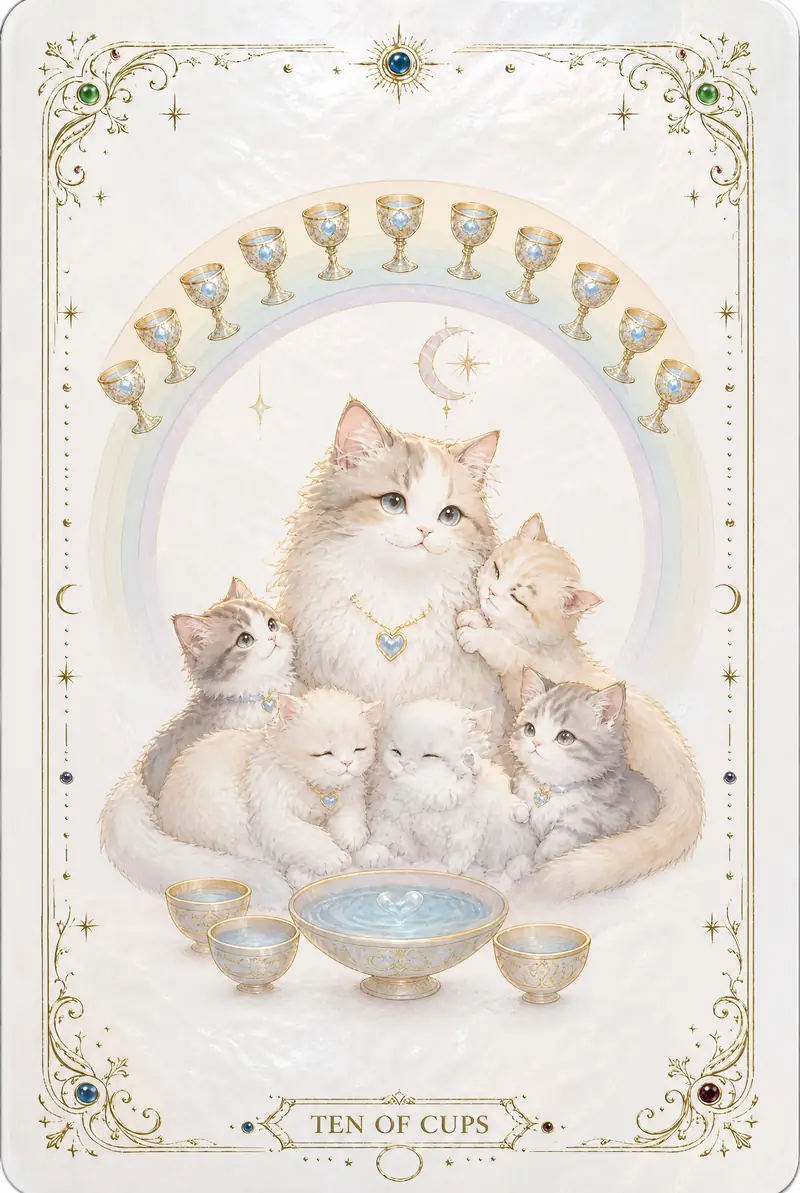
Under a rainbow, a family opens their arms while two children dance on the grass. This is where the Cups story arrives.
The image
A couple stands on the grass in front of their cottage, looking up at a rainbow with ten cups arranged along it. They hold each other with their arms raised high. Beside them, two children hold hands and dance.
Core meaning
- Ten is the number of completion, the end of a cycle. In the Cups it is the end point of emotional growth. Starting from the Ace, the purest stirring of the heart with no one yet to receive it, feeling has come all the way here and finally found a form that is stable, lasting and shared by a whole family or community.
- This is the card of a happy family and a sense of belonging. It goes a step beyond the personal satisfaction of the Nine of Cups: the satisfaction no longer belongs to one person but spreads to everyone who matters.
- As the highest number, ten stands for being filled with the qualities of the suit. The Ten of Wands shows an excessive burden, while in the Ten of Cups joy and the wonder of life spread across the sky like a rainbow. The same number takes on very different faces in different suits.
- Pollack connects the card with the story in the Bible where God makes a covenant with the rainbow, promising that the world will never again be destroyed by flood. She sees the rainbow as carrying an even brighter promise: life will bring real joy, more than just an absence of pain. In the picture the couple hold each other and look up in praise of the rainbow, while the children just dance and never look up. The children stand for innocence; they treat joy as the natural state of life, take it for granted, and still do not waste it.
- The card is also often read as the image of the ideal home itself. It does not have to involve blood ties; any network of relationships that gives a sense of belonging and unconditional acceptance can be described by this card.
- The ten cups hang on the rainbow and are not held by anyone. This fulfillment belongs to no single person; it belongs to the whole scene and the whole network of relationships inferred.
- The family of four in the picture, two parents and two children, can be matched to the father, mother, son and daughter of YHVH, the four-letter name of God. It also echoes in structure the four court cards to come (King, Queen, Knight, Page). The card is both the end of the emotional arc of the number cards and a bridge into the court card system.
- Seen within the story line of the Seven, Eight, Nine and Ten of Cups, reaching the Ten depends on the courage to leave shown in the Eight. First one sees clearly what illusory success is (Seven), then one can let go of what one has that is not good enough and pursue what one truly wants (Eight), then one reaches both material and emotional satisfaction (Nine), and finally the shared fulfillment and belonging of the people around (Ten). Looking back, the earlier losses and departures were all part of the road here.
- In money questions, the point of the Ten of Cups is that at this stage emotional satisfaction deserves more attention than whether finances are stable. Financial stability is only the base that lets a person enjoy life with peace of mind; it is not what this card really wants to stress.
- In health questions, the Ten of Cups is a sign that all is well. Having supportive family and friends nearby, balancing work and leisure, and joining love with emotional abundance are the keys to keeping body and mind balanced and content.
- The rainbow connects heaven and earth, and it also symbolizes that the spirit can help the material world succeed while a material base can support spiritual growth. Heaven stands for the spirit and earth for matter, and this answering between them is a picture of spirit and matter satisfying and completing each other.
Reversed
- Peace on the surface, with unspoken cracks in the family or close relationship underneath: clashing values and long-built-up conflicts held down by the expectation that everyone "should be happy" and kept from coming out (blocked).
- A reunion that should happen cannot, for practical reasons (distance, arguments, unexpected events).
- Holding the ideal of a happy family so tightly that it creates a surface harmony no one dares to break.
- Children drawn into unresolved conflicts between adults and becoming casualties of family tension.
- Money and health: in money matters the sense of lack is often really an emotional emptiness, more than an actual shortage of money. If money problems keep coming back, it often suggests going back to the Nine of Cups to reassess what work or love truly means to the querent. In health matters it often means feeling deeply empty, even depressed, while living inside a family or close relationship. The root is usually losing connection with the important people in one's life or work. Here too the querent needs to go back and get clear on who they are and what they give, and if necessary look outward for better-suited people to form a new support network.
- In money questions the reversal has two more specific forms. One is losing money through the people around: being dragged into others' troubles, always picking up the bill, putting too much into social obligations. The other is earning money but never enough: enough for daily expenses but not enough to save or to reach the threshold of buying a home and settling down. Money is there, but it cannot support fulfillment at the level of a whole group or family.
Correspondences
Ten is the number of completion; see Numbers in Tarot. The card corresponds to the third decan of Pisces; see Astrological Correspondences. The emotional arc of the Cups number cards (Ace through Ten) closes here. Its esoteric title in the Golden Dawn system is "Lord of Perfected Success"; see Esoteric Titles.
Views from different traditions
Crowley's Thoth system names this card "Satiety," which adds to the Waite system's happy family a sense of "enough, even a little too much." This fits the double nature of ten itself, completion and overload inferred. In traditional fortune-telling, the Ten of Cups reversed occasionally points to fierce conflict such as fighting and violence, but this meaning is rarely used in modern readings. Pollack also notes that when the Ten of Cups and the Ten of Pentacles appear together in a reading and are compared, two different kinds of fulfillment, emotional fulfillment and material security, become especially easy to tell apart.