Four of Pentacles
Number IV · Element Earth · Correspondence Third decan of Capricorn
Upright: holding on to money, control, security placed in material things, resistance to change
Reversed: a loosening grip, money slipping out of control, starting to let things flow
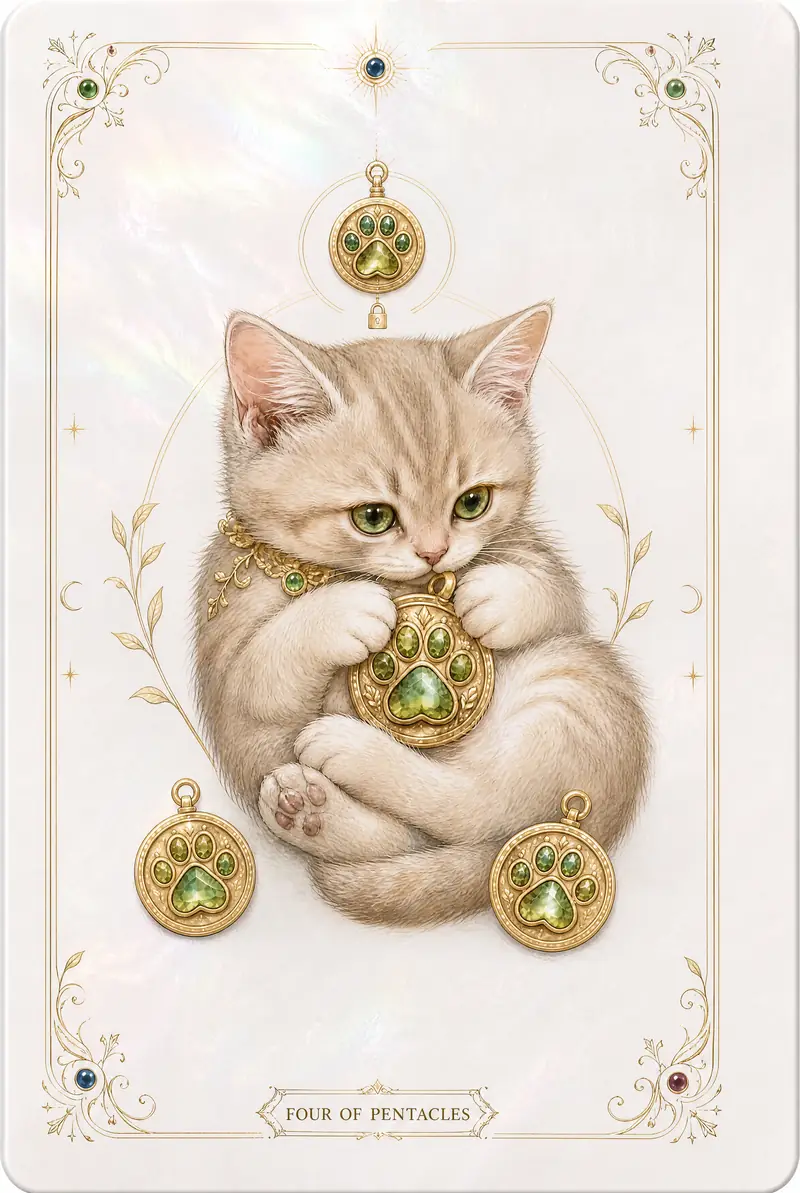
One pentacle balanced on the head, two under the feet, one clutched tight to the chest: every side is guarded.
The image
A man sits alone at the edge of a town, stiff in posture, hugging one pentacle tightly to his chest. Another sits firmly on top of his head, and each foot pins one down, so that he has almost turned into a container for pentacles. The city behind him looks busy, but he sits a little apart, keeping his distance from the crowd.
Core meaning
- Four is the stage of stability (see Numbers in Tarot). In Pentacles, a suit that already leans toward stillness, the pull toward stability is magnified further. This is the number card that holds on the tightest.
- Rachel Pollack reads the man as using the four pentacles to seal off the most important points of his body: the crown of the head (where he also wears a crown), the heart and throat, and the soles of the feet. This stands for closing off his connection to spirit, to other people and to the world around him. Still, he cannot seal his back. However much he wants to make himself a self-sufficient island, life always has a weak spot that cannot be avoided.
- Set against the two people traveling together in the Five of Pentacles, the Four has only one person left. To satisfy a personal need for security, others are shut out too, so this kind of guarding naturally comes with the cost of isolation.
- Pollack points out that the Four of Pentacles, often treated as a "problem card," actually fits some situations quite well. When life has fallen apart into chaos, setting up some kind of structure first, even one that looks selfish and closed, may be exactly what is needed. Some meditation traditions deliberately "seal" the energy field at the end of a practice, both to keep one's own energy from leaking out and to keep outside influences from intruding.
- It often corresponds to saving without spending, resisting any kind of financial change, and being overly defensive about existing resources (which can also be a relationship or a position).
- Compared with the outward cooperation of the Three of Pentacles, the Four is a clear contraction, moving from building a reputation with others to guarding results inward.
- On a deeper level, Pollack notes that the Four of Pentacles also stands for the human mind's ability to give structure and meaning to the chaos of the material universe. People exist in the universe as active creators and not passive onlookers, which is one of the rare points where occult thought and modern physics meet.
- In career readings, the Four of Pentacles can also be positive. It stands for a stable role that holds its place, neither seeking promotion nor at risk of layoff. Organizations need people who are content to do their own job well without strong ambition to climb. Drawing this card does not necessarily mean the querent lacks ability. It may simply mean a good opportunity has not come their way yet, and it does not point to a decline.
- The four pentacles correspond to the four letters of the divine name YHVH (the one on the head is Yod, the one at the chest is Vav, and the two under the feet are the two Hes). This hints that the seemingly stingy, conservative figure is still connected to the divine source. His tight-fistedness can also be read as the prudence of a wise ruler: avoiding waste and keeping a close watch on money so that the storehouses can be opened when there is real need. Plain selfish hoarding is the narrower reading.
- In questions like "Will we get back together?", the Four of Pentacles often gives two opposite readings that both make sense. In one, it resists change and tends to keep the breakup as it is. In the other, it stands for security: a former partner feels safer than getting to know someone new, which actually favors reconciliation. With cards like this, where both sides hold up, it is a good idea in practice to draw another card to help decide, or simply to use the shortcut "upright means yes, reversed means no" to give a clear answer.
- On money, this is one of the more positive financial cards. It stands for income large enough to bring a sense of security, or for holding funds that can be used while still leaving a margin for retirement. On health, it corresponds to the body parts ruled by Taurus, often pointing specifically to problems with the neck, throat and shoulders. In some cases it simply reflects work or the pursuit of wealth affecting the body.
Reversed
- The buildings in the background now rise higher than the figure. Reversed, this suggests the situation has gone beyond what one person can control, and hard outside obstacles have appeared. All that can be done is one's best. This is the blocked type.
- The man clutching the coin now guards against what is above. Reversed, this wariness more easily hardens into stubbornness, pushing relationships that could have been talked through into open conflict. This is the overdone type.
- The coin on top of the head comes loose and falls. This can be read as finally no longer treating money as the only consideration, or it may simply be a real financial loss. The other cards in the spread are needed to tell which disputed.
- From the angle of the negative-meaning method: when growth hits a bottleneck, forcing the way through only makes things more stuck. Patience matters more than effort here. It is also a warning not to sour relationships by fixating on money, inheritance or other concrete interests.
- From the angle of the opposite-meaning method: there is no need to grip everything in your fist. Learning to let go of some things and hold on to what really matters has more strength than never letting go of anything. This leans toward the turned-inward type, another possibility once the tight grip starts to loosen.
- From a money and health angle: the reversal often warns that money is going out faster than wealth is building up and debt is about to appear. This is common when someone props up a life they cannot afford with credit cards or mortgage loans, and it is a reminder not to let spending more than one earns go on too long. On the health side, it sometimes suggests leaving no room to breathe, so that emotional or physical energy is used up. It may also be that health anxiety is really a fear of losing money underneath, such as worry about not being able to pay for health insurance or to keep investing in staying healthy.
- Extreme security is itself a kind of risk. Always playing it safe means life stalls and stops growing. The reversal is sometimes exactly what pushes a person out of an overly safe comfort zone. It brings upheaval and uncertainty, but it may also open new opportunities they would never have gone after on their own.
Correspondences
The number is four (stability; see Numbers in Tarot). The element is Earth. The astrological correspondence is the third decan of Capricorn, with the Sun as the traditional ruler uncertain; see Astrological Correspondences. In the Golden Dawn system this card's esoteric title is "Lord of Earthly Power"; see Esoteric Titles.
Views from different traditions
The Waite system emphasizes the closed posture in the card's image and reads it as stinginess, hoarding and resistance to change. Aleister Crowley's Thoth system names the corresponding card "Power" and puts more weight on control over material resources as a display of strength in its own right, rather than as simple, negative stinginess disputed. The two readings can coexist: whether the same tight grip means security or limitation depends on whether what is being held is really worth guarding.