Five of Wands
Number V · Element Fire · Correspondence First decan of Leo
Upright: competition, disagreement, chaotic contest, wanting to be seen
Reversed: hidden power struggles, avoiding conflict, escalating tension
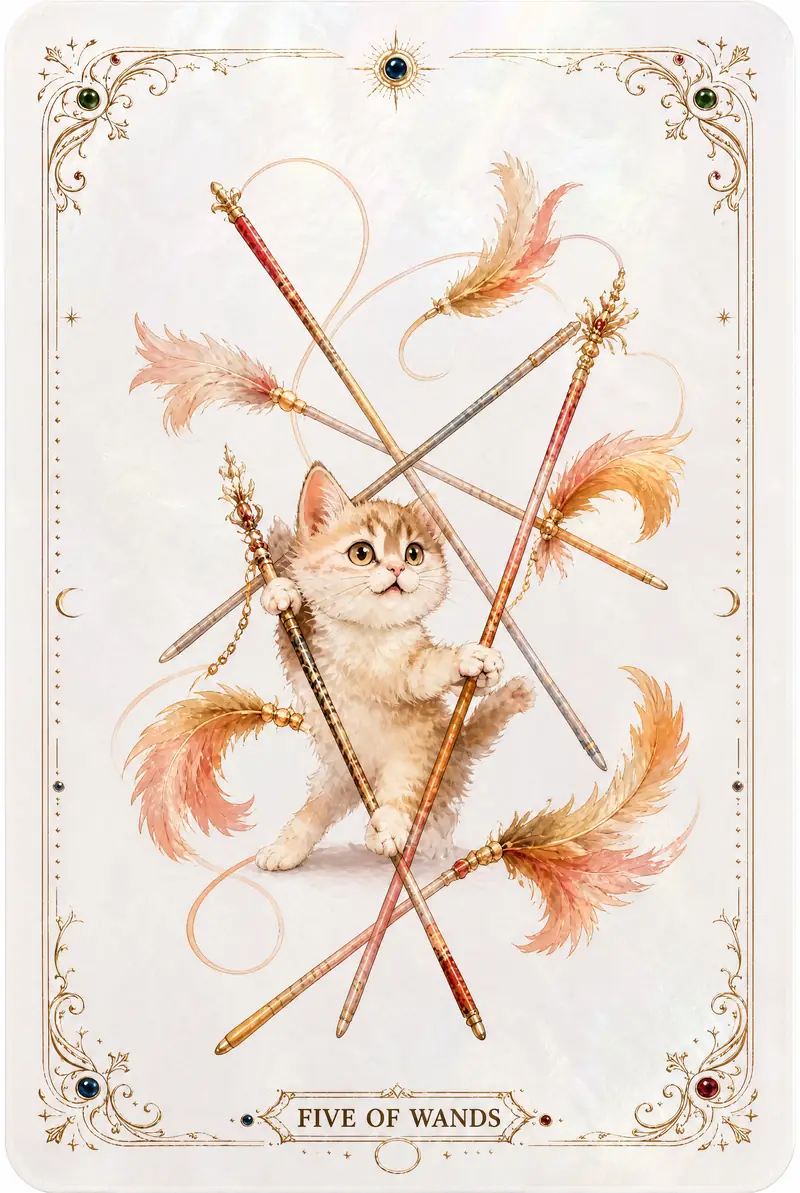
Five people each swing a wand, and nobody is willing to give way first.
The image
Five young men each hold a wand, their movements tangled and crossing. They could be fighting or they could be drilling. Nobody in the picture has actually fallen or been hurt, and the chaos has a touch of play about it (Rider-Waite-Smith).
Core meaning
- The harmony of the Four of Wands is broken. Several voices rise at once, each insisting on its own way. The scene looks noisy, but there is no real malice yet.
- The number five usually means some kind of hardship or loss, but Fire translates it into competition. Competition is one of the ways this person deals with society and with others, a way of communicating, and more than a simple setback.
- The way the figures scuffle looks a lot like children playing at knights: swinging sticks at each other without a single blow really landing. What they are after is the excitement of the action itself. Nobody is trying to destroy anyone.
- What keeps this lively contest within the bounds of a game is a set of rules that everyone tacitly accepts. Once that shared understanding is thrown away, the contest can slide from healthy competition into actually wanting to hurt someone.
- Everyone wants to be seen and wants to prove that their way is right. This is the outgoing, competitive side of Fire, magnified. Especially when reason has not had time to settle things, it is easy to care only about winning and ignore how the other person feels.
- If everyone is left talking past each other for too long, the momentum built up over the first four cards will be wasted. Someone needs to step in and coordinate before things can move toward the Six of Wands.
- The colors of the five figures' clothes can be broken down further into five energies playing different roles in a conflict: one who argues loudly but never actually lifts a hand, one who is really straining and pushing, one who always gets dragged in and takes the impact, one who watches mildly from the side, and one who tries to mediate and make peace. In any dispute, different people naturally fall into different positions.
- This kind of conflict is not necessarily harmful. It can be healthy competition between peers, or simply a mismatch in how people get along. What matters is how the people involved face it: as a chance to understand each other better and adjust how they work together, or by letting it quietly wear away the goodwill built up before.
- Money: often corresponds to resources spread too thin. There are too many goals on your mind and too many different needs at once, so none of them really moves forward. This is especially common in small businesses run single-handed, where one person wears every hat and is too busy and scattered to make a real plan for success.
- Health: Wands energy prefers to earn achievement by competing and scrambling for it rather than waiting for chances to arrive. Keeping that tension up for a long time and burning energy without a break can show up in this card as exhaustion, or as minor illnesses like colds and chills after resistance drops.
- Comparing it with the Five of Swords shows best what is distinctive about this card. The Five of Swords produces a clear winner and loser, and its esoteric title is "Defeat." The Five of Wands produces no winner, and its esoteric title is "Strife." It describes the friction that comes when different energies and different ways of getting along do not fit together, and it does not necessarily have to end with someone winning.
Reversed
- The figures now stand taller than the wands. The focus of the dispute shifts from whose method is right to a contest aimed at people, which easily turns into a clash of egos instead of a straightforward exchange of views (reading from the image).
- All five wands point downward in a jumble. The problem comes more from internal conflict and friction. Rather than competing with outsiders, the first need now is to sort out the disagreements within (reading from the image).
- The demands of the different sides contradict each other, so it is easy to land in a bind where nothing you do pleases anyone. This kind of draining tug-of-war is hard to solve by trying harder (negative meaning).
- Unfair tactics have crept into the competition. Even if you are stronger, you may not win. Rather than keep fighting, look for a neutral third party to mediate (negative meaning).
- It can also go the other way: a conflict that was about to break out suddenly fades, or a planned contest or evaluation is postponed or even cancelled (opposite meaning).
- Turned inward: the reversal also often appears when someone does not dare face a necessary conflict. To please the other person or keep up a surface peace, they keep pushing down their real thoughts and needs. In the short term all looks calm, but the sense of grievance keeps building until one day it bursts out, and only then does the other person discover they have been unhappy all along. A confession that comes this late often hurts the relationship more than speaking up early would have.
- From the angle of money and health, the reversal can sometimes read more positively. As the focus narrows from everyone fighting their own battle to a shared goal, people who were competing start to cooperate and share the gains, and the chances of success rise sharply. Applied to lifestyle, it can mean moving from long-term strain and overextension toward a more balanced state, or it can be a reminder to finally face a health problem that has been ignored.
Correspondences
The number five: the "conflict" stage in Numbers in Tarot. Astrologically, the first decan of Leo; see Astrological Correspondences. In the Golden Dawn system, the card's esoteric title is "Lord of Strife"; see Esoteric Titles.
Views from different traditions
Early traditional readings also often linked the Five of Wands reversed with lawsuits and legal proceedings, possibly pointing to situations involving judges, lawyers or trials. This extended meaning is less often used in modern readings.