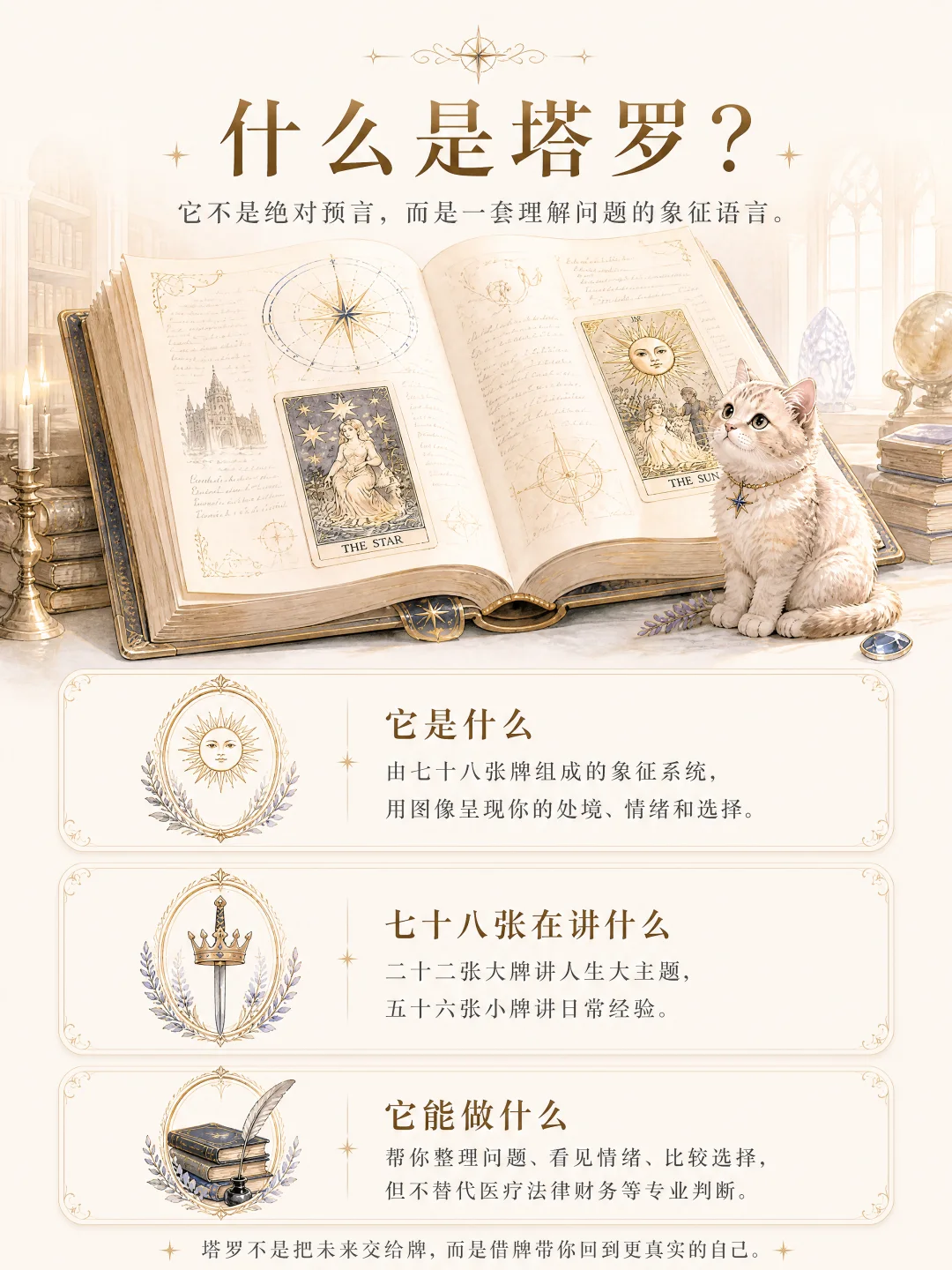
People often reduce tarot to fortune-telling. It can be used for divination, but if you treat it only as a way to predict the future, you miss the part that matters most. What tarot does best is take your situation, emotions, choices and blind spots and show them back to you as images.
It works like a language. You ask a question, the cards offer a picture, and in that picture you see yourself.
Where tarot comes from
The modern tarot most people use grows out of European card traditions, allegorical imagery, esoteric symbolism, and later psychological reading. The Rider–Waite system many readers start with paints each card as a concrete scene — figures, gestures, colours and backgrounds all become clues. That's why beginners don't have to memorise every meaning first. You can see first, and understand slowly.
What the 78 cards talk about
The 22 Major Arcana speak to the larger themes of a life: beginnings, growth, choice, order, change, collapse, healing, completion. The 56 Minor Arcana speak to everyday experience — action, relationships, thinking, money, the body, work — sorted across four suits.
What tarot is good for
Tarot can help you sort out a question, notice an emotion, weigh options, or review a relationship. It shouldn't replace medical, legal or financial judgement, and it should never be treated as an absolute command. A good reading doesn't take away your agency — it returns you, more clearly, to your own life.
How to begin
Start with a concrete question. Instead of "how will my life turn out," ask "why do I feel stuck in this job right now." Instead of "does he love me," ask "what do I most need to see clearly in this relationship." Tarot isn't about handing your future to the cards. It's about using the cards to bring you back to a truer version of yourself.