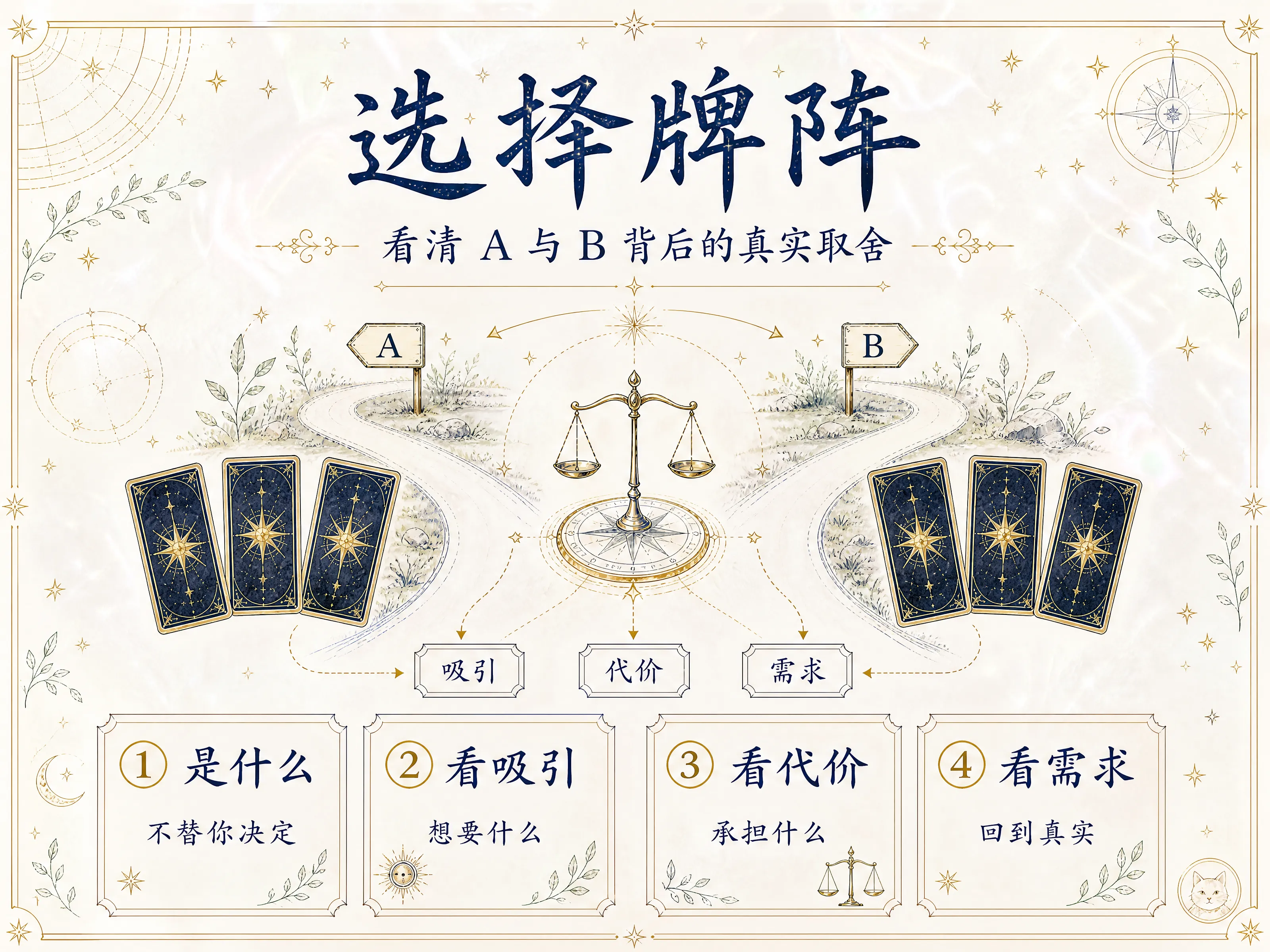
If you only ask "should I choose A or B," tarot easily becomes a tool for making the decision for you. What the choice spread is actually good for is showing you why you're stuck.
What the choice spread compares
It doesn't compare which option is absolutely better. It looks at the opportunity, cost, risk and real pull of each option — and at what's influencing you as you choose: fear, expectation, practical pressure, or a longing for a certain kind of life. Often people don't actually not-know how to choose; they're unwilling to admit that every choice has a price.
When it fits
Changing jobs, moving cities, whether to continue a relationship, choosing between two opportunities — all suit the choice spread. It's especially good for the "they all look fine, but something feels off" kind of question. If you just want a simple answer, it may feel roundabout. If you want to know where your real hesitation lives, it helps a lot.
A case
A client was torn between two jobs. A was stable, decent pay, but limited room to grow. B was more challenging, closer to the direction she loved, but far more uncertain. In the cards, A drew the Four of Pentacles and the Hierophant — safe and structured, but possibly keeping her inside a familiar frame. B drew the Knight of Wands and the Star — passion and vision, but asking her to carry more of the unknown.
The key card was the Two of Swords. The real problem wasn't which job was better — it was that she kept trying to choose a "risk-free" answer. The spread didn't remove the risk for her, but it let her see: choose stability and accept slowness; choose growth and accept uncertainty. Once the cost is clear, choosing turns from anxiety into ownership.