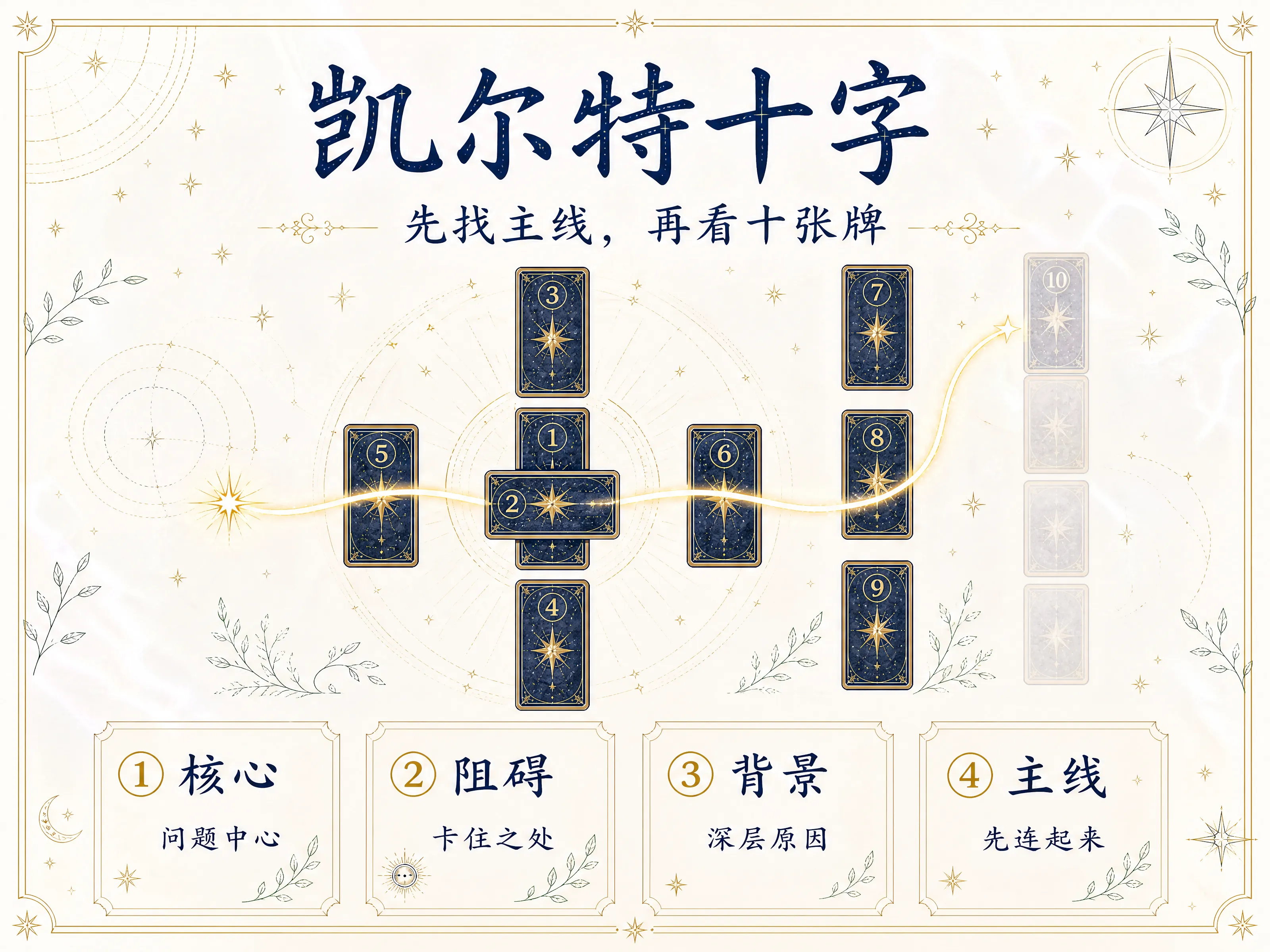
Ten cards laid out at once is a lot of information. If you explain each one in isolation, you'll often reach the end having forgotten the original question. The key to the Celtic Cross isn't memorising all ten positions — it's finding the through-line first.
It suits complex questions
The Celtic Cross fits questions with several layers: why a relationship keeps pulling back and forth, why a career decision won't settle, or a situation that looks practical on the surface but is tangled with emotion, belief and environment underneath. It's not for small questions — the simpler the question, the heavier the spread feels.
Read the core first, then the edges
The first few cards usually show the centre of the question: what's happening now, where the real obstacle is, how the surface differs from the depth. The later cards unfold gradually — past influence, future tendency, the querent's own state, the outside environment, inner expectation, and the possible outcome.
Don't rush to translate card by card. First ask: what repeats across this spread? Lots of Cups, or heavy Swords? Action cards missing, or too many Major Arcana? Those repetitions point to the theme better than any single card's detail.
A case
A client asked about a stalled career. The Hanged Man sat at the core, the Eight of Pentacles at the obstacle. On the surface she was working hard, but she'd stayed too long inside one method. The past was the Hierophant — she'd relied heavily on rules and seniority. The future tendency, the Three of Wands, suggested she needed to open her view and look for new collaboration or outside opportunity. The outcome was Temperance — not an overnight turnaround, but a slow blending of old experience with a new direction.
The Celtic Cross is best at taking a complex question apart. It lets you see that what's really trapping you may not be one event, but a whole pattern that's been running for a long time.