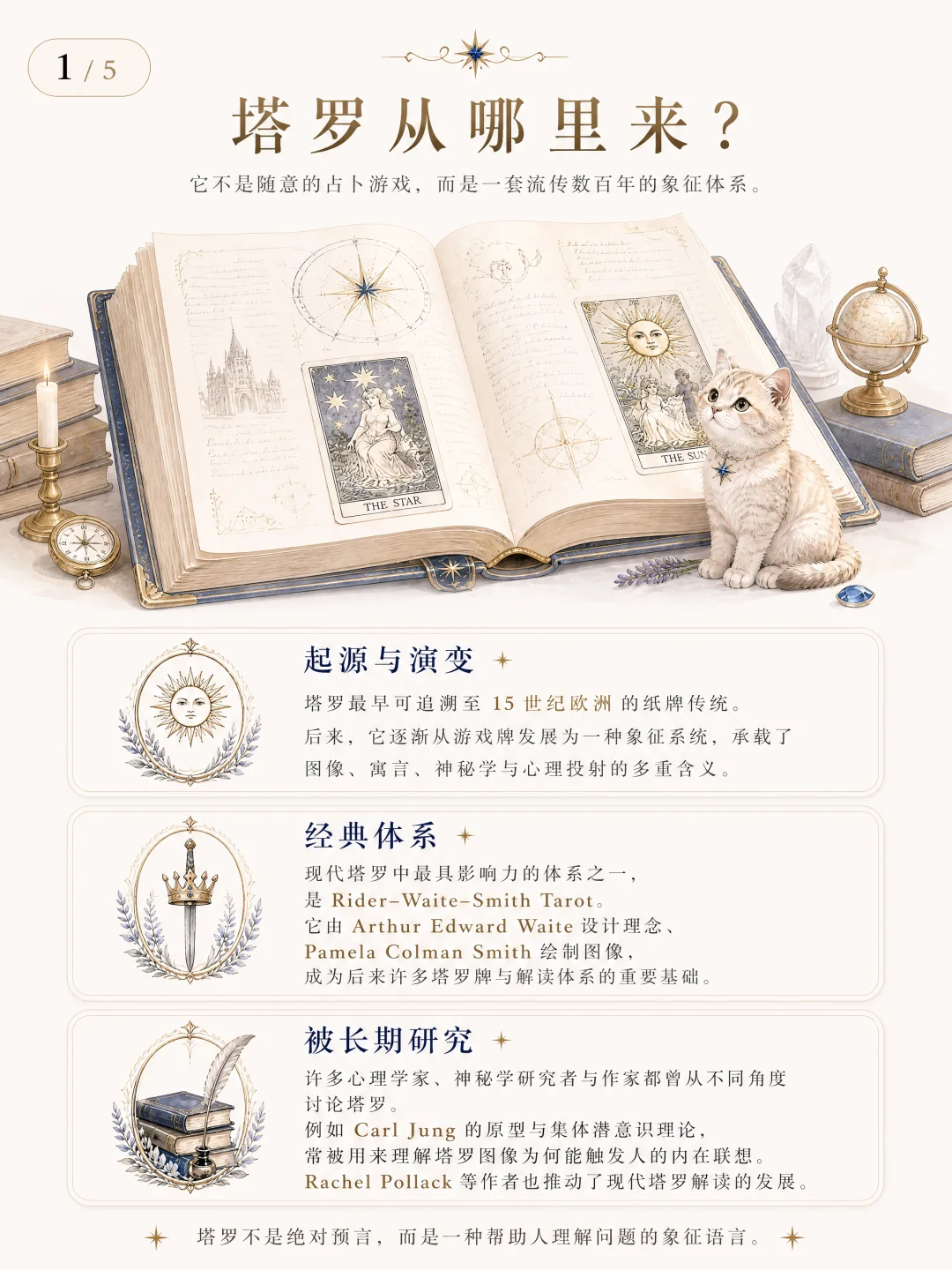
It's natural to want the cards to tell you what will happen. But that isn't tarot's best entry point. What tarot is actually good for is taking something you already feel but haven't put into words, and laying it out as images you can look at slowly.
Before your first reading, these five things matter more than rushing to draw.
1. Tarot is not a verdict
A card won't announce your ending. It's more like a mirror — it shows where you're standing, what emotion is pulling at you, and which options you've quietly overlooked. Treat it as a language for understanding a question, and the reading opens up instead of narrowing to one conclusion.
2. A clearer question gives a more useful answer
"Will I be happy someday" is too large. "Why do I never dare to voice my needs in this relationship" is much clearer. Tarot can answer big questions, but big questions mix many layers together. A good question pulls the focus back so the cards have something to respond to.
3. Don't hand the whole decision to the cards
Tarot can show you the trade-offs, the habits, the blind spots — but you're still the one who chooses. For anything involving money, health, law or real safety, it should never replace professional judgement.
4. When emotions run high, don't keep re-drawing
The more anxious you are, the more you'll want to draw again. But re-drawing rarely brings clarity; it just turns every card into a new alarm. Draw once, read it fully, then stop.
5. Recording beats memorising
You don't need to memorise the whole book of meanings. Instead, write down what you asked, what you drew, and how it felt — then revisit it days later. Learning tarot isn't memorising answers; it's slowly training your own way of seeing a question.